

Explore the region
Tap any red Chinese text to hear it in Mandarin.
Two sides of Dingshu’s pottery culture
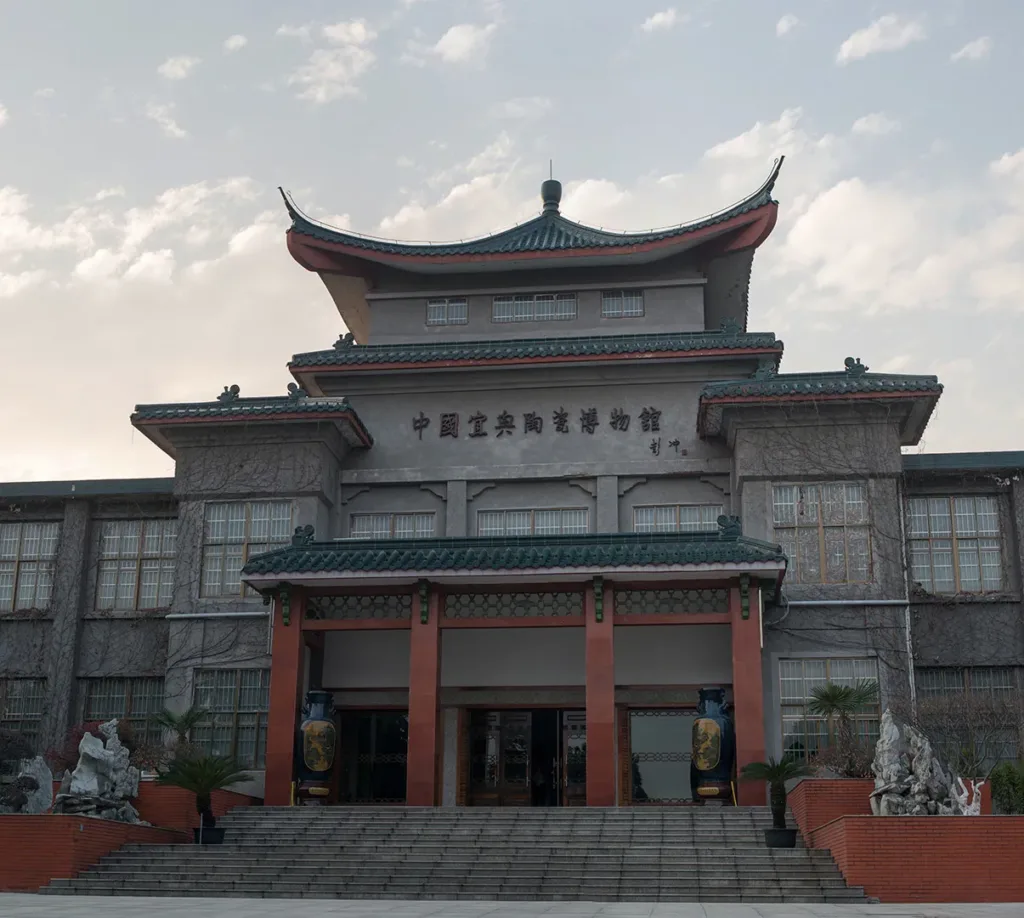
Use the museum for the long, material timeline. The official museum describes holdings from Neolithic sand-tempered pottery and Han glazed pottery through Jin celadon, Song–Yuan jun ware, Ming–Qing zisha and contemporary coloured-glaze, art and fine ceramics. Its expanded post-renovation galleries include a ceramics history gallery and dedicated displays for ancient ceramics, jun ware and zisha; the new building also added a non-heritage experience area and resident-artist studios.
Shushan Gunan Street (蜀山古南街) is the contrasting outdoor stop. It lies in Dingshu Town, backed by Shushan and facing the Li River. The surviving old street is about 400 metres of a former kilometre-long route, only around 2.4–3.4 metres wide in places, with one- and two-storey brick-and-timber shop-and-home buildings. Its value is not a single monument: the street preserves the setting in which purple-clay pottery was made, fired, traded and lived with.
Look along the flagstones and river edge rather than expecting a single grand entrance. Narrow lanes, shop fronts, residences and the mountain-and-water setting explain why Dingshu’s pottery culture grew as a working town. Recent conservation has kept residents and craft-related uses in the area while adding small-scale cultural and visitor functions; cafés, reading spaces and independent design studios may be present, but individual premises are not the same thing as the historic street itself.
A useful way to understand the pair is as two points in the municipal “Past and Present of Zisha” heritage route. The route links the museum with a clay-mine site, Tao’erchang cultural area, Shushan Gunan Street and Qianshu Dragon Kiln to trace raw material, making, firing and sale. The city also describes hands-on zisha-making and kiln activities along the wider route, but those are scheduled experiences rather than something to assume on every visit.
Planning the visit
The museum’s official visitor page currently lists opening at 08:30, last ticket inspection at 16:00, site clearing at 16:30 and closing at 17:00. It provides individual and group reservation buttons and gives 0510-87180688 for enquiries; groups are asked to contact the museum three days in advance. The readable page does not state a current admission fee or explain whether a foreign passport can be used for an individual reservation, so do not treat a domestic real-name booking assumption as confirmation for an international visitor.
The street is a separate historic quarter rather than an extension of the museum. The sources checked here do not provide one consolidated ticket, central gate or street-wide timetable. Treat the street as an open neighbourhood walk, and check any workshop, café, exhibition room or scheduled craft activity separately. The museum ticket, if one is issued, should not be assumed to cover the street.
Getting there and back
For the museum, use the Chinese destination 宜兴陶瓷博物馆 Yíxīng Táocí Bówùguǎn, 宜兴市丁蜀镇丁山北路150号. The museum’s own transport guide lists buses 245, 249, 152/K152, 154/K154 and 201旅游一线 to 陶瓷博物馆站 Táocí Bówùguǎn Zhàn, followed by a walk to the museum. By car, its guide points from the Yixing toll exit along National Highway 104 and Dingshan North Road.
For the street, give the driver 蜀山古南街历史文化街区 Shǔshān Gǔnán Jiē Lìshǐ Wénhuà Jiēqū in 宜兴市丁蜀镇 Yíxīng Shì Dīngshǔ Zhèn rather than the paired English listing title. The sources establish the street’s town, mountain and river setting but do not establish one reliable current bus stop or a single visitor entrance. A taxi transfer between the museum and the street is therefore the clearest practical link; keep the Chinese name ready and ask for the pedestrian access to the historic street, not the museum address. Return by taxi to 宜兴站 Yíxīng Zhàn if continuing by train, or confirm the live direction of one of the museum buses before using the opposite-direction stop. The museum page publishes no return timetable.
Intercity rail travellers can use Yixing Railway Station (宜兴站), an intermediate stop on the Nanjing–Hangzhou high-speed railway, then make a separate road transfer to Dingshu. The station is not the attraction entrance and no direct museum-or-street shuttle is confirmed in the sources used here. Plan the return road leg to 宜兴站 before your train rather than relying on an unverified seasonal or event shuttle.
The simplest sequence is museum first, when its fixed admission hours matter, followed by the street as a slower outdoor walk. Keep the two names and addresses separate in a map or ride-hailing app: 中国宜兴陶瓷博物馆 / 宜兴市丁蜀镇丁山北路150号 for the indoor collections, and 蜀山古南街历史文化街区 / 宜兴市丁蜀镇 for the historic quarter.
Find Yixing Ceramics Museum and Dingshu Gunan Street
陶瓷博物馆与丁蜀古南街 · 宜兴市
The pin marks the area, not the entrance.
Sources & visit information
Sources checked on 24 October 2026. Hours, tickets, reservations and transport can change; confirm with the operator before you go.
Image credits & notes (1)
- The entrance façade of China Yixing Ceramics Museum in Dingshu, Yixing, photographed in January 2014. Photo: DvYangPhoto: CC BY-SA 2.0