

Explore the region
Tap any red Chinese text to hear it in Mandarin.
Why visit
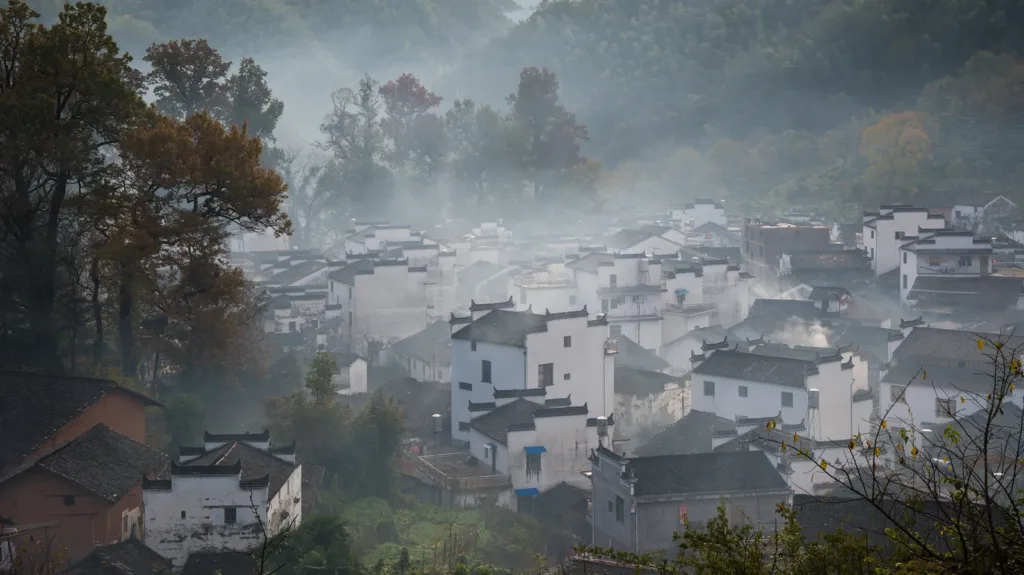
Shicheng is a good detour for a rural landscape that has to be watched rather than ticked off. The scene is built from several ordinary elements: maple trees on the edge of two hillside villages, white walls and dark tiled roofs, a valley that can hold morning mist, and smoke from household cooking. The Jiangxi route published by China’s Ministry of Culture and Tourism describes Shicheng Village as a late-autumn stop where red maples meet Huizhou-style houses; it gives mid-to-late November as the best period for the leaves.
The attraction is not a single monument. It is the changing view across the valley, followed by a walk through the settlements themselves. Come for the first light if the weather is favourable, then slow down after the photographers have left the lookout. A 2026 local tourism notice announced the maple-viewing season from 24 October, but an announced season does not guarantee peak colour, mist or sunrise on a particular morning.
What to look for
Shicheng Scenic Area contains two villages. Daicun is closer to the viewing platform, while Chengcun is closer to the main maple grove; the two are separated by a small rise. From the lookout side, look for the relationship between the red crowns, the low white walls, the dark roofs and the wooded ridge rather than treating the village as a backdrop for one photograph. In the lanes, notice the surviving Huizhou details and the old trees at the settlement edge. The maple stand includes more than one tree species, but the red maples are the seasonal focus.
Mist and smoke are conditions, not a performance scheduled for visitors. Do not ask residents to recreate smoke, enter a private courtyard, or photograph people at close range without permission. The village remains a lived-in place; keep voices low at dawn and leave the narrow lanes clear for residents and service vehicles.
Season, time and scope
The most dependable planning window described by the sources is roughly mid-November to early December, with the exact colour depending on frost and weather. The best light is early morning, so an overnight stay in Chengcun or Daicun is more practical than trying to arrive from the county seat after sunrise. No particular combination of red leaves, mist and smoke can be promised.
Shicheng is a village-and-viewpoint area, not the same visitor entrance as Lingyan Cave. Lingyan Cave is a separate scenic-area stop at Tongyuan Village with its own visitor-centre, opening-time and ticket information. Do not assume that a ticket, parking arrangement or cave access for Lingyan Cave automatically describes the village visit.
The operator page accessed for this guide lists a standalone Shicheng ticket of RMB 60 or a Wuyuan combo ticket. It has no displayed publication date, so treat that figure as a reference rather than a guaranteed current price. Current opening arrangements, passport eligibility, reservation steps and the boundary between the village lanes, lookout and any managed ticket area should be confirmed at the entrance before paying.
Getting there
There is no railway station in Shicheng. The practical public-transport chain is to arrive at Wuyuan Railway Station (婺源站), take local route 1 toward the county bus station, then transfer at Wuyuan Old North Bus Station (婺源老北站) for a county service toward Shicheng. The operator’s Shicheng page currently lists departures from the Old North Bus Station at 08:50, 11:00, 14:00 and 15:20, with a fare of RMB 20, but another page on the same site gives a different set of times for the service passing Lingyan Cave on the way to Shicheng. Ask at the station on the day of travel, ask the driver where the return pickup is, and do not rely on a web timetable for the last ride back. The Shicheng page says there is a parking area rather than a posted village bus stop.
For a taxi or hired car, give the Chinese destination 婺源石城景区(石城村停车场/游客入口), in 江西省上饶市婺源县大鄣山乡石城村 Jiāngxī Shěng Shàngráo Shì Wùyuán Xiàn Dàzhāngshān Xiāng Shíchéng Cūn. The approach road is winding, steep in places and not a good place to improvise a late return; a driver used to the mountain road is a sensible choice if you do not drive in rural hills regularly. Exact entrance and map-pin details were not independently confirmed, so keep the Chinese name and arrange the return before you set out.
The classic walk from Shicheng to Changxi is about 12 km and usually takes 3–4 hours on a mountain path. Parts of the route have no mobile signal and there are forks where walkers can lose the way. Only attempt it in suitable weather with enough daylight, offline mapping and a local guide or reliable route knowledge; it is not a casual extension of the village lanes.
Find Shicheng Village
石城 · 婺源县
No reliable map pin yet: search by the Chinese name.
Sources & visit information
Sources checked on 1 November 2026. Hours, tickets, reservations and transport can change; confirm with the operator before you go.
Image credits & notes (1)
- Morning mist over Shicheng Village's white-walled, dark-roofed houses in Wuyuan, Jiangxi. Photo: liuzr99 (Flickr user 96749690@N04)Photo: CC BY-SA 2.0