

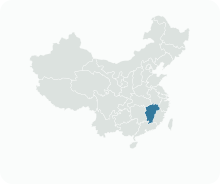
Get to know Wuyuan County
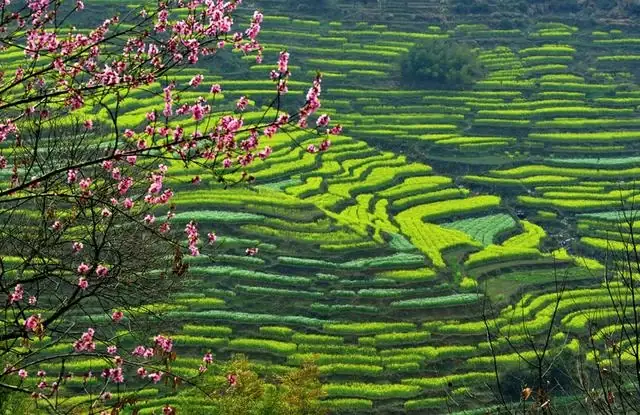
Photo adjustments
Full frame retained; resized proportionally to a maximum dimension of 960 pixels and converted to WebP quality 88. No crop, retouch, generated elements, or subject alteration. Final website rendition: full frame retained, proportionally resized to at most 720 pixels and converted to WebP. No additional retouching or subject alteration. Card displays may crop the view.
- Administrative area
- County · 县
- Part of
- Shangrao
- Chinese name
- 婺源县
- Local areas
- County guide
Area & population
- Area in the source
- 2,967.00 km²
- Population · 2019
- 346,200
Source: cited geographic source, as of the dates shown.
Setting and landscape
A local saying describes Wuyuan as eight and a half parts mountain, one part field and half a part waterways and farmsteads. Mountains fill the east and north and hills and basins the centre and south; overall the land is higher in the north than the south. The highest summit, Leigu Peak (擂鼓峰, 1,629 metres), stands on the northern border with Xiuning (休宁). Most of the county drains to the Le'an River (乐安江). The climate is mid-subtropical and monsoonal: mild and wet, with a short frost season.
History
Wuyuan was created in 740 under the Tang from parts of Xiuning and Leping (乐平), with its seat at Qinghua (清华镇); in 901 the seat moved to Xiangao (弦高), today's Ziyang (紫阳镇). It belonged to Huizhou from the Northern Song onward and to Anhui after the 1911 revolution. Its transfer to Jiangxi in 1934 set off a campaign to return to Anhui, which succeeded in 1947, but from May 1949 the county was placed under Jiangxi again, and it has been part of the Shangrao region since 1952.
What to see
Huangling (篁岭) in Jiangwan town (江湾镇) is a hillside village of more than 500 years, its houses stepped in a fan around the village water entrance. Villagers dry crops on their roofs, and this 'sun-drying autumn' (晒秋) display has become nationally known and Huangling's most distinctive folk symbol. Jiangwan (江湾) is the county's national 5A scenic area. Sixi and Yancun (思溪延村) in Sikou town (思口镇), more than 800 years old, have turned old mansions such as the General's Residence (将军府) into guesthouses. Likeng (李坑) in Qiukou town (秋口镇) is a stream village of bridges and white walls that draws crowds of painters in the summer holidays.
Wuyuan's national key cultural relic sites include the Qinghua Rainbow Bridge (清华彩虹桥), the Yu clan ancestral hall at Wangkou (汪口俞氏宗祠) and the old houses of Likeng village (理坑村), a different village from Likeng in Qiukou. Wangkou (汪口), Yancun, Sixi and Huangling are all listed as Chinese historical and cultural villages. Flowering rapeseed, as at Jiangling (江岭), is another of the county's rural tourism draws.
Food and local products
Wuyuan green tea (婺源绿茶) is a national geographical-indication product. Other local products are the Hebao red carp (荷包红鲤鱼), She inkstones (歙砚), Jiangwan snow pears (江湾雪梨) and Xiaoqi imperial chrysanthemums (晓起皇菊). Study tours in the county offer inkstone making, tea making and inkmaking.
Highlights
- Huangling 篁岭: Hillside village of more than 500 years whose rooftop crop drying became a well-known display.
- Jiangwan 江湾: The county's national 5A scenic area.
- Sixi and Yancun 思溪延村: Villages of more than 800 years in Sikou town, with old mansions turned into guesthouses.
- Likeng 李坑: Stream village in Qiukou town, a popular summer sketching spot.
- Qinghua Rainbow Bridge 清华彩虹桥: National key cultural relic protection site.
- Wuyuan green tea 婺源绿茶: National geographical-indication product.
Sources for this guide
婺源县 - 维基百科,自由的百科全书 · Wikipedia (Chinese) · CC BY-SA 4.0
江西婺源:增强传统村落内生发展动力 · Ministry of Culture and Tourism (from China Culture Daily)
Original English written from the listed sources and checked sentence by sentence against quoted extracts by a separate reviewer. Updated 2026-09-25.
Explore Wuyuan County
Core places to explore, with English and Chinese names.
Places to explore around Wuyuan County
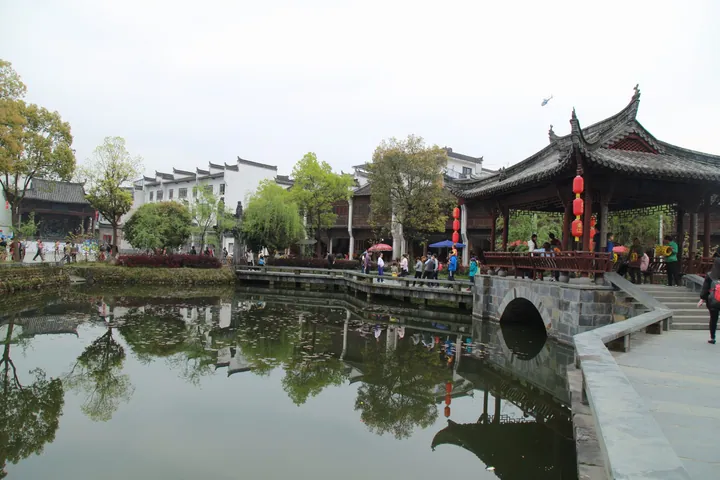 A stone arch bridge and lakeside pavilion at Jiangwan Scenic Area, Wuyuan County · 婺源江湾景区石拱桥与临水亭台 Source-recorded photograph date: Taken on 2 April 2016.
Wuyuan Jiangwan Scenic Area婺源江湾景区
Jiangwan is a historic village destination in northeastern Wuyuan, with a distinctive network of streets and lanes.
Read the place guide →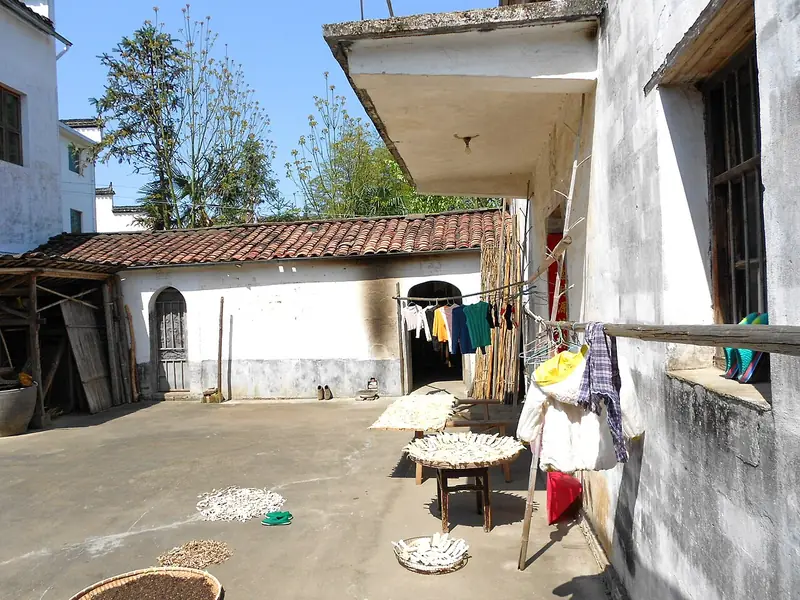 Sixi and Yancun Villages (思溪延村), Wuyuan County. Photograph: "Backyard in Yancun Village - panoramio".
Sixi and Yancun Villages思溪延村
Sixi Yancun (思溪延村) is a pair of neighbouring old villages in Sikou Town, Wuyuan County, Shangrao, Jiangxi, built on the profits of merchants who traded timber, tea and salt far beyond the county.
Read the place guide →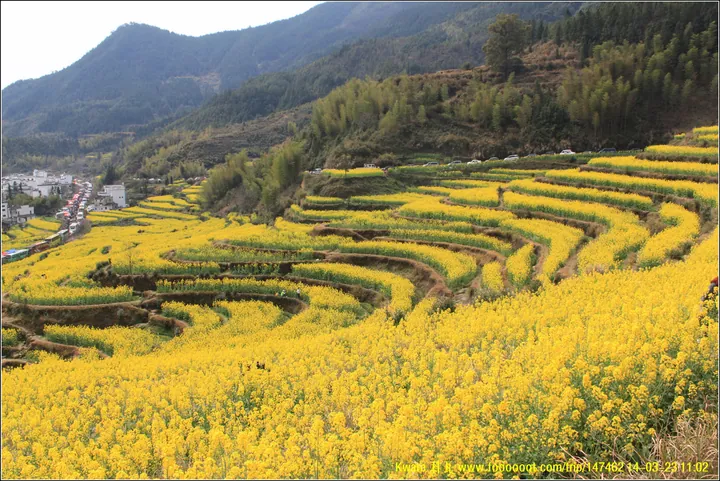 Terraced rapeseed-flower fields on a hillside above a village at Jiangling Scenic Area, Wuyuan County · 婺源江岭梯田油菜花景观,婺源县 Source-recorded photograph date: 2014-03-23 11:02.
Jiangling Scenic Area江岭
Jiangling (江岭) is a terraced upland in Wuyuan County, Shangrao, Jiangxi, where hillside rice terraces are sown with rapeseed and flower in spring above scattered whitewashed villages.
Read the place guide →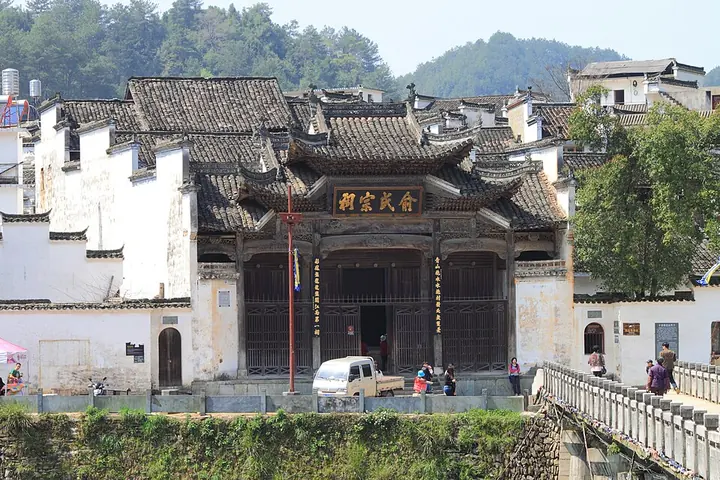 The Yu Family Ancestral Hall in Wangkou village · 汪口俞氏宗祠 Photograph date recorded by the source: 31 March 2012, 13:29:54.
Wangkou汪口
Wangkou is a Huizhou village in Jiangwan, Wuyuan, surrounded by water on three sides. Founded in the Song period, it developed as a settlement of the Yu lineage.
Read the place guide → Huangling Tourism Resort · 篁岭
Huangling, Wuyuan篁岭
Huangling climbs a hillside above Wuyuan’s fields, its white walls and dark tiles arranged around the reconstructed Tianjie street. Wooden racks and round drying trays create the village’s celebrated shaiqiu imagery. The…
Read the place guide →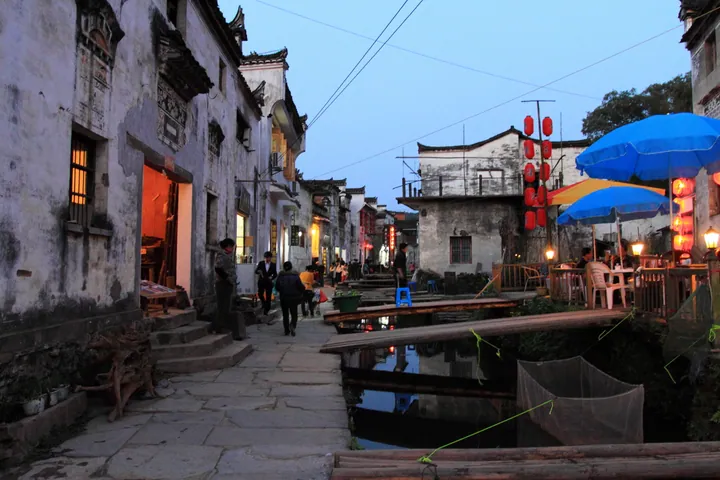 An evening view of Likeng Village village's canal-side street, Wuyuan County · 婺源李坑村水圳沿岸街景,黄昏 Source-recorded photograph date: 2012-03-31 18:42:01.
Likeng Village李坑
Likeng (李坑) is an old village in Qiukou Town, Wuyuan County, Shangrao, Jiangxi, built along a stream that runs through the middle of the settlement and crossed by stone-slab bridges.
Read the place guide →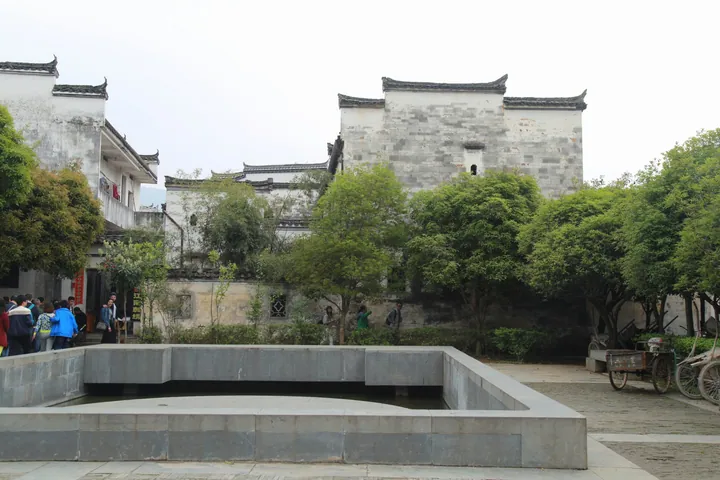 A paved village square in Wuyuan: white-walled Hui-style houses with grey tiled roofs and stepped horse-head gables behind a sunken rectangular stone-walled pool, a large tree in front, a group of visitors at the left, a tricycle and parked bicycles at the right, under a blank pale sky.
Jiangwan Village江湾
Jiangwan (江湾) is an old village and township centre in the north-east of Wuyuan County, Shangrao, Jiangxi, laid out as a single street with six lanes running off it.
Read the place guide →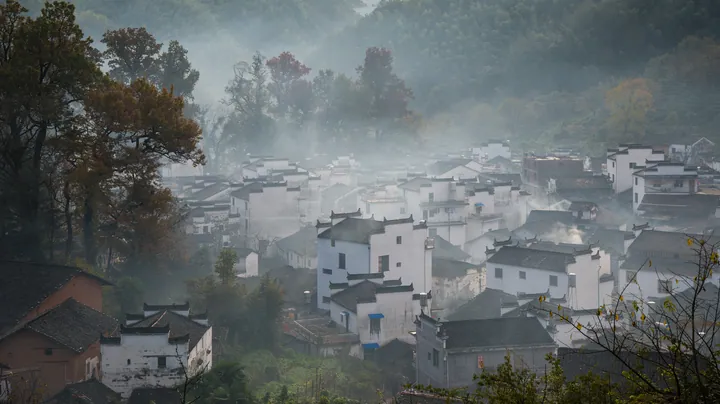 A hillside village of white-walled, grey-roofed houses packed into a wooded valley, autumn foliage in red and orange among the trees, mist or wood smoke drifting between the roofs, a few small modern buildings at the left and a wooded ridge behind.
Shicheng Village石城
Shicheng (石城) is a small village in Dazhangshan Township, Wuyuan County, Shangrao, Jiangxi, set in a valley among tall old maples and known for the autumn colour recorded by the county as one of the features of the Lingyandong scenic area.
Read the place guide →Plan your visit
Getting there
Wuyuan County is about 90 km in a straight line from central Shangrao. Search for 婺源县 in a map app to find stations and your accommodation.
Where to stay →Build your route
Wuyuan Jiangwan Scenic Area and Sixi and Yancun Villages are both listed here. The linked place guides have entrance and visit details.
Continue with Shangrao →More in Shangrao
Sources & geographic information
Administrative names and parent areas: Official geographic directory · Reference date 2026-09-06.
Some facts checked against 婺源县 — Wikipedia contributors, CC BY-SA 4.0.
Photo: Wuyuan Jiangwan Scenic Area · 江上清风1961 · CC BY 3.0. Full frame retained; proportionally resized and converted to WebP. No retouching or changes to the photographed subject. Card displays may crop the view.
.jpg)
Photo: Sixi and Yancun Villages · Raki_Man · CC BY 3.0. Full frame retained; EXIF orientation normalized, proportionally resized to at most 800 pixels and converted to WebP. No generated pixels or subject changes. Cards may crop the display.

Photo: Jiangling Scenic Area · Kware Ji from Shenzhen, China · CC BY 2.0. Full frame retained; proportionally resized and converted to WebP. No retouching or changes to the photographed subject. Card displays may crop the view.
.jpg)
Photo: Wangkou · Zhangzhugang · CC BY-SA 4.0. Full frame retained; proportionally resized and converted to WebP. No retouching or changes to the photographed subject. Card displays may crop the view.

Photo: Huangling, Wuyuan · EditQ · CC BY-SA 4.0. Wikimedia thumbnail; fitted to the ranking-card frame.

Photo: Likeng Village · Zhangzhugang · CC BY-SA 4.0. Full frame retained; proportionally resized and converted to WebP. No retouching or changes to the photographed subject. Card displays may crop the view.

Photo: Jiangwan Village · 江上清风1961 · CC BY 3.0. Full frame retained; proportionally resized and converted to WebP. No retouching or changes to the photographed subject. Card displays may crop the view.

Photo: Shicheng Village · liuzr99 · CC BY-SA 2.0. Full frame retained; proportionally resized and converted to WebP. No retouching or changes to the photographed subject. Card displays may crop the view.
.jpg)
Map data © OpenStreetMap contributors. Pins mark approximate centres, not entrances or boundaries.