

Explore the region
Tap any red Chinese text to hear it in Mandarin.
Why visit Jiangwan
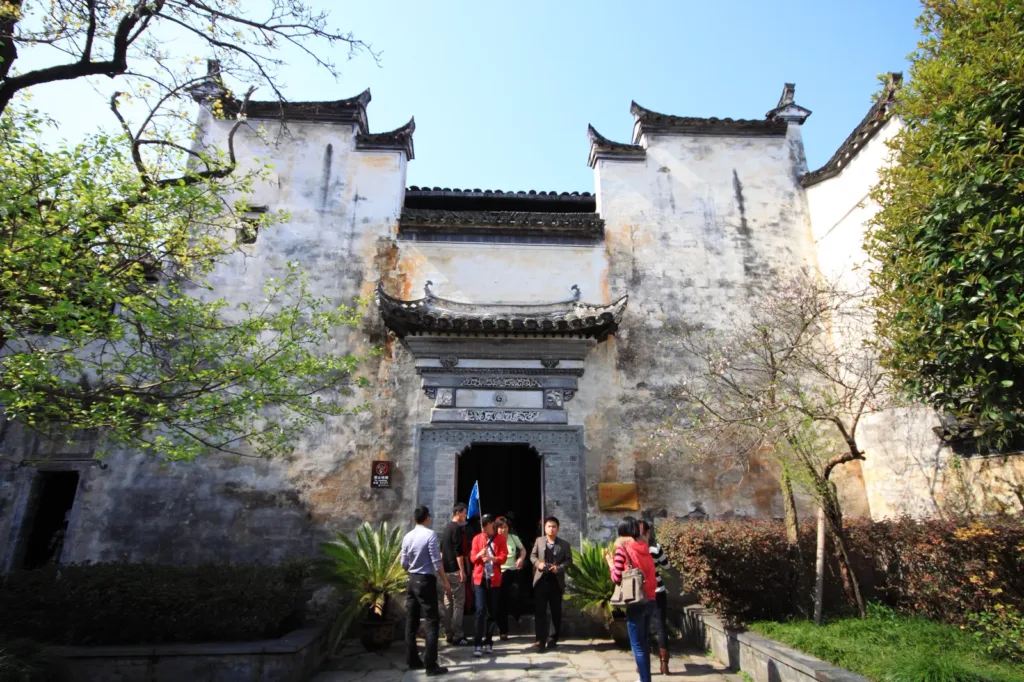
Jiangwan is both a historic village and the centre of Jiangwan Town. The village is described as dating to the late Sui–early Tang period, while the Jiang clan’s move to the settlement is associated with 1079. Its white walls, dark tiled roofs, ancestral halls and former official residences make more sense as a connected settlement than as a row of isolated photo stops. Jiangwan Village is also the subject of the national 5A scenic-area designation, so the ticketed attraction and the living village overlap rather than forming two separate destinations.
Walk slowly through the public lanes and notice how larger clan or official buildings meet ordinary homes. The main architectural stops include Xiaojiang Ancestral Hall, former residences such as Yushi Fu and Zhongxian Di, and named halls including Sansheng Tang. The group of old wells known as the Big Dipper Seven Wells and the S-shaped Liyuan River are useful clues to how water, landscape and settlement planning were understood together.
Jiangwan also has facilities that interpret local life beyond architecture. A 2021 Xinhua profile described the Jiangwan Folk Museum, Guchuitang and other visitor-oriented spaces, with exhibits of local crafts and programmes associated with Hui opera, Nuo dance, wedding customs and tea culture. These facilities and performances may have their own hours or current arrangements, so treat them as things to check on the day rather than guaranteed daily shows.
How to spend the visit
After entering, first get a sense of the village street pattern before choosing individual halls. Compare the formal fronts, carved details and courtyards with the narrower residential passages, then look for the ancestral hall and old wells. A walk along Liangshang Street gives the visit a more everyday scale; the local visitor guide describes it as the village’s historic commercial street. If the path is open and conditions are suitable, the same guide suggests walking towards Houlong Mountain for a broader view over the settlement.
This remains a lived-in village. Keep to visitor areas, ask before entering a home or photographing residents, and do not treat ordinary activity as a performance. The attraction name covers the village core and its visitor facilities; an individual hall, museum or performance should not be assumed to have a separate ticket or to be open simply because it is named in an older guide.
Tickets, hours and seasonal planning
The visitor-information page available at the time of checking lists a 210 RMB five-day pass for 14 Wuyuan attractions and a 120 RMB individual Jiangwan ticket. The same page lists concession categories for some children, older visitors and full-time students, but it does not state whether an overseas passport can be used for any concession. Prices, eligibility and included areas can change, and other ticket pages display different figures, so confirm the current price and document requirements at purchase rather than relying on an old guide.
A Wuyuan visitor guide lists opening hours of 08:00–18:00 and recommends March–May and September–November. Those are planning references, not a promise that every hall, performance or path will operate throughout the day; check the attraction’s notice on the date of travel.
Getting there
There is no useful metro connection for this rural attraction. The practical rail approach is to arrive at Wuyuan Railway Station (婺源站) and use the station’s intercity/scenic-area bus facilities. A route announcement dated 7 March 2026 describes a direct bus from Wuyuan Train Station or Wunvzhou Resort to Huangling Scenic Area, stopping at Civil Affairs Bureau, Old North Station and Jiangwan Scenic Area on the way. The published fare from Wuyuan Train Station or Wunvzhou Resort to Jiangwan is 13 RMB per person.
The same announcement publishes departures from Wuyuan Train Station to Huangling and returns from Huangling to Wuyuan Train Station, but it does not provide a separate Jiangwan return timetable. Confirm that the bus is accepting passengers at Jiangwan for your return direction before leaving the station, and check the current stop and ticket availability in DiDi’s Station Bus function or at the bus station. Do not assume that an outbound intermediate stop guarantees a seat on every return service.
For a taxi or hired car, use the Chinese destination 江湾景区 Jiāngwān Jǐngqū, 上饶市婺源县江湾镇云湾路 Shàngráo Shì Wùyuán Xiàn Jiāngwān Zhèn Yúnwān Lù. Amap lists that destination and address, but the pages checked did not establish a named vehicle drop-off gate, so follow the current on-site signs instead of asking to be left at an unverified entrance.
Find Wuyuan Jiangwan Scenic Area
婺源江湾景区 · 江西 · 婺源县
The pin marks the area, not the entrance.
Sources & visit information
Sources checked on 1 November 2026. Hours, tickets, reservations and transport can change; confirm with the operator before you go.
Image credits & notes (1)
- Entrance facade of Dunlun Tang (Jiang Yilin Memorial Hall) in Jiangwan Village, Wuyuan. Photo: ZhangzhugangPhoto: CC BY-SA 4.0