

Explore the region
Tap any red Chinese text to hear it in Mandarin.
Hekou is best visited as a historic town rather than as a single enclosed attraction. Its main historic core is the Ming–Qing Street (河口明清古街), a riverfront commercial district in Hekou Town, Yanshan County. The town grew through waterborne trade in tea, paper and other goods; a cultural history account describes the street as a typical example of commerce and settlement developing along a river, while a contemporary report presents Yanshan as an important tea-processing and distribution centre on the Ten-Thousand-Mile Tea Road.
The interest is in the relationship between the parts. Shop fronts face the old street, buildings extend deeply behind them, and the river edge explains why this was a place for moving, storing and selling goods rather than simply a row of picturesque façades. The tea route is also a wider historical network, not a claim that the town stood alone: the Ministry of Culture and Tourism reported that the Ten-Thousand-Mile Tea Road entered China’s World Heritage tentative list in 2019.
What to look for
Read the street plan
Follow the long riverfront alignment and compare the named sections recorded in the historic account: Yibao Street, Erbao Street, Qipan Street, Sanbao Street and Banbian Street. That account describes a roughly 2.5-kilometre Linhe Street, with more than 500 surviving shop houses between the Yibao and Sanbao sections. The useful question is not which façade is most photogenic, but how a street-facing shop leads into courtyards, work rooms, storage areas and domestic space.
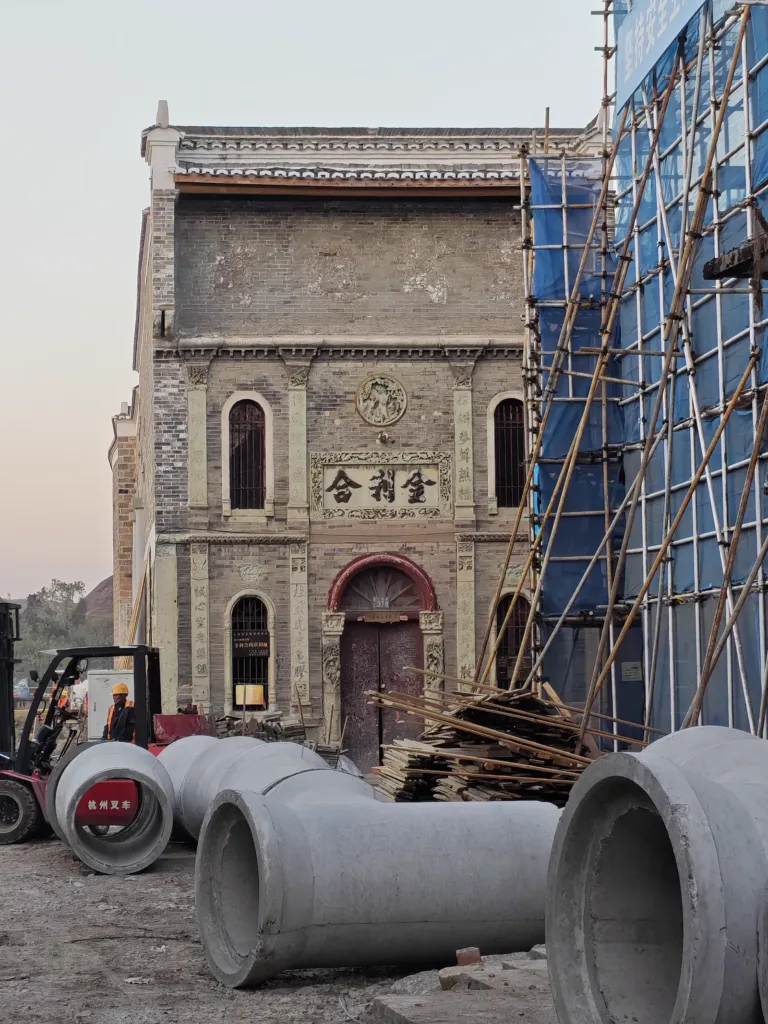
Stone paving, narrow lanes and the depth of the houses help make the old commercial logic visible. Former guild halls and shop buildings associated with tea merchants, pharmacies and other trades are reminders that Hekou served traders from several regions. The historic account specifically discusses the Jinlihe pharmacy (金利合) and the former merchant halls; treat named buildings as things to locate and observe from public space, not as a promise that every interior is open.
Follow the tea-and-paper story
Hekou’s prosperity was tied to both tea and paper. The CNR report describes the town’s role as an early transport choke point and a major collection, processing and transfer centre, while the cultural history account places paper and tea at the centre of the old commercial street. Look for the scale of the shop-house fabric and the river-facing setting that made bulk trade possible; these are more informative than repeating the town’s promotional nickname.
Visit with care
This is a living historic-town area, with homes and ordinary streets mixed into the heritage fabric. Stay on public lanes, ask before entering a courtyard or separately managed house, and ask permission before photographing residents. Do not treat people going about daily life as part of a performance.
A May 2026 Jiangxi report recorded a special May Day programme at the old street that included performances, intangible-heritage activities, food and evening events. Those were holiday arrangements, not a daily timetable. The street should therefore be worth visiting even when no programme is running. Current unified ticketing, opening hours and booking rules for the street are not established here; if a particular house, exhibition or event has its own gate, fee or reservation, follow that facility’s current notice. Do not assume a domestic-ID booking flow accepts a foreign passport without checking the individual operator.
Getting there
- Rail and coach: The documented road option begins at 上饶汽车东站(高铁站). An August 2024 route update for the Shangrao–Yanshan “站点巴士” listed 古镇街头 Gǔzhèn Jiētóu among the stops before 铅山汽车站 Yánshān Qìchēzhàn. If the service is still shown on the booking platform for your date, select the old-town stop rather than assuming that the county bus station is the visitor entrance. The same notice says to buy through the “赣悦行” WeChat account or the DiDi app/mini-program and to follow the live schedule. A Jiangxi Changyun bulletin confirms that the Shangrao–Yanshan station-bus network was operating as part of its 2024 intercity service, but neither source should be treated as a 2026 timetable.
- Return: Before leaving the street, check the reverse departure from 古镇街头 Gǔzhèn Jiētóu or the connection via 铅山汽车站 Yánshān Qìchēzhàn in the current app. Do not rely on the historical times in the 2024 notice.
- Taxi or ride-hail: Show 河口明清古街,江西省上饶市铅山县河口镇临河古街道 Hékǒu Míng-Qīng Gǔjiē, Jiāngxī Shěng Shàngráo Shì Yánshān Xiàn Hékǒu Zhèn Línhé Gǔjiēdào. The historic area follows a riverfront street and does not have one verified universal visitor gate. Ask for a legal drop-off near the public old-street approach, and do not use a residential doorway as an entrance.
There is no current public passenger-boat route that can be responsibly used here as a visitor connection. The river and old wharves explain Hekou’s history, but an old wharf is not evidence of a present-day boat service; confirm any locally advertised water activity, boarding point, season and return arrangement before paying or boarding.
Find Hekou Ancient Town
河口古镇 · 铅山县
The pin marks the area, not the entrance.
Sources & visit information
Sources checked on 1 November 2026. Hours, tickets, reservations and transport can change; confirm with the operator before you go.
Image credits & notes (1)
- Jinlihe Pharmacy (金利合药店) in Hekou Town, Yanshan County, photographed from the street. Photo: ZhangzhugangPhoto: CC BY-SA 4.0