

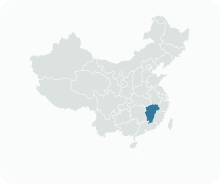
Get to know Yanshan County
- Administrative area
- County · 县
- Part of
- Shangrao
- Chinese name
- 铅山县
- Local areas
- County guide
Area & population
- Area
- 2,178.00 km²
- Population · 2019
- 481,700
Source: English Wikipedia, as of the dates shown.
Yanshan (铅山, pronounced Yánshān) is a county to explore by landscape rather than by a single town. The Xin River crosses the county and the terrain changes as you travel south: a lower river corridor in the north, hill country through the middle, and Wuyi Mountain terrain toward the Fujian border.
That geography explains its character. Hekou grew around river trade in tea and paper; Ehu preserves the memory of a major 1175 scholarly meeting; Gexian Mountain and the southern edge turn the trip toward mountain scenery. These places belong to one county history, but they are not one compact sightseeing cluster.
Read Yanshan in zones
Hekou and the Xin River corridor
Start with Hekou (河口) if you want a town-scale introduction. The old river port stands at a confluence and developed through the movement of tea, paper and other goods. More than 300 old shop buildings and homes remain in the historic area, alongside a long Ming–Qing commercial street.
Walk slowly rather than looking only for a landmark. Notice the depth of the shopfronts, the relationship between lanes and the water, and the practical scale of the old commercial buildings. Hekou is the place to understand why Yanshan's culture is tied to trade and transport, not only to mountain scenery. Individual venues inside the historic fabric can have their own opening arrangements, so do not assume that every doorway follows the hours of the street itself.
Ehu and the central cultural landscape
Ehu Academy (鹅湖书院) belongs to a separate cultural outing. In 1175, Lü Zuqian brought Zhu Xi together with the brothers Lu Jiuling and Lu Jiuyuan at Ehu; the debate became known as the Goose Lake Meeting. The academy's stone gateway is also noted for its 18 inverted carp carvings.
The useful way to visit is to read the site as a setting for discussion and teaching. Look at the gateway, courtyards and the relationship between the buildings and the surrounding hills, rather than treating the famous debate as a single photo stop. Ehu should not be used as a supposed back entrance to Hekou's old street or to the mountain resorts.
Gexian Mountain, Gexian Village and the southern hills
In the central and southern hills, Gexian Mountain reaches 1,096.3 metres at its main peak, while Gexian Village Resort sits at the mountain's foot. They represent different experiences: a mountain and religious landscape on one side, and a purpose-built holiday complex on the other. The county sources place them together geographically but do not establish that one ticket, entrance or opening rule covers both; check them separately before travelling.
Farther south, Huanggang Mountain rises to 2,160.8 metres on the Jiangxi–Fujian border and forms part of Yanshan's Wuyi Mountain landscape. That is a high-mountain and boundary-area proposition, not an assumed extension of a resort visit. Confirm current access, weather and any local protection or boundary requirements before attempting a mountain outing; this county overview does not present an unverified hiking route.
Paper, tea and everyday flavours
Shitang is associated with Yanshan's paper-making tradition, while Liansi paper (铅山连四纸) is valued for its fine texture, ink absorption and durability. The craft is best understood through a verified heritage or workshop visit rather than by assuming that ordinary shops are open demonstrations.
For food, look for the county's own names instead of a generic Jiangxi menu: Yanshan tangfen (铅山烫粉), a rice-noodle bowl with broth, pork and pepper; and dengzhan guo (灯盏粿), a steamed rice snack shaped like a small lamp and filled with ingredients such as pork, mushroom, soybean sprouts and bamboo shoot. Hehong tea (河红茶) carries the name of Hekou's tea-trade history.
Search for “铅山烫粉” or “灯盏粿” on Meituan (美团) or Amap / Gaode Maps (高德地图) to find nearby places serving the dish. Check menus, recent reviews, opening information and today's availability before choosing. Regional versions and fillings vary; ask about pork, stock, chilli and other ingredients if you have dietary restrictions.
Plan the visit at county scale
Do not choose one “Yanshan entrance.” Hekou, Ehu, Gexian Mountain and Village, Shitang and the southern mountain roads are different sub-areas. Pick a zone for each half-day or full day, carry the exact Chinese destination, and leave time for the return connection rather than trying to cross the whole county between fixed admissions.
The practical arrival pattern is road-based. Transport reports in 2025 describe “Yanyunhao” point-to-point buses linking Shangrao High-Speed Railway Station with Gexian Mountain and other scenic areas; a 2024 adjustment notice also listed a return service between Shangrao High-Speed Railway Station and Yanshan Bus Station. These reports demonstrate useful intercity links, but they are not a guarantee of a November 2026 timetable. Check the current route, stop, seat availability and return service in the DiDi app or the 赣悦行 platform before departure.
Once you leave the main road, a ride-hail or taxi request should use the exact destination name—河口古镇, 鹅湖书院, 葛仙村度假区, 葛仙山景区 or 石塘镇—rather than only “Yanshan.” No single county-level arrival point gives you the correct entrance to every sub-area. Before setting out for a specific venue, confirm its current opening, reservation, ticket or cableway arrangements and whether its booking and ticket checks accept your travel document.
Explore Yanshan County
Core places to explore, with English and Chinese names.
Places to explore around Yanshan County
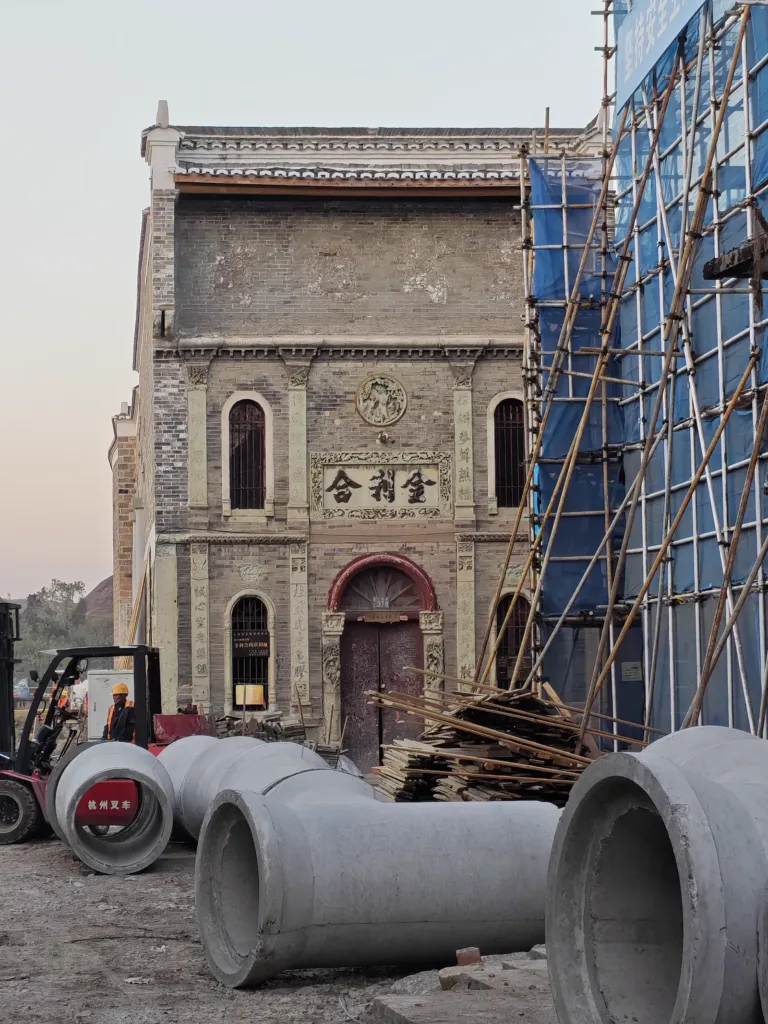 Jinlihe Pharmacy (金利合药店) in Hekou Town, Yanshan County, photographed from the street. Photo: Zhangzhugang · CC BY-SA 4.0
Hekou Ancient Town河口古镇
Hekou is a living river-port town in Yanshan, with a long Ming–Qing street where tea, paper and regional trade can still be read in the street plan, shop-house depth and river edge.
Read the place guide →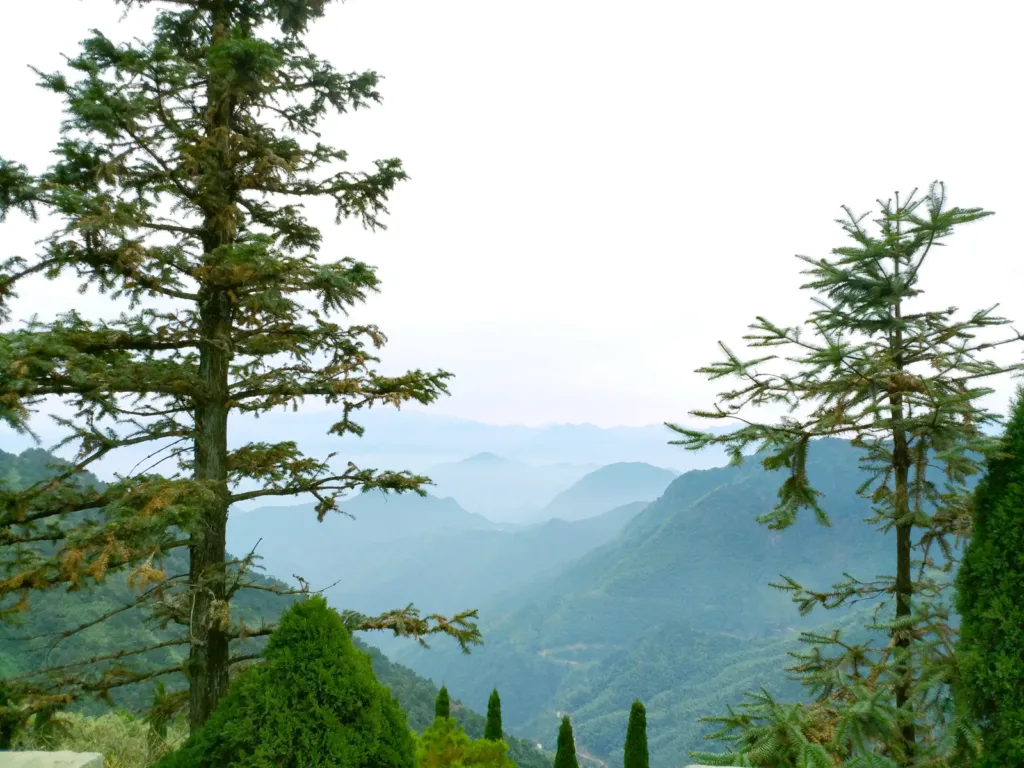 Mountain ridges viewed from Mount Gexian, framed by evergreen trees. Photo: Zhangzhugang · CC BY-SA 4.0
Mount Gexian葛仙山
Mount Gexian is a 1,096.3-metre Taoist mountain in Yanshan County, Shangrao, where a Taoist shrine and the Buddhist Ciji Temple share the upper slopes above Gexian Village Resort. It suits visitors who want to read a living religious landscape, compare mountain and resort spaces, and look over the surrounding ridges rather than treat the summit as a photo stop.
Read the place guide →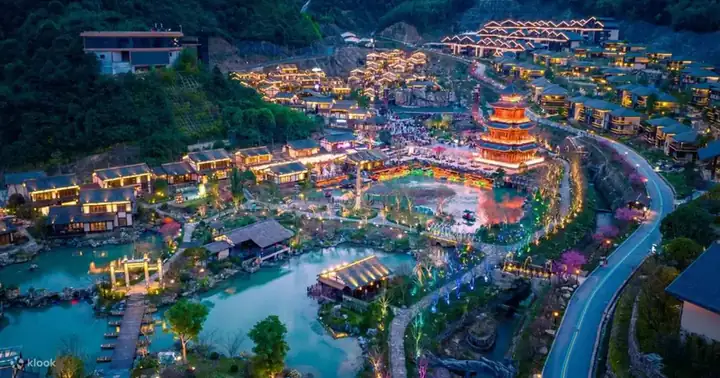 Gexian Village Resort · 葛仙村度假区
Gexian Village Resort葛仙村度假区
Gexian Village Resort is a purpose-built leisure complex at the foot of Gexian Mountain in Yanshan County, Shangrao. Its lower village combines newly built traditional-style architecture, hotels and cultural programming with an evening circuit of illuminated waterways, markets and performances; the upper mountain is a separate scenic and Taoist landscape, so plan village entry, cable-car access and the return journey as separate parts of the visit.
Read the place guide →Plan your visit
Getting there
Yanshan County is about 30 km (straight-line distance) from central Shangrao. Search for 铅山县 in a map app to find stations and your accommodation.
Where to stay →Build your route
Hekou Ancient Town and Mount Gexian are about 30 km apart (straight-line distance). The linked place guides have entrance and visit details.
Continue with Shangrao →More in Shangrao
Sources & geographic information
Administrative names and parent areas: Official geographic directory (dmfw.mca.gov.cn) · Reference date 2026-09-06.
Sources and licences for the original area background:
Sights and heritage
Chinese Wikipedia: 铅山县 (revision 90898924, 2025-12-30)
English Wikipedia: Yanshan County, Jiangxi (revision 1336928439, 2026-02-06)
Adapted from Wikipedia contributors, "铅山县", Chinese Wikipedia · CC BY-SA 4.0. Translated into English and condensed from the cited revision; figures and dates as stated there. Not independently verified.
Adapted from Wikipedia contributors, "Yanshan County, Jiangxi", English Wikipedia · CC BY-SA 4.0. Condensed from the cited revision; figures and dates as stated there. Not independently verified.
Background text adapted from Yanshan County, Jiangxi — Wikipedia contributors, under CC BY-SA 4.0. Text has been shortened and reorganized; source revision 1336928439.
Photo: Gexian Village Resort · klook.com. Resized for the web; the photo itself has not been edited.
Map data © OpenStreetMap contributors. Pins mark approximate centres, not entrances or boundaries.
Image credits & notes (1)
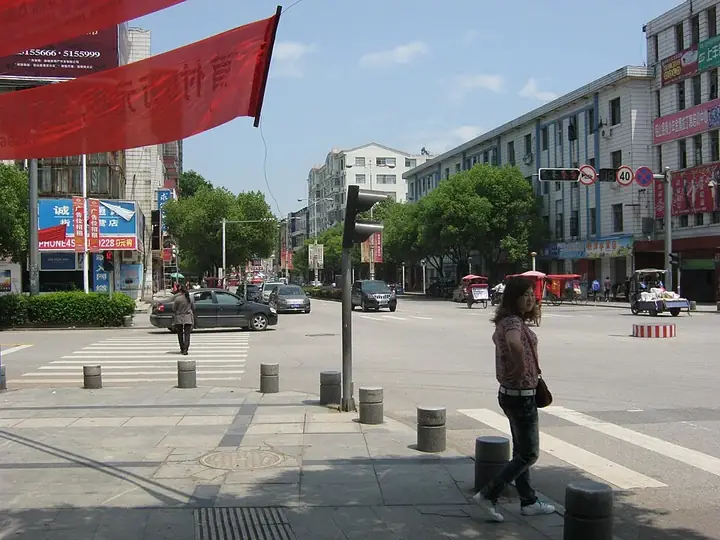
- Shijiang Avenue and streetfront shops in Yanshan County, Jiangxi. Photo: 2012-05-05.Photo: PanShiBo · CC BY-SA 3.0Resized for the web; the photo itself has not been edited. Thumbnails may show a cropped view.
