

Explore the region
Tap any red Chinese text to hear it in Mandarin.
Liuding Mountain Cultural Tourism Area is a south-of-Dunhua cultural landscape where Zhengjue Temple, the 48-metre Jinding Buddha and the protected Bohai royal tomb area are presented within a wider multi-zone park. Plan it as a linked temple, statue and heritage visit, using the visitor-service entrance and checking the internal ride and return transport rather than treating every named attraction as a separate public gate.
What this place is
Liuding Mountain is best understood as the name of a cultural tourism area, not just the bronze Buddha or the temple shown in many photographs. It lies in the southern outskirts of Dunhua, on the Mudan River side of the city. The provincial description distinguishes a 52-square-kilometre planning area from a 10-square-kilometre developed core, whose zones include an entrance service area, Buddhist culture, Bohai culture and Qing-ancestor culture.
That scale matters when planning a visit. The public-facing core brings together religious architecture, a monumental statue, forested hills and archaeological remains, but the named attractions are not interchangeable entrances. Use the visitor-service area as your starting point, then follow the operating route and signs for the parts of the park open on your date.
Begin with the temple and Buddha
Zhengjue Temple is the clearest place to start. The official and government descriptions place it alongside the Jinding Buddha as the religious focus of the area, while the wider park also contains a Buddhist Culture and Art Museum and other culture-oriented facilities. Look first at the temple’s sequence of halls and courtyards, then allow time for the Buddha area rather than treating the statue as a quick roadside photo stop.
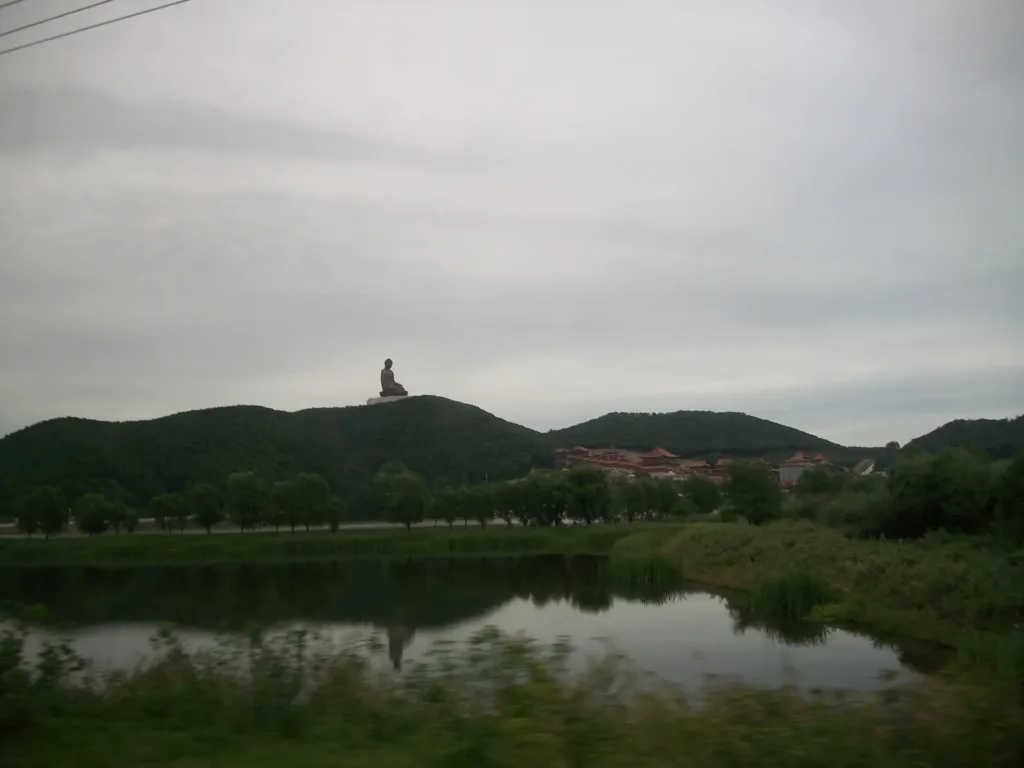
The Jinding Buddha is a 48-metre seated bronze image of Sakyamuni. The English government travel page describes it as facing south towards Zhengjue Temple and Changbai Mountain. That alignment gives the upper viewpoint a different experience from the enclosed temple courtyards: the visit moves from close architectural detail to a large-scale view across the southern Dunhua landscape.
The temple is a religious site, not merely a scenic backdrop. Keep voices low, follow any posted photography or access rules, and do not enter closed halls or service areas. The operator says that an internal sightseeing vehicle is available; check its current route and fare at the visitor-service centre instead of assuming that every zone is walkable or that the vehicle serves every named attraction.
Keep the Bohai tombs in a separate layer
The Six-Ding Mountain Ancient Tombs are the archaeological layer of the visit. Xinhua describes them as the early royal and aristocratic tombs of the Bohai Kingdom and as a national key protected cultural relic. A local Yanbian account identifies the tomb of Princess Zhenhui as a major point of interest and describes finds associated with the burial, including a tombstone and stone lions.
Do not fold the tombs into a guaranteed temple-and-statue route. The protected archaeological area has a different conservation purpose, and the public sources read here do not establish that tomb chambers or excavation areas are freely open on every date. Ask the visitor centre which tomb-related display or managed viewing area is accessible when you arrive. This keeps the historical claim precise without promising entry to a place that may be closed or separately managed.
Opening, reservation and practical limits
The operator’s FAQ currently lists ticket sales from 07:00 to 16:30 and park opening from 05:00 to 20:00 between April 1 and October 31. For November 1 to March 31, it lists ticket sales from 07:30 to 16:00 and park opening from 05:00 to 18:00. It also says that the area uses real-name reservations through the official website, official WeChat account or app, with the reservation ID required at entry.
Those are the operator’s published rules, not a promise that every hall or archaeological component will operate identically. The FAQ does not explain how a foreign passport is handled in the reservation and admission flow. International visitors should contact the scenic area before payment or travel and ask whether passport details can be used, which entrance accepts the booking, and whether any part of the visit needs a separate arrangement. The operator’s visitor line is 0433-6688330.
Getting there and getting back
Save the Chinese destination 吉林省敦化市六鼎山文化旅游区 Jílín Shěng Dūnhuà Shì Liùdǐngshān Wénhuà Lǚyóuqū. That is the address given by the operator; it is safer than navigating only to “Jinding Buddha” or “Zhengjue Temple”, which are components inside the wider area.
The Dunhua municipal government’s December 2024 transport guide says that visitors arriving at Dunhua Railway Station(敦化火车站) can walk forward to the 8路 bus stop at the railway station and take the bus towards Liuding Mountain Cultural Tourism Area. The same guide places a taxi waiting point near the coach station, to the right after leaving the railway station, for a direct ride to the cultural tourism area.
For the return, do not rely on an unverified last bus. Before entering, ask the operator or the driver where the current 8路 return stop is and when the last service leaves the entrance area; the government guide confirms the outbound connection but does not publish a return timetable. If you are catching a train from Dunhua, keep the railway station as your return anchor and leave time to get back from the park. The operator’s published address identifies the cultural tourism area as a whole, so confirm the actual visitor-service gate and the day’s internal transport before setting off.
Combine your visit
Suggested order within this visit:
-
Zhengjue Temple
Start with the religious compound at the foot of the statue hill.
-
Jinding Buddha and Buddhist art area
Follow the operating internal route to the monumental figure and its associated interpretation.
The ancient Balhae tombs are a separate protected component; this temple-and-statue sequence does not promise entry to tomb chambers or excavation areas.
Find Liuding Mountain
六鼎山 · 延边朝鲜族自治州
The pin marks the area, not the entrance.
Sources & visit information
Sources checked on 1 November 2026. Hours, tickets, reservations and transport can change; confirm with the operator before you go.
Image credits & notes (1)
- A distant view of the Jinding Buddha on a wooded hill above a pond at Liuding Mountain, Dunhua, with temple roofs below the hill. Photo: Anonymous (Wikimapia user submission, as listed on Wikimedia Commons)Photo: CC BY-SA 3.0