

Photo adjustments
EXIF orientation normalized; resized without changing aspect ratio; converted to WebP. No subject edits.
Explore the region
About Niuheliang
Its significance comes from the relationship between temple remains, stone cairns and an altar, rather than a single standing monument. The main museum supplies the archaeological context before a visit to the protective hall over the Goddess Temple and the second site's cairn-and-altar group. These are separate parts of a large park, so organise the internal connections instead of assuming one short walk.
Niuheliang is a group of late Hongshan-culture (红山文化) remains, dated to about 5,500 years ago, in the Nulu'erhu Mountains (努鲁儿虎山), covering about 50 square kilometers. It was discovered in 1981 during a survey of cultural relics, and repeated excavation recovered jade objects representative of the Hongshan culture.
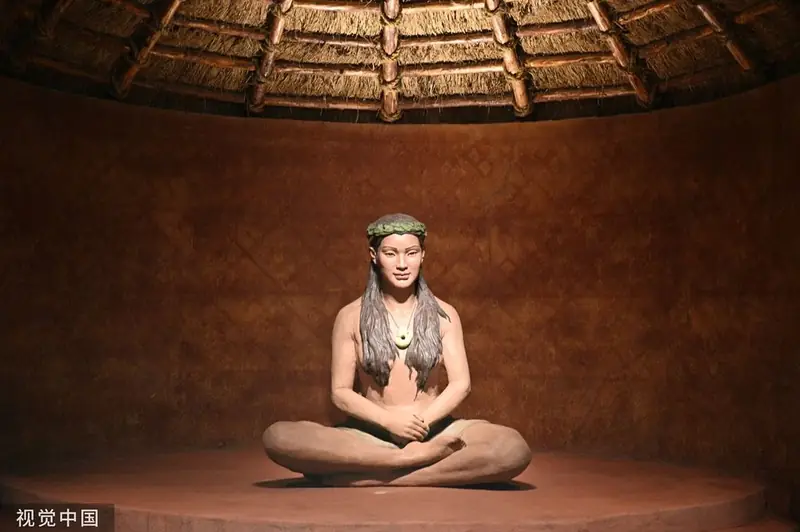
The Goddess Temple (女神庙) is a semi-subterranean, multi-room structure with a main chamber, side rooms and front and back rooms, decorated with wall paintings and imitation-timber ornament, and once held large clay goddess figures, animal statues and painted pottery ritual vessels; an open platform of about 40,000 square meters lies to its north. The second site's cairn group covers 22,870 square meters and includes five cairns, one a 340-square-meter square tomb, with more than twenty jade pieces recovered from nearby stone-slab graves; two further cairn groups lie at Jiazishan (架子山) and Heishantou (黑山头).
In 1986 the site was named a Liaoning provincial cultural relics protection unit, and in 1988 it was listed as a Major Historical and Cultural Site Protected at the National Level (全国重点文物保护单位). It was designated a key large site by the National Cultural Heritage Administration (国家文物局) in 2004 and placed on China's Tentative List for World Heritage in 2006 and 2012. In 2014 the Niuheliang National Archaeological Site Park (牛河梁国家考古遗址公园) opened, covering about 8 square kilometers.
What to look for
- The protected remains of the Goddess Temple at Site 1.
- The stone-cairn and altar arrangement at Site 2, interpreted alongside the museum's Hongshan-culture displays.
Background & history
Niuheliang (Chinese: 牛河梁) is a Neolithic archaeological site in Liaoning Province, Northeast China, along the middle and upper reaches of the Laoha River and the Yingjin River (presently on the border of Chaoyang and Jianping County). Discovered in 1983, the Niuheliang site belongs to the Hongshan culture (4700–2900 BC). It includes evidence of religion, such as a temple, an altar and a cairn.
Excerpt from Wikipedia: Niuheliang · Wikipedia contributors · CC BY-SA 4.0. Selected introductory sentences; formatting simplified. Background information, not current visitor-service advice.
Location & getting there
Getting to Niuheliang
Use the Niuheliang archaeological park's main museum on the northeastern side of the site between Lingyuan and Jianping as the arrival point. Confirm the day's connections to Sites 1 and 2.
Combine your visit
Suggested order within this visit:
-
Main museum
Begin with the layout and archaeological interpretation.
-
Site 1 Goddess Temple protective hall
Examine the ceremonial building remains.
-
Site 2 cairns and altar
Compare the adjacent forms of ritual construction using the operating park connection.
This sequence is an editorial suggestion based on the features described in the sources. Access to individual buildings or areas should be checked locally; no travel time or shared admission is implied.

Find Niuheliang
牛河梁遗址 · 朝阳市
The pin marks the area, not the entrance.
More places nearby
Approximate straight-line distances between map pins, not travel distances.
North Pagoda of Chaoyang 朝阳北塔
84 km awayChaoyang's North Pagoda contains several periods of construction within its square brick form. Earlier tower cores and foundations were incorporated into later rebuilding, while the closely spaced eaves and sculpted exterior…
View guide →Xingcheng 兴城
129 km awayXingcheng's old centre preserves the square plan of the Ming garrison town of Ningyuan. Four gates, corner defences and the central Drum Tower make its military organisation legible within a living town. South Street adds the…
View guide →Jiumenkou 九门口长城
135 km awayAt Jiumenkou the Great Wall crosses a river on nine arches, making water engineering as prominent as defence. Stone paving across the riverbed and the controlled openings below the wall distinguish this section from a…
View guide →Sources & visit information
The sources below support the place-specific description and arrival information. Suggested combinations are editorial planning ideas; confirm current opening, entry arrangements and transport services for your date.
Visitor information adapted and edited from Wikipedia contributors · CC BY-SA 4.0. Source revision 93353137.
Background paragraphs translated and condensed from Wikipedia contributors, "牛河梁遗址", Chinese Wikipedia · CC BY-SA 4.0. Source revision 93353137.