

Explore the region
Tap any red Chinese text to hear it in Mandarin.
What this place is
The visitor institution is 旅顺日俄监狱旧址博物馆 Lǚshùn Rì-É Jiānyù Jiùzhǐ Bówùguǎn; the historic site is the former Lüshun Prison. It is not an architectural attraction to skim for a few photographs. The surviving compound shows how detention, surveillance, interrogation, execution and forced labour were arranged within one enclosed system. Visit quietly and allow the rooms and exhibits to carry the weight of the history.
Russia began the prison in 1902. Japan expanded it after taking control of Lüshun, adding cell blocks, workshops and other facilities in 1907. The site was dissolved in 1945, restored and opened as a public exhibition facility in July 1971, and listed in 1988 as a Major Historical and Cultural Site Protected at the National Level.
What to look for
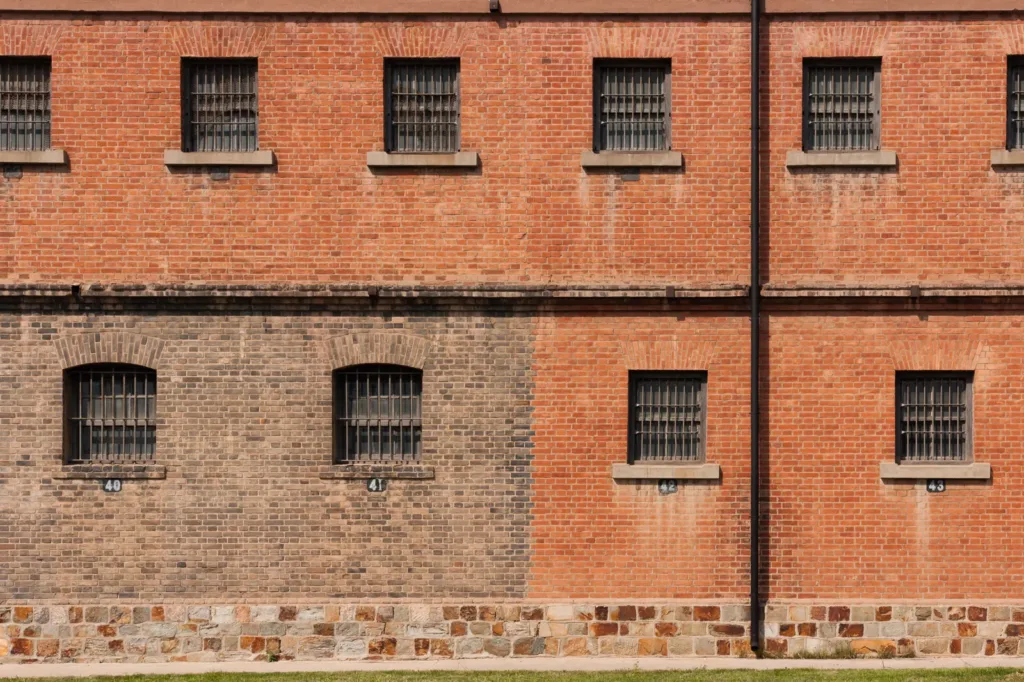
The central cell complex has a distinctive three-direction, roughly “大”-shaped plan. Grey-brick sections belong to the Russian construction phase, while red-brick extensions belong to the Japanese expansion. From the central guard position, the arrangement made it possible to watch several wings at once. The compound also retains or interprets inspection, interrogation and execution spaces.
The workshops are essential to understanding the place. The Liaoning government describes 15 workshops for clothing, textiles, weaving, laundry, shoemaking, printing, machinery, ironwork and carpentry; prisoners were forced to produce military and everyday supplies for the colonial authorities. Outside the main wall, the historic grounds also included a kiln, woodland, orchards, vegetable plots and guard housing. These wider areas should not be assumed to be open visitor zones.
Exhibits and historical interpretation have included Chinese and Korean prisoners, opponents of Japanese rule and other people held by the prison system. An Jung-geun, the Korean independence activist, was imprisoned here before his execution. Displays and access to individual rooms can change, so treat these as the themes to look for rather than a promise that every exhibit is open on every date.
Before you go
A conservation closure began on 17 October 2025. A local report dated 17 August 2026 records the museum operating again and gives a summer extension, while the visitor notice issued in July 2026 sets the regular seasonal hours at 09:00–16:30 from May to October, with last entry at 16:00, and 09:00–16:00 from November to April, with last entry at 15:30. It also states that individual visitors must reserve through the 旅顺日俄监狱旧址博物馆 Lǚshùn Rì-É Jiānyù Jiùzhǐ Bówùguǎn official mini-program from seven days ahead, including the day of the visit; unreserved visitors cannot enter. Mondays are normally closed, except when a public holiday arrangement applies.
The same 2026 notice describes free scheduled interpretation at 09:30, 10:30, 13:30 and 14:30, plus paid on-site guiding and other educational services. It does not establish a current admission fee. Do not reuse older fee information without checking the latest notice. The notice describes entry verification by the booked identity document or reservation code; whether a foreign passport can be used in the mini-program and at the gate was not stated in the sources reviewed, so confirm this with the museum before relying on an international visitor booking.
Location and getting there
The museum is at No. 139 Xiangyang Street, Yuanbaofang, Lüshunkou District, Dalian. For a taxi or ride-hailing car, show the Chinese destination 旅顺日俄监狱旧址博物馆,大连市旅顺口区元宝坊向阳街139号. The historic office building at the southwest corner served as the entrance to the prison; follow the current signed visitor entrance because conservation work or crowd control may alter the route.
For public transport, Dalian Metro Line 12 serves 旅顺站 (Lüshun) on the 河口—旅顺新港 Hékǒu — Lǚshùn Xīngǎng route. From the city side, take a train towards 旅顺 or 旅顺新港, then use a taxi for the final leg to 向阳街139号. For the return, go back to 旅顺站 and take Line 12 towards 河口, checking the day’s service before leaving the museum. The metro source confirms the line and station names but not a walking route from 旅顺站 to the museum, so do not assume the station is the visitor entrance.
The site was closed when the 2025 legacy guide was written, but later 2026 notices record renewed operation. Check the museum’s current announcement, reservation result and same-day entrance status before making the trip, especially outside the published summer extension.
Combine your visit
Conditional sequence for a future confirmed reopening:
-
Cell-block interpretation
Understand the prison's layout and prisoner experience.
-
Workshop and historical-person displays
Connect the spaces with forced labour and individual lives.
This sequence is an editorial suggestion based on the features described in the sources. Access to individual buildings or areas should be checked locally; no travel time or shared admission is implied.
Find Lüshun Russo-Japanese Prison
旅顺日俄监狱旧址 · 大连市
The pin marks the area, not the entrance.
More places nearby
Approximate straight-line distances between map pins, not travel distances.
Lüshun Museum 旅顺博物馆
3 km awayLüshun Museum brings together archaeological and decorative-art collections in a historic European-style museum building. Xinjiang material and the museum's ceramics, enamels and snuff bottles give the collections a wider reach…
View guide →Lüshun Submarine Museum 旅顺潜艇博物馆
3 km awayLüshun Submarine Museum is organised around a retired Type 033 submarine on the Huangjinshan shore. The boat is the principal object, supported by retired land, sea and air equipment and simulated submarine experiences. These…
View guide →Sources & visit information
Sources checked on 24 October 2026. Hours, tickets, reservations and transport can change; confirm with the operator before you go.
- Lüshun Russo-Japanese Prison Site Museum (4A) ↗
- Using Historical Scenes to Tell Stories of Revolutionary Struggle ↗
- This Museum Has Suspended Public Opening ↗
- Two Lüshun Museums Extend Summer Opening Hours ↗
- Lüshun Russo-Japanese Prison Site Museum Visitor Reservation Notice ↗
- Lüshun Prison Site ↗
- Dalian Metro Line 12 ↗
Image credits & notes (1)
- Exterior wall of the preserved former Lüshun Prison, showing barred cell windows and the red-brick Japanese-era addition over a grey-brick Russian-era section; photographed on 19 May 2009. Photo: CEphoto, Uwe AranasPhoto: CC BY-SA 4.0