

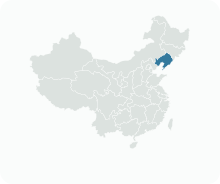
Get to know Lüshunkou District
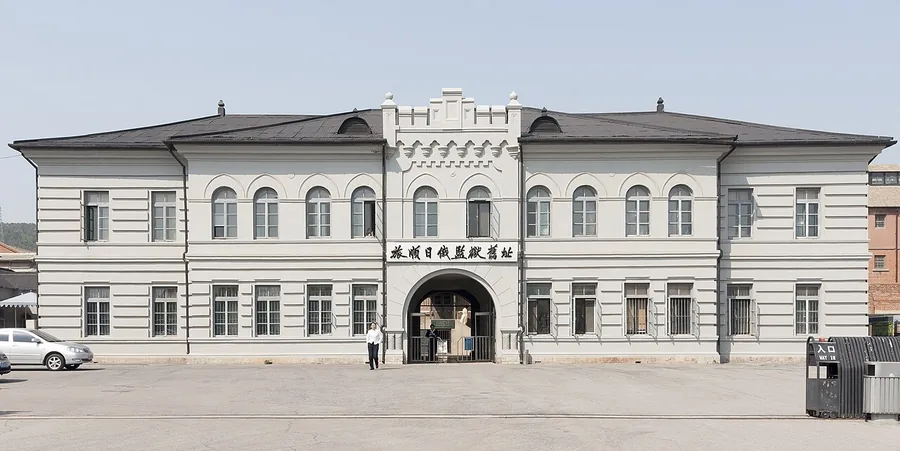
Photo adjustments
Proportionally resized and converted to WebP without cropping, retouching or changing the photographed subject.
- Administrative area
- District · 市辖区
- Part of
- Dalian
- Chinese name
- 旅顺口区
- Local areas
- District guide
Area & population
- Area in the source
- 512.15 km²
- Population · 2020
- 398,579
Source: cited geographic source, as of the dates shown.
History
The district government traces settlement here back 5,000 years. The harbour was known in the Yuan dynasty as Shizikou (狮子口, 'Lion's Mouth'). In 1371 Ming troops sailed from Penglai (蓬莱) in Shandong and landed here to retake Liaodong, and because the crossing had gone smoothly the place was renamed Lüshunkou, 'smooth-journey harbour'. From 1880 the Qing built the base of the Beiyang Fleet (北洋水师), with docks and gun batteries. Lüshun (旅顺) was a main battlefield of the First Sino-Japanese War of 1894 and the Russo-Japanese War of 1904, and was held by Russia for 7 years and by Japan for 40; a long-standing saying calls it half of China's modern history in one harbour. Soviet troops were stationed here from August 1945 until May 1955, and the district was fully opened to the outside world only in November 2009.
Setting and landscape
The district is coastal hill country, higher in the east, with 292 hills and 169.7 kilometres of coastline. The highest, Laotie Mountain (老铁山, 465.6 metres), stands directly on the sea boundary. Off Laotieshan Cape (老铁山岬) a visible line forms where the tides of the Yellow Sea and the Bohai meet. Laotie Mountain is a stopover for more than 200 species of migrating birds each spring and autumn, and Snake Island (蛇岛), about 0.8 square kilometres, lies 7 nautical miles off Shuangdao town (双岛镇) and is home to the Snake Island pit viper.
What to see
Baiyu Mountain (白玉山), 130 metres high in the centre of the town, got its name in 1881 when Li Hongzhang (李鸿章) looked out from it at Huangjin Mountain (黄金山, 'Gold Mountain') in the distance and said the nearer hill should be 'white jade'. From the top you look south over the naval harbour, east to its century-old dock and west to the S-shaped Tiger's Tail (老虎尾) dune. Laotieshan Lighthouse (老铁山灯塔), built in 1892 by the Qing customs service under British supervision with French-made parts, stands on Laotieshan Cape with the Yellow Sea to one side and the Bohai to the other.
National key cultural relic sites in the district include the Lüshun Japanese-Russian Prison site (旅顺日俄监狱旧址), the old Kwantung Office Museum (关东厅博物馆) building that now houses the Lüshun Museum (旅顺博物馆), the Wanzhong Tomb (万忠墓), the Sino-Soviet Friendship Tower (中苏友谊纪念塔) and the old Lüshun dockyard (旅顺船坞旧址). Lüshun is also known for its spring cherry blossom and magnolias.
Highlights
- Baiyu Mountain 白玉山: 130-metre hill in the town centre overlooking the naval harbour, named by Li Hongzhang in 1881.
- Laotieshan Lighthouse 老铁山灯塔: Lighthouse of 1892 on the cape where the Yellow Sea and Bohai meet.
- Lüshun Museum 旅顺博物馆: Housed in the former Kwantung Office Museum, a national key cultural relic site.
- Lüshun Japanese-Russian Prison site 旅顺日俄监狱旧址: National key cultural relic protection site.
- Snake Island 蛇岛: Island of about 0.8 square kilometres, home of the Snake Island pit viper.
Sources for this guide
中国大连旅顺口区政务信息网--走进旅顺口(旅顺口历史) · Lüshunkou District People's Government, Dalian
中国大连旅顺口区政务信息网--走进旅顺口(自然地理) · Lüshunkou District People's Government, Dalian
中国大连旅顺口区政务信息网--走进旅顺口(白玉山景区) · Lüshunkou District People's Government, Dalian
中国大连旅顺口区政务信息网--走进旅顺口(蛇岛) · Lüshunkou District People's Government, Dalian
中国大连旅顺口区政务信息网--走进旅顺口(黄渤海交界线) · Lüshunkou District People's Government, Dalian
旅顺口区 - 维基百科,自由的百科全书 · Wikipedia (Chinese) · CC BY-SA 4.0
Original English written from the listed sources and checked sentence by sentence against quoted extracts by a separate reviewer. Updated 2026-09-25.
Explore Lüshunkou District
Core places to explore, with English and Chinese names.
Places to explore around Lüshunkou District
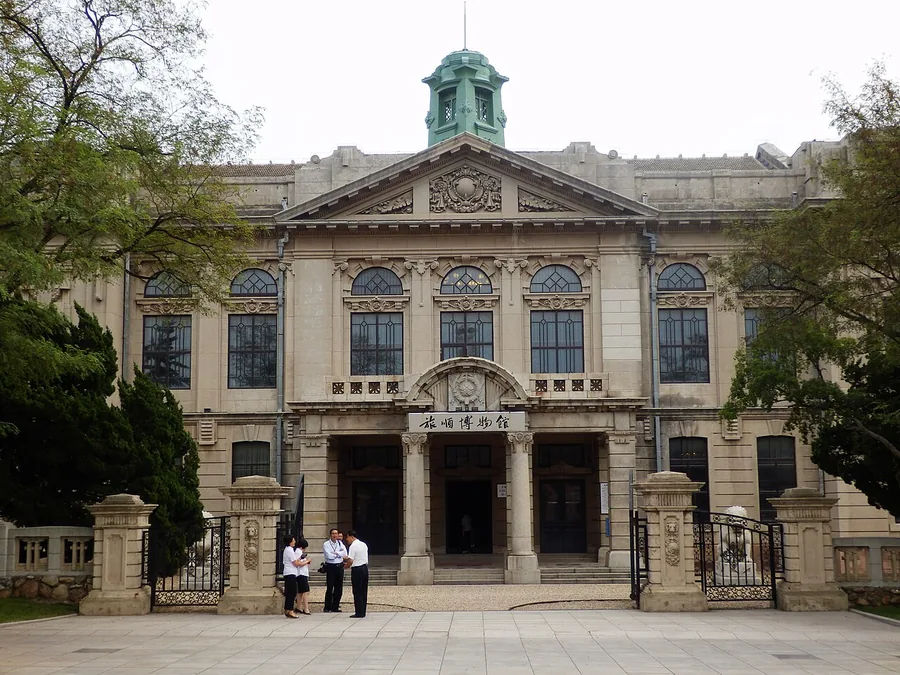 The historic main entrance facade of Lüshun Museum, September 2013.
Lüshun Museum旅顺博物馆
Lüshun Museum brings together archaeological and decorative-art collections in a historic European-style museum building. Xinjiang material and the museum's ceramics, enamels and snuff bottles give the collections a wider reach…
Read the place guide →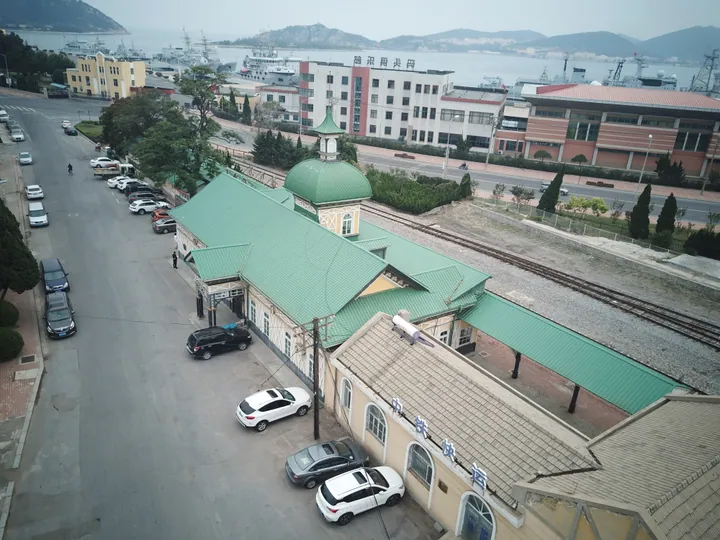 Aerial view of Lüshun Railway Station's Russian-style station building, Lüshunkou District, Dalian · 大连市旅顺口区旅顺火车站俄式风格站房航拍 Source-recorded photograph date: 2019-09-20 15:36:39.
Lushun Railway Station旅顺火车站
Lushun Railway Station (旅顺火车站) is the historic railway terminus near Lüshun harbour, known for its Russian-style timber station building.
Read the place guide → Lushun Russo-Japanese Prison Museum · 日俄监狱旧址博物馆
Lushun Russo-Japanese Prison Museum日俄监狱旧址博物馆
The Lüshun Russo-Japanese Prison Museum preserves a prison compound in Lüshunkou that was built under Russian rule and later enlarged and used by the Japanese colonial authorities.
Read the place guide → The White Jade Hill Tower monument seen from a park path on Baiyu Mountain, Lüshunkou District, Dalian, with a preserved historic cannon in the foreground · 大连市旅顺口区白玉山,园路远眺白玉山塔,前景为保留的历史炮台 Source-recorded photograph date: 2017-02-04.
Baiyu Mountain白玉山
Hill in the centre of Lüshunkou, Dalian, with a 1909 Japanese memorial tower and a view over the naval harbour and Laohuwei Peninsula.
Read the place guide →Plan your visit
Getting there
Lüshunkou District is about 30 km in a straight line from central Dalian. Search for 旅顺口区 in a map app to find stations and your accommodation.
Where to stay →Build your route
Lüshun Museum and Lushun Railway Station are both listed here. The linked place guides have entrance and visit details.
Continue with Dalian →More in Dalian
Sources & geographic information
Administrative names and parent areas: Official geographic directory · Reference date 2026-09-06.
Some facts checked against 旅顺口区 — Wikipedia contributors, CC BY-SA 4.0.
Photo: Lüshun Museum · 阴阳权政 · CC BY-SA 3.0. Proportionally resized and converted to WebP without cropping, retouching or changing the photographed subject.

Photo: Lushun Railway Station · David290 · CC BY-SA 4.0. Full frame retained; proportionally resized and converted to WebP. No retouching or changes to the photographed subject. Card displays may crop the view.

Photo: Lushun Russo-Japanese Prison Museum · Source photographer · License not provided. EXIF orientation normalized; resized without changing aspect ratio; converted to WebP. No subject edits.
Photo: Baiyu Mountain · Ffggss · CC BY-SA 4.0. Full frame retained; proportionally resized and converted to WebP. No retouching or changes to the photographed subject. Card displays may crop the view.

Map data © OpenStreetMap contributors. Pins mark approximate centres, not entrances or boundaries.