

Explore the region
Tap any red Chinese text to hear it in Mandarin.
Why this hill matters
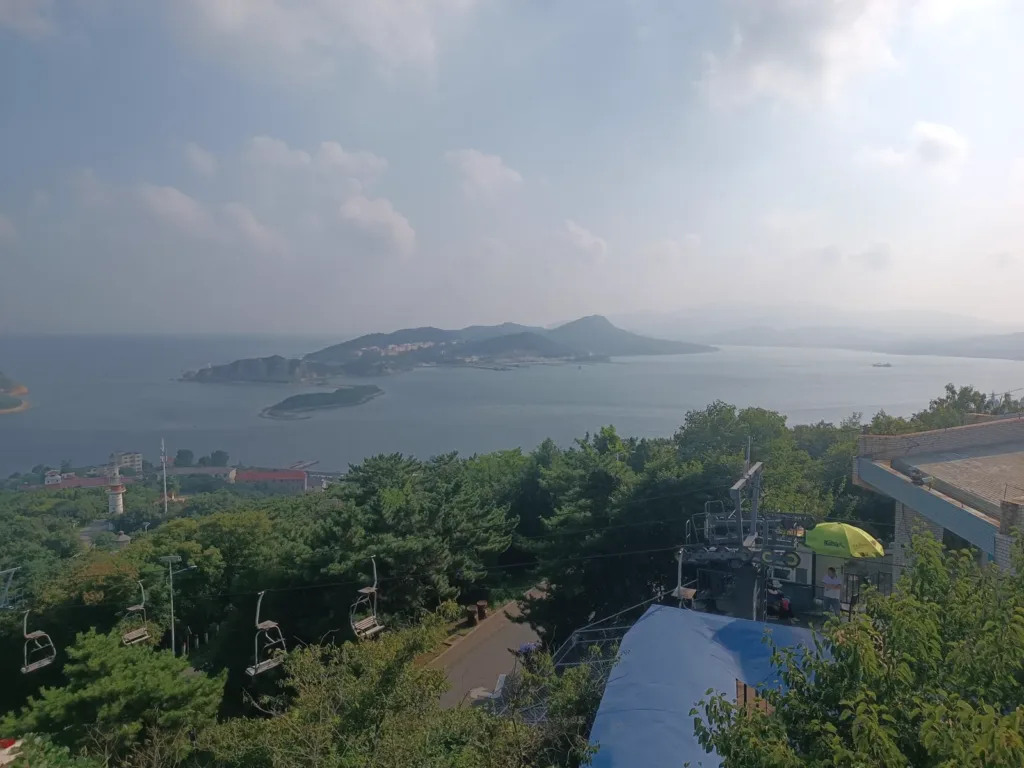
Lüshun is easiest to understand from a height. Baiyu Mountain rises in the urban centre of Lüshunkou, on the north side of Lüshun Port; from the summit, the harbour and the sandbar-like Tiger Tail Peninsula sit in the same frame.
The hill was formerly called Xiguan Mountain. A late-Qing naming story links “Baiyu” (white jade) to Li Hongzhang’s visit with Prince Chun after hearing that the opposite hill was Huangjin (Gold) Mountain. Another explanation connects the name with pale rock. It is best treated as local historical lore rather than as a single proven etymology.
The harbour below became the Beiyang Fleet’s Lüshun base during the Self-Strengthening Movement. The hill’s most striking built landmark has a darker history: Japanese forces began the tower in 1907 after the Russo-Japanese War to commemorate Japanese dead, and completed it in 1909 as Biaozhong Tower, or “Tower of Loyalty”. Chinese historical accounts record the coercive use of Chinese labour in its construction. After 1945, its name and inscriptions were altered; the monument was formally renamed Baiyushan Tower in 1986.
What to see
- Baiyushan Tower (白玉山塔). The 66.8-metre tower has a shell-shaped profile. Historical descriptions record a 273-step iron spiral stair inside, but the current visitor listing treats climbing the tower as a separate paid option, so do not assume that the scenic-area ticket includes the interior ascent.
- The harbour view. Look south across Lüshun Port and towards the narrow Tiger Tail Peninsula. The view is not only a panorama: it shows why this bay mattered as a naval base and why Baiyu Mountain remains a useful orientation point in Lüshun.
- The eastern stair and summit roads. The provincial tourism profile describes 499 concrete steps on the east slope, with rest pavilions, as well as winding roads approaching from the north and south. A cableway rises from the southern foot.
- The summit facilities. The same provincial profile lists the Lüshun Naval Weapons Museum and a 110-metre television signal tower beside the Baiyu Mountain Tower. They are separate facilities within the wider scenic-area visit, so check the day’s opening and ticket arrangements rather than assuming one ticket covers every interior.
Visiting and getting there
Baiyu Mountain is a ticketed national 4A scenic area. A current Trip.com attraction listing displays 07:30–17:30 opening and tickets from ¥40, and notes that tower access may be an additional purchase; these are the listing’s current figures rather than a guaranteed tariff, so check the date-specific ticket page before travelling.
For a taxi or ride-hailing destination, show or enter 大连市旅顺口区白玉山街158号(南道票口). This is the south-pass address used by current visitor listings. The eastern ticket office is a different approach, near 黄河路与长江路交叉口、白玉山隧道右侧 Huánghé Lù yǔ Chángjiāng Lù jiāochākǒu, Báiyùshān Suìdào yòucè; the east-gate listing places it about 50 metres northwest of the junction. This is the practical starting point for the 499-step walk.
The most legible public-transport route from Dalian is Metro Line 1 to 河口站 (Hekou), then Metro Line 12 to 旅顺站 (Lushun). Line 12’s published station order runs from Hekou through 龙王塘 (Longwangtang), 塔河湾 (Tahewan) and 旅顺 to 旅顺新港 (Lushun New Port). From 旅顺站, take a taxi for the final road section rather than treating the station as the entrance.
For the eastern ticket office, local bus routes 旅顺口5路、6路、12路、18路、19路 stop at 友谊公园 Yǒuyì Gōngyuán. The stop is listed as about a one-minute walk from the east gate; 中心广场 Zhōngxīn Guǎngchǎng is a farther alternative. If you arrive at 旅顺汽车站 Lǚshùn Qìchēzhàn, use the same local routes or a taxi. In this itinerary, 旅顺站 Lǚshùn Zhàn means the Metro Line 12 station, not a guaranteed mainline-rail arrival; confirm any separate railway service before relying on the historic name “旅顺火车站”.
For the return, descend to the east-gate area and use 友谊公园 Yǒuyì Gōngyuán or 中心广场 Zhōngxīn Guǎngchǎng, or take a taxi back to 旅顺站 Lǚshùn Zhàn. From there, Line 12 runs eastbound to 河口站 Hékǒu Zhàn, where Line 1 provides the onward city connection. Check the last train and local bus service on the day, especially if you finish after the scenic area’s listed closing time.
Wear shoes suitable for stairs and keep water with you. The harbour is an active military landscape: follow posted photography and access rules, stay on marked paths, and do not treat every visible quay or hillside as a visitor area.
Find Baiyu Mountain
白玉山 · 旅顺口区
The pin marks the area, not the entrance.
Sources & visit information
Sources checked on 24 October 2026. Hours, tickets, reservations and transport can change; confirm with the operator before you go.
- Baiyu Mountain Scenic Area (4A) — Liaoning Provincial Government ↗
- 白玉山 — Chinese Wikipedia ↗
- 白玉山塔 — Chinese Wikipedia ↗
- Lushun Baiyu Hill — Trip.com ↗
- Baiyu Mountain Scenic Area East Gate — Moovit ↗
- Dalian Metro Line 12 — Dalian Bus Network ↗
- Lüshunkou District Bus Routes — Dalian Bus Network ↗
- Dalian Metro Line 12 — TravelChinaGuide ↗
- Dalian Baiyu Mountain Scenic Area — ezTravel ↗
Image credits & notes (1)
- View from Baiyu Mountain over Lüshun Port and the surrounding shoreline; photographed on 22 August 2024. Photo: SufangxiPhoto: CC BY-SA 4.0