

Photo adjustments
Full frame retained; proportionally resized and converted to WebP. No retouching or changes to the photographed subject. Card displays may crop the view.
Explore the region
About White Pagoda (Liaoyang)
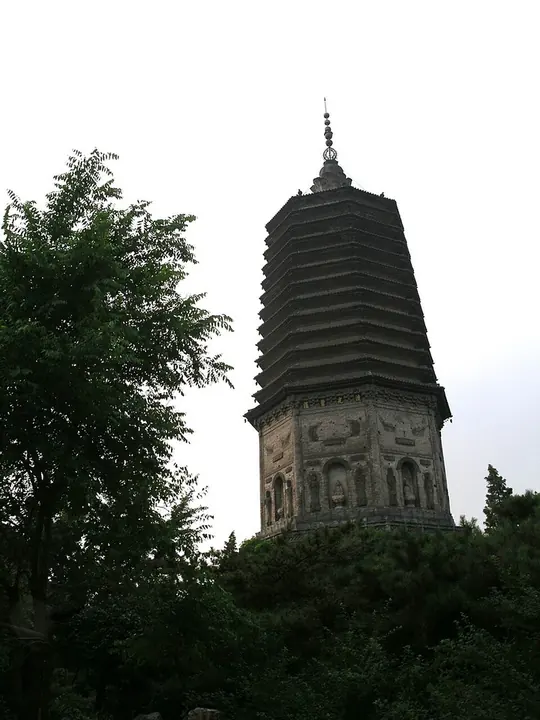
Its white surface makes the profile striking at a distance, but the lower carved details deserve a slower look. Buddhist figures, guardian warriors, celestial figures and imitation architectural openings enliven the base and first storey. The nearby Guangyou Temple provides a useful comparison with a modern reconstructed temple complex; the pagoda itself is an exterior architectural visit, not an interior climb.
The date of construction is disputed: inscriptions from 1590 and 1842 describe the pagoda as built in the Han dynasty and repaired in the Tang, while a pagoda inscription excavated nearby in 1922 has been read as evidence that Empress Dowager Zhenyi (贞懿皇太后), mother of Emperor Shizong of Jin, was buried in a relic pagoda completed in 1189 after her death in 1161. A third view, based on the tower's style and a 1423 inscription, holds that it was built in the Liao dynasty; the site is generally believed to date from the Liao-Jin period (辽金).
The pagoda was originally a subordinate structure of Guangyou Temple (广佑寺); the temple was burned down by Russian troops in 1900, leaving only the pagoda standing, and in 1908 Japan built Baita Park around it, from which Liaoyang's Baita District later took its name. The pagoda has been repaired repeatedly since the Yuan dynasty, including three times after 1949, and was not seriously affected by the 1975 Haicheng earthquake. In 1988 it was listed as a Major Historical and Cultural Site Protected at the National Level (全国重点文物保护单位).
What to look for
- The octagonal plan and thirteen-tier, whitewashed brick silhouette.
- The lower Buddhist figures, guardian warriors and decorative false windows.
Location & getting there
Getting to White Pagoda (Liaoyang)
Use Baita Park in central Liaoyang as the arrival point. The White Pagoda stands in the park beside the Guangyou Temple area.
Combine your visit
Suggested order within this visit:
-
Baita Park tower view
Observe the complete profile before approaching the base.
-
Pagoda lower exterior
Study the carvings from the permitted perimeter.
-
Guangyou Temple广佑寺
Optionally compare the old pagoda with the neighbouring reconstructed temple, checking its separate access.
This sequence is an editorial suggestion based on the features described in the sources. Access to individual buildings or areas should be checked locally; no travel time or shared admission is implied.
Find White Pagoda (Liaoyang)
辽阳白塔 · 辽阳市
The pin marks the area, not the entrance.
More places nearby
Approximate straight-line distances between map pins, not travel distances.
Guangyou Temple 广佑寺
Less than 1 km awayGuangyou Temple beside Liaoyang's White Pagoda is a substantial modern reconstruction of an older religious site. Its axial arrangement leads from a stone ceremonial arch through successive gates and halls to the main Buddha…
View guide →Wang Erlie Memorial Hall 王尔烈纪念馆
1 km awayWang Erlie's memorial occupies a reconstructed version of his Hanlin residence in central Liaoyang. The scholar and calligrapher worked on the Siku Quanshu compilation, but the museum also follows his studies, poetry and return…
View guide →Jade Buddha Palace 玉佛苑
24 km awayAnshan's Jade Buddha Temple, formerly known as Yufuyuan, centres on a monumental carving made from a single large piece of Xiuyan jade. Shakyamuni occupies one side and Guanyin the other, giving visitors a reason to look beyond…
View guide →Sources & visit information
The linked encyclopedia sources support background and place descriptions. Current opening hours, ticket prices, booking rules and transport schedules have not been independently verified for this guide. Confirm them with the venue or operator before travelling.
Visitor information adapted and edited from Wikipedia contributors · CC BY-SA 4.0. Source revision 86545790.
Background paragraphs translated and condensed from Wikipedia contributors, "辽阳白塔", Chinese Wikipedia · CC BY-SA 4.0. Source revision 86545790.