

Photo adjustments
Wikimedia thumbnail; fitted to the ranking-card frame.
Explore the region
About Shenyang Imperial Palace
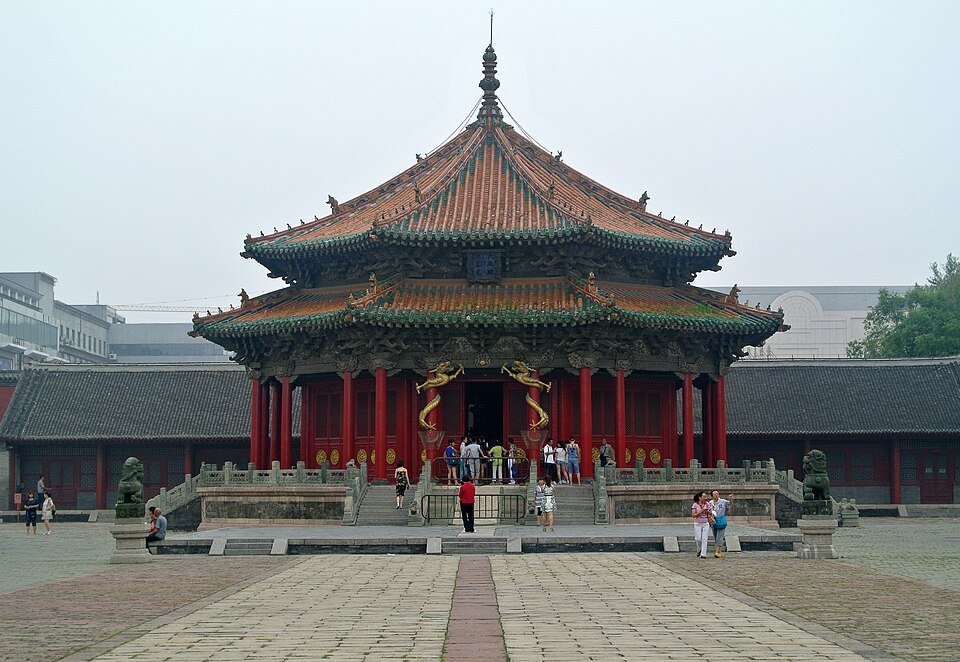
Its eastern group is especially distinctive: an octagonal Dazheng Hall faces the Ten Princes' Pavilions in a layout associated with the Eight Banners. In the central group, Chongzheng Hall served government business while the residential palaces rise on a higher platform behind it. Reading these two arrangements together makes the palace's Manchu architectural character much clearer.
Construction began in 1625 under Nurhaci, founder of the Later Jin dynasty, with further building completed by 1631 under his successor, Hong Taiji; the first three Qing emperors lived there until 1644. After the Qing conquest moved the capital to Beijing, the palace lost its status as imperial residence and became a secondary palace, expanded again in 1780 during the Qianlong era. A Museum of Three Eastern Provinces was established there in 1928, renamed the Fengtian Old Palace Museum in 1932 and closed in 1936; a Manchukuo monument built at its southwest corner in 1934 was demolished in 1945.
In the western section, and in the eastern and western subsidiary palaces of the central section, the architecture is built entirely in Han Chinese style. The arrangement in the central section, with the residential quarters set above and the halls used for governance below, is said to derive from a Manchu custom of living on raised ground.
The palace was designated a Major Historical and Cultural Site Protected at the National Level in its first batch in March 1961, and in 2004 was inscribed on the World Heritage List as an extension of the Ming and Qing imperial palaces centred on the Forbidden City in Beijing.
What to look for
- Dazheng Hall and the Ten Princes' Pavilions, expressing the organisation of the Eight Banners.
- Chongzheng Hall and the raised residential area reached through Phoenix Tower.
The surrounding area
Provincial capital base; Fangcheng, Tiexi and Xita are different city districts with distinct reasons to visit.
Location & getting there
Getting to Shenyang Imperial Palace
Use 171 Shenyang Road in Shenhe District; the museum identifies Zhongjie as a nearby metro stop. Check the day's visitor circulation before choosing the eastern or central group first.
Combine your visit
Suggested order within this visit:
-
Dazheng Hall and Ten Princes' Pavilions
Read the early court's banner-based layout.
-
Chongzheng Hall
Compare the main government hall.
-
Phoenix Tower and raised palace courts
See how residential space sits above the ceremonial halls.
This sequence is an editorial suggestion based on the features described in the sources. Access to individual buildings or areas should be checked locally; no travel time or shared admission is implied.
Find Shenyang Imperial Palace
沈阳故宫 · 沈阳市
The pin marks the area, not the entrance.
More places nearby
Approximate straight-line distances between map pins, not travel distances.
Zhang Xueliang Former Residence 张氏帅府
Less than 1 km awayZhang Xueliang's former residence, long known as the Zhang Marshal's Mansion, combines a traditional three-courtyard house with western-style villas. The Daqing Building served as the family's office, while the Xiaoqing Building…
View guide →9.18 Historical Museum 九一八历史博物馆
4 km awayThe 9.18 Historical Museum examines the Mukden Incident of September 1931 through photographs, objects and historical interpretation. Its broken-calendar monument gives the date a forceful physical presence before visitors enter…
View guide →Xinle Ancient Ruins Museum 新乐遗址博物馆
6 km awayXinle Ancient Ruins Museum occupies the actual prehistoric settlement site in northern Shenyang. Its two-part layout is useful: the southern museum explains the finds, then the northern archaeological area places them in a…
View guide →Sources & visit information
The sources below support the place-specific description and arrival information. Suggested combinations are editorial planning ideas; confirm current opening, entry arrangements and transport services for your date.
- Wikipedia: 沈阳故宫 ↗
- Shenyang Palace Museum: palace architecture guide ↗
- Chinese Wikipedia: 沈阳故宫 (revision 94239476, 2026-09-08) ↗
- English Wikipedia: Mukden Palace (revision 1363491002, 2026-07-10) ↗
Visitor information adapted and edited from Wikipedia contributors · CC BY-SA 4.0. Source revision 94187481.
Background paragraphs translated and condensed from Wikipedia contributors, "沈阳故宫", Chinese Wikipedia · CC BY-SA 4.0. Source revision 94239476.
Background paragraphs condensed from Wikipedia contributors, "Mukden Palace", English Wikipedia · CC BY-SA 4.0. Source revision 1363491002.