

Explore the region
Tap any red Chinese text to hear it in Mandarin.
A city between mountain, river and lakes
Yinchuan is the capital of the Ningxia Hui Autonomous Region. The Helan Mountains rise to the west of the Ningxia Plain, while the Yellow River runs through the wider city area. That geography gives Yinchuan an unusual visual rhythm: bare ridges and open sky beside reed-filled lakes, channels and cultivated fields. The contrast is not just a scenic slogan; it explains why a dry northwestern city can feel both broad and water-rich.
Water is part of daily city life as well as a landscape backdrop. Yinchuan is known for its lakes and wetlands, and current local reporting describes people walking or cycling beside waterways, visiting Yuehai Lake, and exploring the reed channels at Mingcui Lake. These are useful places to slow down and observe the city’s relationship with the Yellow River plain rather than treating Yinchuan only as a gateway to desert scenery. Seasonal boating, opening arrangements and individual park services still need checking for your date.
Western Xia in the landscape
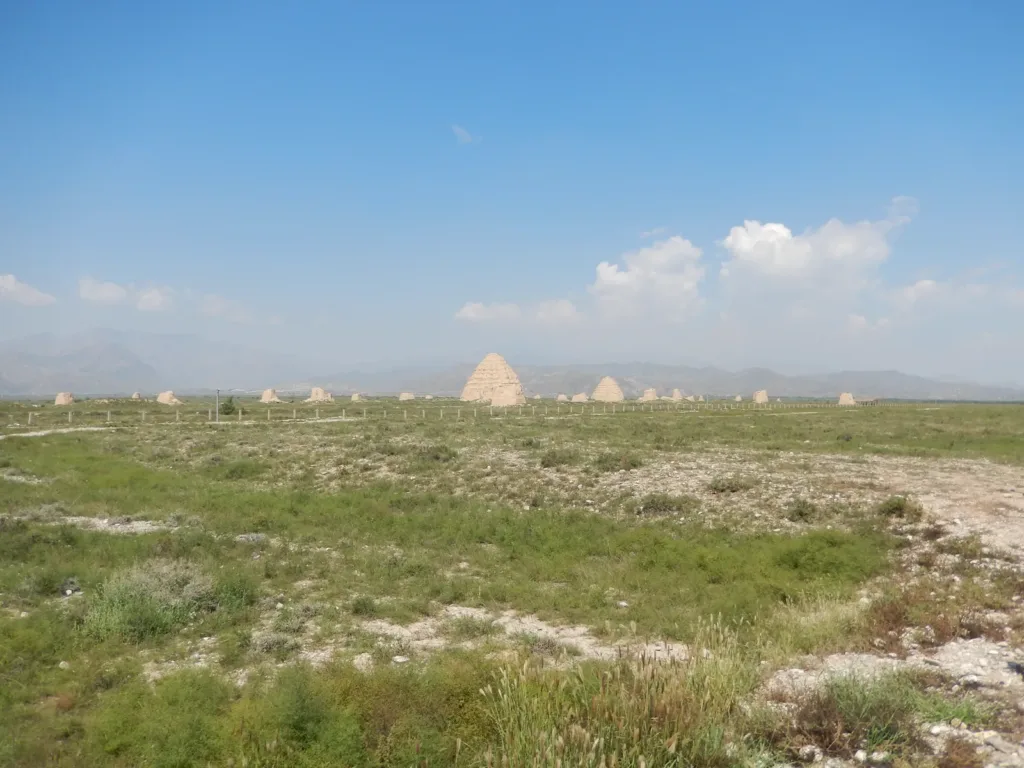
Yinchuan’s historical identity is closely tied to the Western Xia, the Tangut-ruled state that lasted from 1038 to 1227. At the eastern foot of the Helan Mountains, the Xixia Imperial Tombs preserve nine imperial tombs, 271 subordinate tombs and other archaeological remains across a large protected landscape. The site was added to the UNESCO World Heritage List in 2025, so the tombs are not simply isolated earthen mounds: their layout, building traditions and mountain setting record cultural exchange along the Silk Road.
For a first look at that history, the Ningxia Museum in Jinfeng District, on the east side of People’s Square, provides regional context through archaeology, history and local culture. Its displays include the Gilded Bronze Ox, the Strongman-shaped Stone Pedestal with Inscriptions and the stone doors carved with Sogdian Whirl Dancers. Start with the museum if you want the tombs and the wider history to make sense, then reserve the Helan foothills and Xixia Imperial Tombs for a separate outing rather than squeezing both into an urban walk.
Food and everyday texture
Yinchuan is a practical place to try Ningxia food in an ordinary setting. Look for hand-grasped lamb (手抓羊肉) or lamb saozi noodles (羊肉臊子面); lamb offal soup (羊杂碎) is another local-style option if you enjoy stronger aromas and varied textures. Recipes and seasoning differ between kitchens, so ask what is in the broth, whether offal is included and how chilli is served. Do not infer that a dish is vegetarian or free of allergens from its appearance.
Eight-Treasure Tea (八宝茶) is a Ningxia regional drink made by combining tea with a selection of local ingredients. It is also described as a marker of cultural exchange and unity in the region. In Yinchuan, it makes a gentle companion to a lamb meal, but the exact blend varies; ask what is in the bowl if you need to avoid nuts, dried fruit or other ingredients.
The eastern foothills of the Helan Mountains add another layer to the city’s present-day identity: vineyards and independently operated wineries sit in the same broad mountain-and-irrigation landscape that frames the older heritage sites. A winery visit is a separate regional experience, not a reason to treat every vineyard as part of central Yinchuan; check the individual estate’s current visitor arrangements before setting out.
Getting there and moving around
Check the exact Chinese station or airport printed on your ticket. Rail travellers may arrive at Yinchuan Railway Station (银川站), then continue to a hotel or city sight by taxi, ride-hailing or a current local bus service. For the return, go back to 银川站 Yínchuān Zhàn rather than assuming that directions for the airport or another station will apply.
Air travellers use Yinchuan Hedong International Airport (银川河东国际机场). The airport is also served by Hedong Airport Station (河东机场站): a 2026 China Civil Aviation News report describes the high-speed-rail connection beside the terminal, with a 68-metre transfer and about a three-minute walk between the station and check-in area. If your ticket names 河东机场站 Hédōng Jīchǎng Zhàn, follow the signed rail-to-terminal route and use the same named station for the return connection.
For the first and last kilometre, keep the Chinese destination ready: 宁夏博物馆 Níngxià Bówùguǎn is at the east side of People’s Square in Jinfeng District; other searches may use 银川鼓楼 Yínchuān Gǔlóu, 鸣翠湖 Míngcuì Hú or 西夏陵 Xīxià Líng. The map pin for a city is not a visitor entrance. Do not rely on a fixed taxi fare, journey time or an unverified seasonal bus; check the current route, entrance and return connection in Amap or Apple Maps, and confirm venue notices before leaving.
Combine your visit
Choose from these complementary stops when planning your visit.
-
Ningxia Museum宁夏博物馆
Begin with regional historical context.
-
Xingqing old city兴庆老城
Group the central heritage landmarks together.
-
Western Xia tombs on another outing另行安排西夏陵
Reserve a separate road trip for the foothill cemetery.
This is a suggested combination, not a timed route; confirm the opening and transport arrangements for your date.
Find Yinchuan overview
银川 · 银川
The pin marks the area, not the entrance.
More places nearby
Approximate straight-line distances between map pins, not travel distances.
Ningxia Science and Technology Museum 宁夏科技馆
Less than 1 km awayNingxia Science and Technology Museum offers hands-on exhibits in Yinchuan’s People’s Square museum area. Its programme connects general science with regional themes such as soil conservation and desertification, making the…
View guide →Ningxia Museum 宁夏博物馆
Less than 1 km awayNingxia Museum introduces the region through archaeology, art and local history. Notable collection pieces include carved tomb doors showing the whirling Hu dance, a gilded bronze ox and a stone support carved as a strongman…
View guide →Ningxia Geological Museum 宁夏地质博物馆
2 km awayNingxia Geology Museum connects the region’s rocks and fossils with the larger story of Earth. Mineral specimens and geological displays explain the resources beneath the desert and mountain landscapes visitors see elsewhere in…
View guide →Sources & visit information
Sources checked on 24 October 2026. Hours, tickets, reservations and transport can change; confirm with the operator before you go.
Image credits & notes (1)
- Western Xia imperial tombs, Tombs 1 and 2, at the eastern foot of the Helan Mountains near Yinchuan, Ningxia. Photo: BabelStone (Andrew West)Photo: CC BY-SA 3.0