

Photo adjustments
Proportionally resized and converted to WebP without cropping, retouching or changing the photographed subject.
Explore the region
About Zhongwei Gaomiao
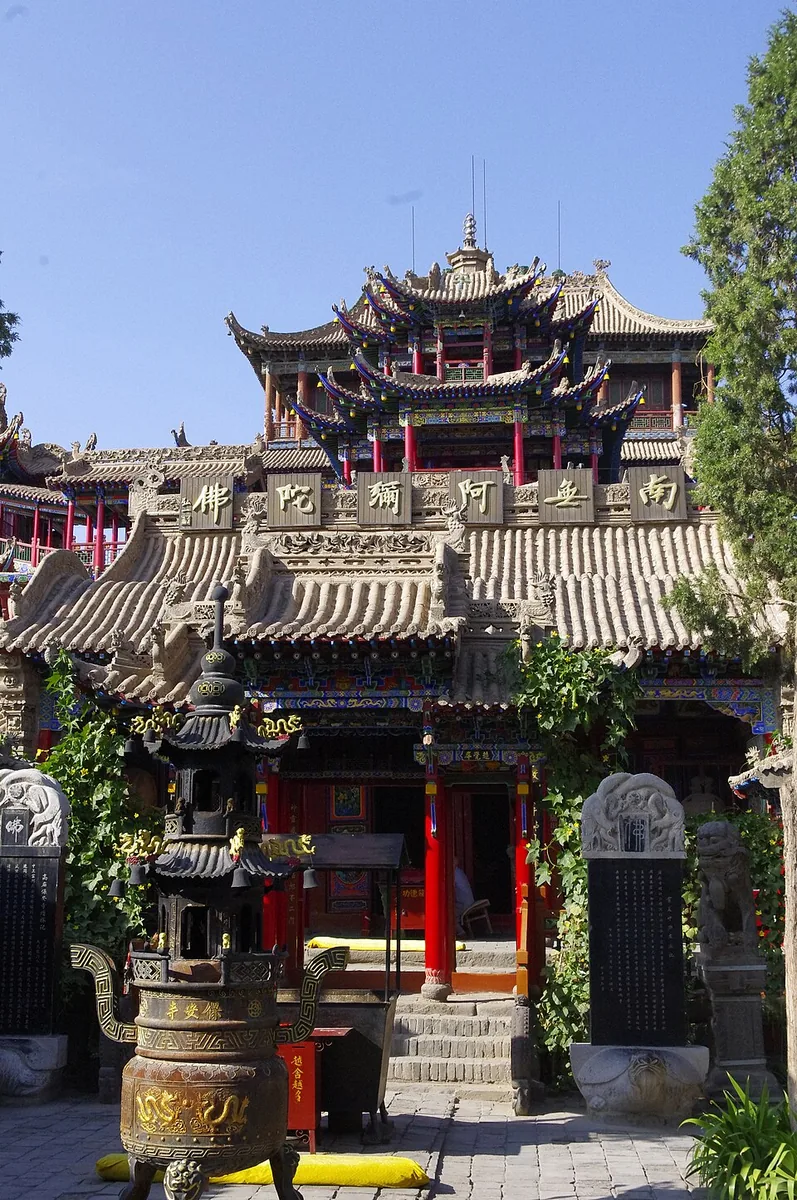
Buddhist, Daoist and Confucian elements share the complex. The Mahavira Hall, South Heavenly Gate and upper pavilions are linked by steps and galleries, creating a striking roofscape within a compact footprint. Rebuilding and restoration are part of its history, so the surviving ensemble reflects several periods.
The temple, also called Bao'an Temple (保安寺) and originally Xin Miao (新庙), was established before the Ming dynasty and reached its present form when the Mahavira Hall and central tower were added in the Yongle era (永乐). It was destroyed by an earthquake in 1709, the 48th year of the Kangxi era (康熙), rebuilt as a Jade Emperor pavilion, then destroyed again in 1739, the third year of the Qianlong era (乾隆), and rebuilt at once. Rebuilding followed in 1822, 1858 and 1882, adding the Tianchi (天池) pavilions.
A fire during a temple fair on 31 March 1942 destroyed the central tower and part of the main temple; repairs begun in June 1943 added a bell tower, drum tower and monks' quarters, completed in 1947. During the Cultural Revolution its statues were smashed, relics destroyed and monks expelled, and heritage authorities then took over the site. Restoration began in 1979, the temple reopened for Buddhist activities in 1982, and a consecration ceremony was held on 27 March 1986.
The temple was listed as an Autonomous-Region-Level Protected Cultural Site (自治区级文物保护单位) in 1963 and as a Major Historical and Cultural Site Protected at the National Level (全国重点文物保护单位) in 2013. Its Qing-era Tianchi (天池) pavilions are linked beneath the steps by a tunnel called the 'Hell Reincarnation Cave' (地狱轮回洞).
What to look for
- Rising platforms and connecting galleries create a compact architectural maze.
- The halls combine Buddhist, Daoist and Confucian traditions.
The surrounding area
The desert-and-river landscape around Shapotou, suitable for a distinct scenic stay.
Location & getting there
Getting to Zhongwei Gaomiao
Use Gaomiao/Bao’an Temple in central Zhongwei’s Shapotou District. Start from the southern public entrance and follow the open stair route; some upper or enclosed areas may have separate access limits.
Combine your visit
Choose from these complementary stops when planning your visit.
-
Lower courtyard下层院落
See the Mahavira Hall and first platform.
-
South Heavenly Gate南天门
Follow the permitted connection to the upper levels.
-
Upper roofscape上层楼阁景观
Look across the interlocking roofs from open areas.
This is a suggested combination, not a timed route; confirm the opening and transport arrangements for your date.
Find Zhongwei Gaomiao
中卫高庙 · 中卫
The pin marks the area, not the entrance.
More places nearby
Approximate straight-line distances between map pins, not travel distances.
Zhongwei Drum Tower 中卫鼓楼
Less than 1 km awayZhongwei’s Drum Tower anchors the intersecting streets of the old town. The upper timber building rises in several tiers above a substantial base, creating a recognisable skyline from each approach. The monument’s history…
View guide →Zhongwei Xiangshan Park 中卫香山公园
3 km awayXiangshan Park provides a lakeside green space in southern Zhongwei, away from the busier old-town monuments. Paths around Xiangshan Lake and planted banks make it suitable for an unhurried walk or a break between journeys…
View guide →Jinsha Island · Tengger Desert Wetland 腾格里沙漠湿地·金沙岛旅游区
7 km awayLakes, reeds and flower gardens on the Tengger Desert's edge near Zhongwei, with seven linked lakes, a 30 m sand hill and Great Wall remains.
View guide →Sources & visit information
The linked encyclopedia sources support background and place descriptions. Current opening hours, ticket prices, booking rules and transport schedules have not been independently verified for this guide. Confirm them with the venue or operator before travelling.
- 中卫高庙 — Wikipedia geographic and historical reference ↗
- Chinese Wikipedia: 中卫高庙 (revision 89571711, 2025-10-18) ↗
Geographic and historical facts selectively adapted from Wikipedia contributors, 中卫高庙 · CC BY-SA 4.0. Source revision 89571711.
Background paragraphs translated and condensed from Wikipedia contributors, "中卫高庙", Chinese Wikipedia · CC BY-SA 4.0. Source revision 89571711.