

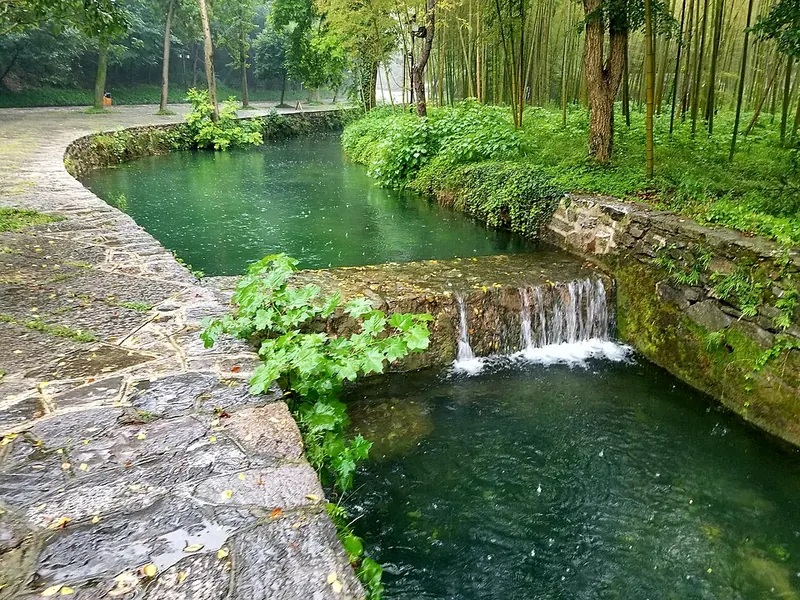
Photo adjustments
Full frame retained; proportionally resized and converted to WebP. No retouching or changes to the photographed subject. Card displays may crop the view.
Explore the region
About Mount Langya
Wooded slopes, springs and lake scenery surround a group of historic pavilions and temple buildings.
Zuiweng Pavilion is closely associated with Ouyang Xiu’s writing. Langya Temple and Shenxiu Lake provide different focuses within the same mountain area. Select an internal route linking the features that interest you rather than assuming every named sector is close together.
The mountain lies near Jiankang (建康, present-day Nanjing), the capital of the Eastern Jin dynasty. It is said to take its name from Sima Rui (司马睿), later Emperor Yuan of Jin, who took refuge here during the period when he held the title Prince of Langya. Mount Langya is designated a National Forest Park (国家森林公园), a National Key Scenic Area (国家重点风景名胜区) and a national 5A-level tourist area (国家AAAAA级旅游区). Its main peak, Xiaofeng Mountain (小丰山), rises to 321 meters.
What to look for
- Zuiweng Pavilion supplies the landscape’s best-known literary association.
- Langya Temple and Shenxiu Lake combine religious architecture and water scenery.
Location & getting there
Getting to Mount Langya
Approach the Mount Langya scenic area southwest of Chuzhou and choose an entrance serving the pavilion or temple route.
- Confirm the selected entrance and current internal access before departure.
Combine your visit
A suggested sequence through the source-confirmed features.
-
Zuiweng Pavilion醉翁亭
Begin with the pavilion associated with Ouyang Xiu’s writing.
-
Shenxiu Lake
Compare the literary landmark with the mountain’s lake scenery.
-
Langya Temple
Finish with the separate Buddhist architectural setting.
The sequence is editorial. Check local access and connections between sectors; no walking time or same-ticket access is promised.
Find Mount Langya
琅琊山 · 滁州市
The pin marks the area, not the entrance.
More places nearby
Approximate straight-line distances between map pins, not travel distances.
Zuiweng Pavilion 醉翁亭
2 km awayZuiweng Pavilion owes its literary identity to Ouyang Xiu’s essay about enjoying the mountains with the people of Chuzhou. The present pavilion belongs to later rebuilding, surrounded by a wooded landscape that helps explain the…
View guide →Caishiji 采石矶
66 km awayCaishiji is a rocky promontory on the eastern bank of the Yangtze in western Ma’anshan. The narrowed river channel made the area important in river defence, including the Song-period Battle of Caishi.
View guide →Ma'anshan Museum 马鞍山市博物馆
72 km awayMa’anshan Museum connects the city’s Yangtze-side position with a longer history of regional exchange. Its local-history exhibition moves from the meeting of Wu and Chu traditions through the Six Dynasties and the area’s poetic…
View guide →Sources & visit information
The sources below support the place-specific description and arrival information. Suggested combinations are editorial planning ideas; confirm current opening, entry arrangements and transport services for your date.
- www.wikidata.org ↗
- 琅琊山 ↗
- Chinese Wikipedia: 琅琊山 (revision 86493940, 2025-03-19) ↗
- English Wikipedia: Mount Langya (Anhui) (revision 1369573749, 2026-08-15) ↗
Visitor information adapted and edited from Wikipedia contributors, “琅琊山” · CC BY-SA 4.0. Source revision 86493940.
Background paragraphs translated and condensed from Wikipedia contributors, "琅琊山", Chinese Wikipedia · CC BY-SA 4.0. Source revision 86493940.
Background paragraphs condensed from Wikipedia contributors, "Mount Langya (Anhui)", English Wikipedia · CC BY-SA 4.0. Source revision 1369573749.