

Photo adjustments
Full frame retained; proportionally resized and converted to WebP. No retouching or changes to the photographed subject. Card displays may crop the view.
City & district guides
About Shou County
The city walls and moat give the settlement its outline, while Bao’en Temple, the Confucian temple and mosque reveal different religious traditions within it. At Bao’en, the Qing-period arhat sculptures add a particularly tangible focus. The streets also contain later repairs and adapted shopfronts, so look for individual monuments and surviving details rather than assuming every building shares the walls’ age.
Shou County stood at a crossroads of north-south routes and repeatedly served as a capital: the Chu state moved its capital here late in the Warring States period, and the Western Han kingdom of Huainan, together with Yuan Shu and the Liu Song state, were later based here as well. Archaeologists have identified the Chu capital site southeast of the present county town, near Dongjin ferry. South of the town stands Anfeng Tang (安丰塘), a large irrigation work built by the Chu minister Sunshu Ao that remains in use today as a reservoir.
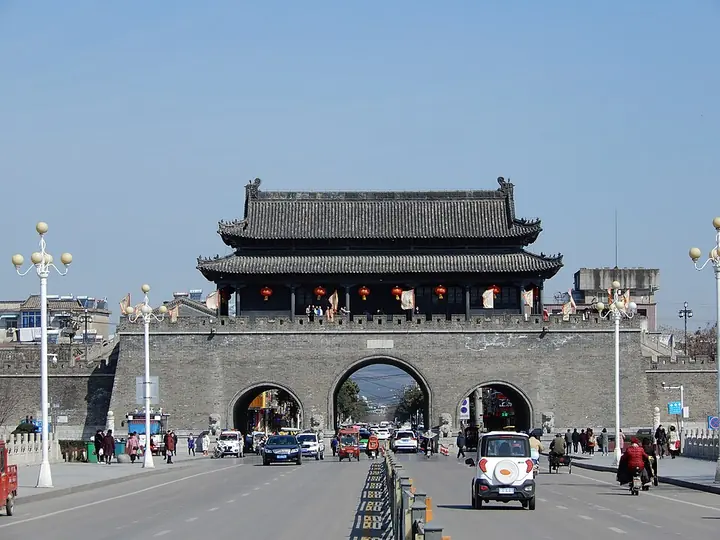
In the Song dynasty the town became the seat of Shouchun Prefecture. The city walls built at that time survive today, running 7,417 meters and ranked among China's seven best-preserved ancient city walls, noted for their flood-control function; in the severe Jianghuai flood of 1991 the walled town sheltered about 300,000 refugees. Inside the walls, Bao'en Temple, the mosque and the Confucian temple were all built in the Tang dynasty, giving them histories of more than 1,300 years.
What to look for
- The old city walls, gates and moat defining the historic centre.
- Bao’en Temple’s Qing-period arhat sculptures and the religious buildings within the walls.
Background & history
Shou County or Shouxian (simplified Chinese: 寿县; traditional Chinese: 壽縣; pinyin: Shòu Xiàn) is a county in the north-central part of Anhui Province, China, and is located on the southern (right) bank of the Huai River. It is the southernmost county-level division of the prefecture-level city of Huainan. It is a National Cultural and Historical City. The jurisdiction of Shou County was transferred 3 December 2015 from Lu'an to Huainan. Shou County has jurisdiction over 17 towns, 7 townships and 1 ethnic township. The seat of Shou County is Shouchun.
Excerpt from Wikipedia: Shou County · Wikipedia contributors · CC BY-SA 4.0. Selected introductory sentences; formatting simplified. Background information, not current visitor-service advice.
Location & getting there
Getting to Shou County
Use the Shouzhou Ancient City visitor centre and Binyang Gate on the east side of the walled town. East Street leads into the historic centre and towards the Bao’en Temple quarter.
Combine your visit
A suggested sequence linking the specific features of this visit.
-
Binyang Gate and city wall
Read the defensive outline before entering the town.
-
Bao’en Temple
Focus on the temple and its arhat sculptures.
-
Confucian temple
Compare the educational and ritual precinct with the Buddhist temple.
This order is editorial. Confirm access and any transfers between stops; it does not establish a walking route, same-day connection or common admission ticket.

Find Shou County
寿县 · 淮南市
The pin marks the area, not the entrance.
More places nearby
Approximate straight-line distances between map pins, not travel distances.
Shou County City Wall寿县古城墙
4 km awayShou County’s city wall preserves a complete sense of an enclosed historic town. Its four gates are Binyang, Tongfei, Dinghu and Jinghuai, and their barbicans remain important parts of the defensive layout.
View guide →Balihe Scenic Area八里河风景区
46 km awayBalihe mixes a broad lake landscape with deliberately constructed miniature monuments and gardens. The western section presents interpretations of world landmarks, including the Arc de Triomphe and a Greek temple, while the…
View guide →Shuangdun site双墩遗址
69 km awayShuangdun is a Neolithic terrace site in Shuangdun village, north of the Huai River at Bengbu. Its archaeological remains date back more than seven millennia.
View guide →Sources & visit information
The sources below support the place-specific description and arrival information. Suggested combinations are editorial planning ideas; confirm current opening, entry arrangements and transport services for your date.
- Shou County ↗
- www.shouxian.gov.cn ↗
- wlj.huainan.gov.cn ↗
- Chinese Wikipedia: 寿县 (revision 88598062, 2025-08-05) ↗
Visitor information adapted and edited from Wikipedia contributors, “Shou County” · CC BY-SA 4.0. Source revision 1331073507.
Background paragraphs translated and condensed from Wikipedia contributors, "寿县", Chinese Wikipedia · CC BY-SA 4.0. Source revision 88598062.