

Photo adjustments
Resized and WebP compressed; subject not altered.
Explore the region
About Badachu
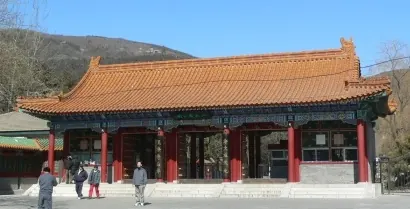
Its name refers to eight sites, so the attraction is a landscape of separate compounds rather than one temple courtyard. Lingguang Temple, Dabei Temple, Xiangjie Temple, and Baozhu Cave are among the named places in the complex. Choose a limited temple route and let the hillside setting shape the day; reaching every upper site involves a different outing from seeing the lower compounds and their architecture.
The temples were built during the Sui, Tang, Ming, and Qing dynasties, and the Qing-dynasty Minister of Rites Guiqing (贵庆) lived here in retirement in his later years. They were damaged by the Eight-Nation Alliance in 1900, and after 1949 the complex was restored and opened as Badachu Park; during the Cultural Revolution, Buddha statues and ritual objects at the temples suffered severe damage. Religious activity gradually stopped at the temples, though Lingguang Temple resumed it in the 1980s under the China Buddhist Association.
The temples are spread across three hills at the southern foot of Beijing's Western Hills (西山): Cuiwei Mountain (翠微山), formerly called Pingpo Mountain (平坡山), the highest of the three and home to five of the temples; Jue Mountain (觉山), popularly known as Hutou Mountain (虎头山), with two temples; and Lushi Mountain (卢师山), which holds Zhengguo Temple and, according to local tradition, is where a monk named Lu Shi tamed two dragons at the end of the Sui dynasty and buried them.
In 1957 'Xishan Badachu' (西山八大处) was placed on the first list of Beijing Municipal Cultural Relics Protection Units (北京市文物保护单位). Badachu Park is also rated a national AAAA-level tourist attraction (国家AAAA级旅游景区) and designated one of Beijing's model parks; the five-character park name was written by Zhao Puchu (赵朴初).
What to look for
- Lingguang Temple: look at the pagoda and the temple’s position within the lower religious landscape.
- Dabei and Xiangjie temple settings: compare separate compounds on the wooded slopes rather than treating them as one building.
Location & getting there
Getting to Badachu
The complex lies at the foot of the Western Hills in Shijingshan. Use Badachu Park as the arrival destination and select a temple circuit from the entrance map.
- The temples occupy different heights and slopes; a direct line between map pins is not a pedestrian route through the park.
Combine your visit
Suggested order within this visit:
-
Lingguang Temple
Begin with a principal temple and its pagoda setting.
-
Dabei Temple
Add a second compound to compare the architecture and hillside placement.
These are selected sites within Badachu. Follow the signed path and adapt the climb to current access and your group; the sequence does not claim that all eight sites are open or easily linked.
Find Badachu
八大处 · 石景山区
The pin marks the area, not the entrance.
More places nearby
Approximate straight-line distances between map pins, not travel distances.
Fahai Temple (Beijing) 法海寺
2 km awayFahai Temple preserves Ming murals in the Moshikou area of Shijingshan. The paintings reward close attention to faces, garments, and especially the delicate gauze around Water-and-Moon Guanyin. The temple setting also includes a…
View guide →Fragrant Hills 香山
4 km awayFragrant Hills, or Xiangshan, rises at the edge of Beijing’s Western Hills with wooded slopes and the remains of an imperial garden. The park offers two different emphases: the northern area links Spectacles Lake, Jianxin Zhai…
View guide →Beijing Botanical Garden 国家植物园北园
5 km awayThe former Beijing Botanical Garden is now the North Garden of the China National Botanical Garden, below the Western Hills. Its appeal extends beyond flower beds: the conservatory brings tropical vegetation and succulents…
View guide →Sources & visit information
The sources below support the place-specific description and arrival information. Suggested combinations are editorial planning ideas; confirm current opening, entry arrangements and transport services for your date.
- Wikipedia: Badachu ↗
- Wikivoyage: Beijing/Shijingshan ↗
- Chinese Wikipedia: 八大处 (revision 92021254, 2026-03-24) ↗
Visitor information adapted and edited from Wikipedia contributors · CC BY-SA 4.0. Source revision 1367597421.
Visitor information adapted and edited from Wikivoyage contributors · CC BY-SA 4.0.
Background paragraphs translated and condensed from Wikipedia contributors, "八大处", Chinese Wikipedia · CC BY-SA 4.0. Source revision 92021254.
Background paragraphs condensed from Wikipedia contributors, "Badachu", English Wikipedia · CC BY-SA 4.0. Source revision 1367597421.