

Photo adjustments
Proportionally resized and converted to WebP without cropping, retouching or changing the photographed subject.
Explore the region
About Ming tombs
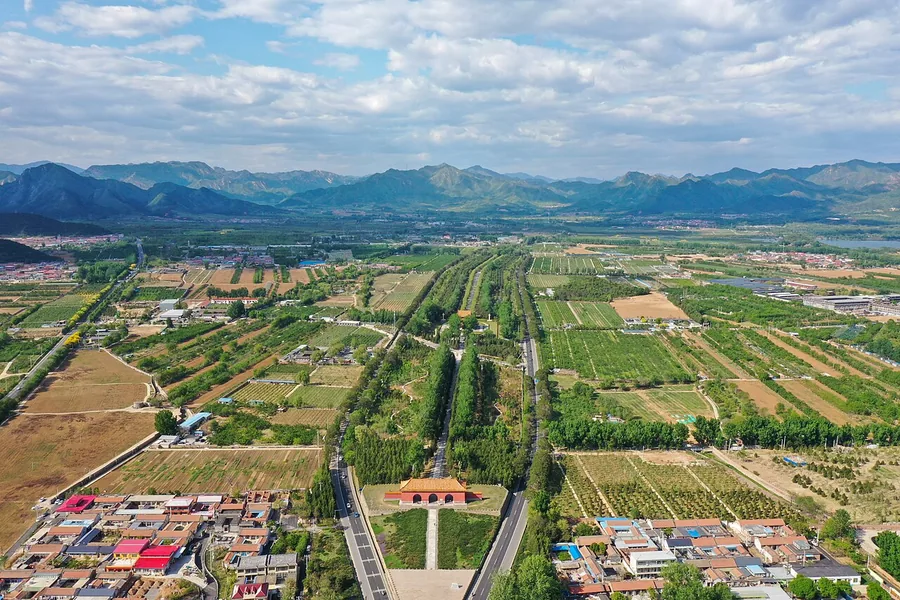
The Sacred Way introduces the ceremonial landscape through stone animals and officials. Changling emphasizes monumental timber architecture, especially its Ling'en Hall, while Dingling offers the unusual chance to see an excavated imperial underground palace. These are dispersed sites rather than rooms within one complex. Additional tombs have opened under guided or reservation arrangements, so choose the specific compounds you want instead of relying on older descriptions that only a few can ever be visited.
The complex originated with the Yongle Emperor's Changling (长陵), built from 1409 to 1413 on a site he chose and named Tianshou Shan; he died in 1424 and was buried there, though Changling was not completed until 1427. Only thirteen of the Ming dynasty's sixteen emperors were buried here: the founding Hongwu Emperor was buried at Nanjing, the Jianwen Emperor disappeared without a tomb, and the Jingtai Emperor was buried separately west of Beijing before his tomb was later enlarged. Changling, the Jiajing Emperor's Yongling (永陵) and the Wanli Emperor's Dingling (定陵) were built during their occupants' lifetimes and are the largest; others were begun only after death.
The tomb complex occupies a basin below Tianshou Shan, part of the Taihang mountain range, which connects west to Juyongguan pass and north to Huanghua town and forms a protective screen north of Changping and the capital. Considering the site auspicious by feng shui, the Ming planted the area mainly with pine and cypress trees.
The tombs were designated a Major Historical and Cultural Site Protected at the National Level (全国重点文物保护单位) in 1961 and inscribed on the World Heritage List in 2003, together with the Qing Eastern and Western Tombs. Today Changling, Dingling, Zhaoling (昭陵), Kangling (康陵) and the Sacred Way are open to visitors; the other tombs remain closed.
What to look for
- The Sacred Way's procession of carved stone animals and human figures.
- Changling's Ling'en Hall, noted for its large timber columns and ceremonial scale.
- Dingling's excavated underground palace, associated with the Wanli Emperor and two empresses.
Location & getting there
Getting to Ming tombs
Use Shisanling Town in Changping as the area anchor, then set navigation to the specific Sacred Way or tomb entrance.
- Allow road transfers between compounds. The similarly named subway station is not an entrance to all thirteen tombs.
Combine your visit
Suggested order within this visit:
-
Sacred Way
Begin with the ceremonial approach and its stone figures.
-
Changling
Compare the above-ground halls with the ceremonial avenue.
-
Dingling
Finish with the excavated burial chambers if included in your booking.
This sequence is an editorial suggestion based on the features described in the sources. Access to individual buildings or areas should be checked locally; no travel time or shared admission is implied.
Find Ming tombs
明十三陵 · 昌平区
The pin marks the area, not the entrance.
More places nearby
Approximate straight-line distances between map pins, not travel distances.
Yinshan Pagoda Forest 银山塔林
8 km awayYinshan Pagoda Forest combines historic Buddhist pagodas with a mountain landscape in Changping. The dark rock faces at the mountain’s foot explain the associated name Iron Wall, while winter snow inspired the Silver Mountain…
View guide →Juyong Pass 居庸关
14 km awayJuyong Pass occupies the Guangou Valley in Changping, where the Great Wall guarded a strategic approach toward Beijing. The landscape makes the defensive purpose clear: walls rise on the surrounding slopes while the route passes…
View guide →Huanghuacheng 黄花城水长城
15 km awayHuanghuacheng’s Lakeside Great Wall brings the defensive line into unusually close contact with reservoir water in Huairou. The wall follows the surrounding hills, while the lake interrupts and frames its route, including…
View guide →Sources & visit information
The sources below support the place-specific description and arrival information. Suggested combinations are editorial planning ideas; confirm current opening, entry arrangements and transport services for your date.
- Wikipedia: Ming tombs ↗
- Beijing Government: Jingling Tomb opens and current Ming Tomb access ↗
- Beijing Government: Ming Tombs location and layout ↗
- Beijing Magazine: Ming Tombs architecture ↗
- Chinese Wikipedia: 明十三陵 (revision 93387496, 2026-07-09) ↗
Visitor information adapted and edited from Wikipedia contributors · CC BY-SA 4.0. Source revision 1368100796.
Background paragraphs translated and condensed from Wikipedia contributors, "明十三陵", Chinese Wikipedia · CC BY-SA 4.0. Source revision 93387496.
Background paragraphs condensed from Wikipedia contributors, "Ming tombs", English Wikipedia · CC BY-SA 4.0. Source revision 1368100796.