

Photo adjustments
Proportionally resized and converted to WebP without cropping, retouching or changing the photographed subject.
Explore the region
About Yinshan Pagoda Forest
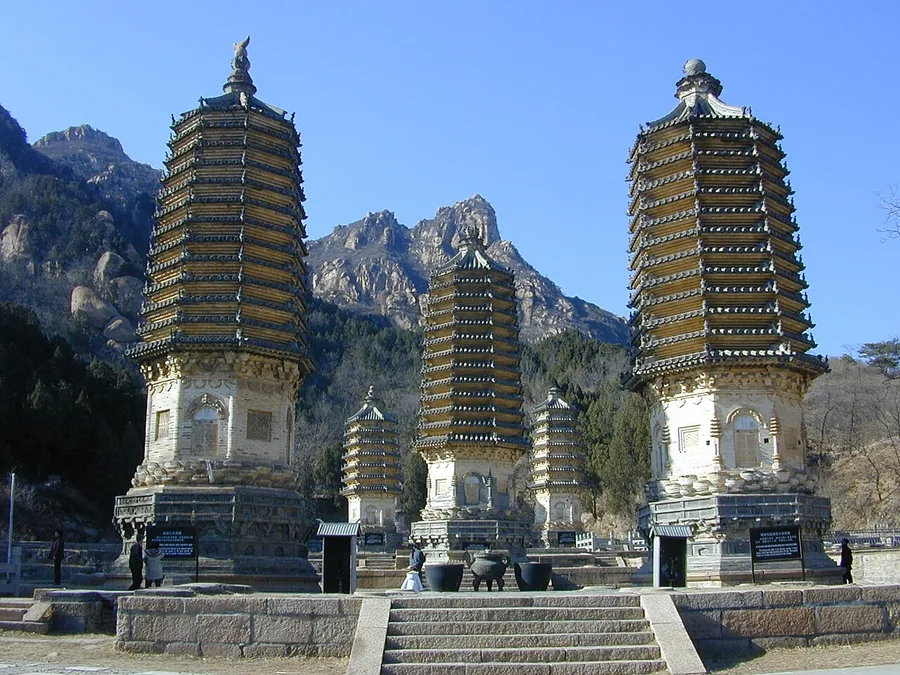
The dark rock faces at the mountain’s foot explain the associated name Iron Wall, while winter snow inspired the Silver Mountain name. The pagodas preserve the religious importance of a landscape that once held several temples, including the Fahua Temple setting. A visit works best as a close comparison of the surviving towers against the surrounding cliffs and trees. The sources differ on how many structures they count, so the architectural group and landscape matter more than a repeated headline total.
Monks established temples around the mountain during the Tang dynasty. Dayansheng Temple (大延圣寺), also known as Yanshou Temple (延寿寺), was founded in 1125 during the Jin dynasty. Wu Liang (吴亮) restored it in 1437, when it received the name Fahua Temple (法华寺). Nearby temples were demolished and the pagodas damaged in 1941. The towers later underwent repeated repairs and were listed as a Major Historical and Cultural Site Protected at the National Level (全国重点文物保护单位) in 1988.
Five Jin-dynasty funerary pagodas with closely spaced eaves stand within the Fahua Temple ruins in a plum-blossom arrangement. Fojue Pagoda (佛觉塔) occupies the centre. It has an octagonal plan, thirteen tiers of eaves and a height of 20.1 metres, supported by a two-tiered pedestal. Its body is solid, with carved imitation doors and windows. Additional pagodas from the Yuan and Ming periods are scattered around the surrounding hillsides.
What to look for
- Ancient pagoda group: compare the towers’ proportions, tiered silhouettes, and decorative surfaces.
- Iron Wall and Silver Mountain setting: look at the dark cliffs and the wooded slopes behind the religious remains.
Location & getting there
Getting to Yinshan Pagoda Forest
The municipal tourism reference places the scenic area by Haizi Village in Changping. Use Yinshan Pagoda Forest as the final destination.
- Keep the visit centered on signed pagoda and mountain paths; the site is distinct from the Ming Tombs valley even when both appear in regional itineraries.
Combine your visit
Suggested order within this visit:
-
Main pagoda group
Begin by comparing the surviving towers.
-
Temple-remains setting
Relate the pagodas to the former Buddhist compounds.
-
Cliff-and-mountain viewpoint
Finish with the landscape that gave the site its name.
This sequence is an editorial suggestion based on the features described in the sources. Access to individual buildings or areas should be checked locally; no travel time or shared admission is implied.
Find Yinshan Pagoda Forest
银山塔林 · 昌平区
The pin marks the area, not the entrance.
More places nearby
Approximate straight-line distances between map pins, not travel distances.
Ming tombs 明十三陵
8 km awayThe Ming Tombs occupy a broad valley in Changping, where thirteen emperors were buried in separate compounds set against the surrounding mountains. The Sacred Way introduces the ceremonial landscape through stone animals and…
View guide →Huanghuacheng 黄花城水长城
10 km awayHuanghuacheng’s Lakeside Great Wall brings the defensive line into unusually close contact with reservoir water in Huairou. The wall follows the surrounding hills, while the lake interrupts and frames its route, including…
View guide →Chinese Aviation Museum 中国航空博物馆
15 km awayThe Chinese Aviation Museum at Datangshan brings a large aircraft collection into the setting of a former airbase. Part of the museum uses a cavern cut into the mountain, while the collection includes aircraft from the propeller…
View guide →Sources & visit information
The sources below support the place-specific description and arrival information. Suggested combinations are editorial planning ideas; confirm current opening, entry arrangements and transport services for your date.
- Yinshan Pagoda Scenic Area: landscape and history ↗
- Yin Mountain Pagoda Forest: Haizi Village setting ↗
- Chinese Wikipedia: 银山塔林 (revision 92021247, 2026-03-24) ↗
Background paragraphs translated and condensed from Wikipedia contributors, "银山塔林", Chinese Wikipedia · CC BY-SA 4.0. Source revision 92021247.