

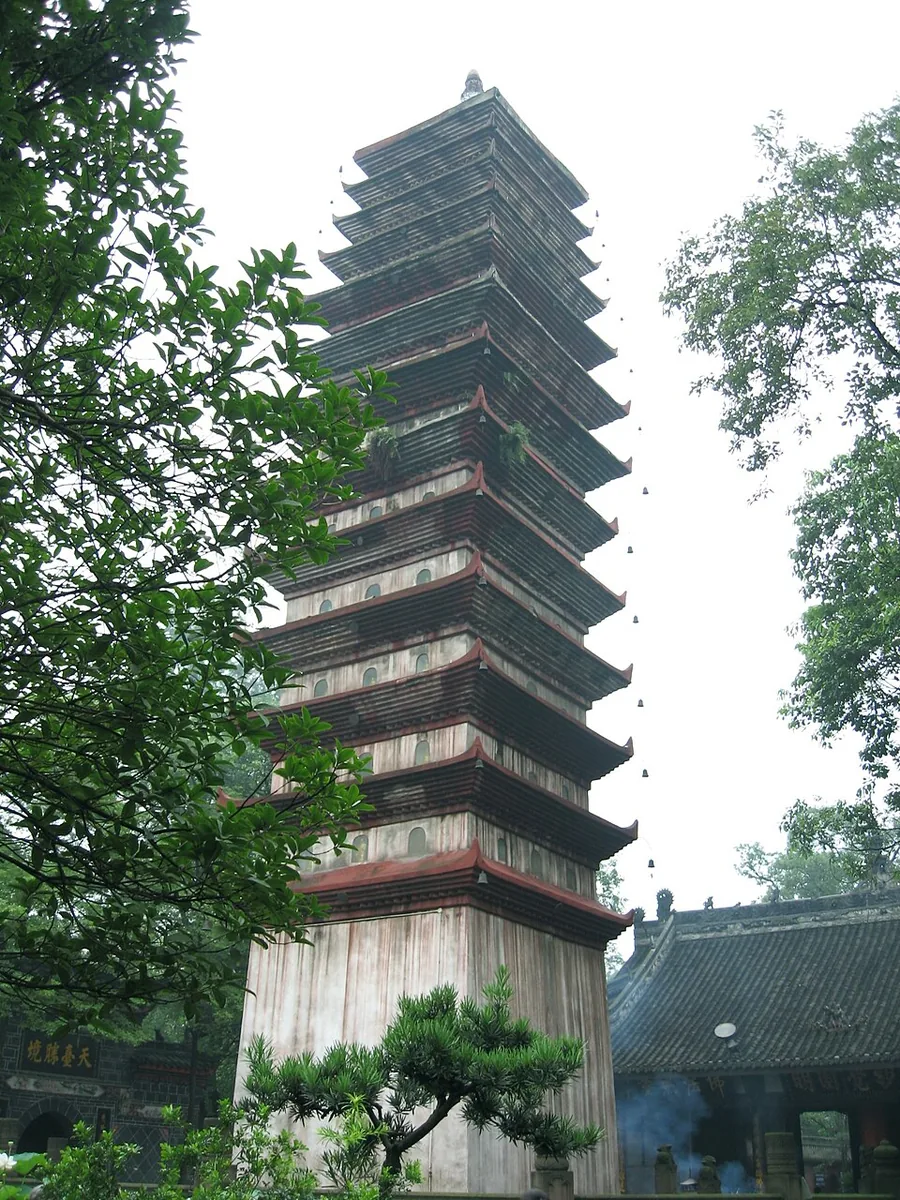
Photo adjustments
Converted to WebP and resized without changing the subject or cropping the source frame.
Explore the region
About Baoguang Temple
The solid pagoda is viewed from outside, where the closely spaced roofs and slight lean are visible. Inside the Arhat Hall, clay figures have individual expressions and poses, offering a very different rhythm from the repeated pagoda tiers. Build the visit around those two elements before exploring the other open halls.
The temple was first built during the Tang dynasty, on a site covering 100,000 square meters supported by more than 400 large stone pillars; it burned down during the Ming dynasty and was rebuilt following the reign of the Kangxi Emperor (1654-1722) in the Qing dynasty. Its pagoda, the only part still dating from the Tang, was built between 862 and 888; it partially collapsed soon afterward, and when the upper section was restored during the Ming dynasty, the seventh floor and those above it were built tilted slightly to the west rather than to the original proportions, giving the pagoda its noticeable lean.
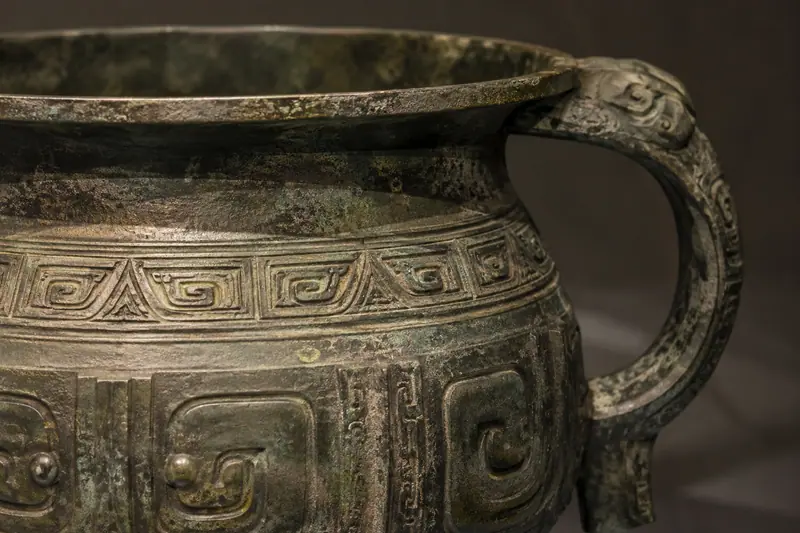
The temple holds a Tang-dynasty sarira stupa, a Liang-dynasty jade Buddha and stone sarira pagoda, a bronze tripod from the Shu Han era, a Tang-dynasty pottery pagoda from the Xianqing era, and a Yuan-dynasty copy of the Avatamsaka Sutra written in gold and silver ink, along with sarira relics and palm-leaf sutras. It was listed as one of Sichuan's first Historical and Revolutionary Cultural Relic Protection Units on 16 August 1956, re-listed as a Sichuan cultural relic protection unit on 7 July 1980, and included in the fifth group of Major Historical and Cultural Sites Protected at the National Level on 25 June 2001.
What to look for
- The central stupa has thirteen tiers with upturned eaves and a visible lean.
- The Arhat Hall contains a large gathering of individually modelled clay figures.
Location & getting there
Getting to Baoguang Temple
The temple entrance is on Baoguang Street in central Xindu, at number 81. Arrange the final local connection to this temple frontage rather than a general Xindu destination.
Combine your visit
Suggested order for the visit:
-
Central stupa exterior
Observe the tiered roofs and alignment.
-
Arhat Hall
Compare the figures’ expressions and poses.
-
Other open temple halls
Continue according to the worship and visitor arrangements.
This is an editorial sequence of named spaces or places. It does not imply a verified walking connection or promise opening, ticket availability or a journey time.
Find Baoguang Temple
宝光寺 · 新都区
The pin marks the area, not the entrance.
More places nearby
Approximate straight-line distances between map pins, not travel distances.
Guihu Park 桂湖公园
1 km awayGuihu is Xindu’s historic garden associated with the Ming scholar Yang Shen, also known as Yang Sheng’an. The lake, covered links and pavilions create a compact classical garden, while the museum introduces Yang Shen, his wife…
View guide →Nibatuo Scenic Park 泥巴沱风景区
5 km awayNibatuo occupies a bend of the Pi River south of Xindu, where the water curves around a peninsula. The old river-trade setting has become a recreation landscape with bamboo, woodland and waterside paths. The river bend is the…
View guide →Chengdu Botanical Garden 成都植物园
8 km awayChengdu Botanical Garden combines specialist plant collections with a plant-science exhibition hall. Seasonal flowers are an attraction, but the labelled trees and conservation work give the visit substance beyond blossom…
View guide →Sources & visit information
The sources below support the place-specific description and arrival information. Suggested combinations are editorial planning ideas; confirm current opening, entry arrangements and transport services for your date.
- Baoguang Temple ↗
- Buddhist temple directory: Xindu Baoguang Temple ↗
- Chinese Wikipedia: 宝光寺 (revision 85491400, 2024-12-30) ↗
- English Wikipedia: Baoguang Temple (revision 1317488749, 2025-10-18) ↗
Visitor information adapted and edited from Wikipedia contributors, “Baoguang Temple” · CC BY-SA 4.0. Source revision 1317488749.
Background paragraphs translated and condensed from Wikipedia contributors, "宝光寺", Chinese Wikipedia · CC BY-SA 4.0. Source revision 85491400.
Background paragraphs condensed from Wikipedia contributors, "Baoguang Temple", English Wikipedia · CC BY-SA 4.0. Source revision 1317488749.