

Photo adjustments
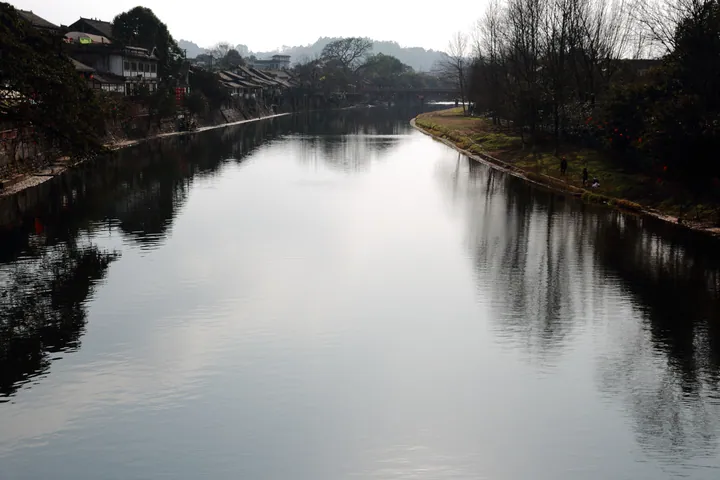
Full frame retained; proportionally resized and converted to WebP. No retouching or changes to the photographed subject. Card displays may crop the view.
Explore the region
About Pingle Ancient Town
Leshan Bridge gives the town a clear landmark and a useful starting point for understanding the old crossing and waterfront. The visit works well at a slower pace, with time for a riverside tea stop. The Western Sichuan Bamboo Sea is a separate nearby attraction, so add it only with its own entry and transport arrangements.
Pingle's old name was Pingluo (平落). The settlement had already become a market town by the Western Han dynasty. A Pingluo township (平落乡) was established in 1940; the township was abolished and Pingle became a town (镇) in 1983, and it took its present name, Pingle, in 1993. In December 2019 the administrative areas of Qinghua Community (青华社区), Zhenghang Village (郑航村) and Baotang Village (包塘村), previously under Linji (临济镇), were transferred to Pingle's jurisdiction.
Pingle is designated one of China's Historical and Cultural Famous Towns (中国历史文化名镇). In 2023 it was named one of China's top 100 cultural towns (中国文化百强镇) in the second such listing. The town lies 15 kilometres (9.3 mi) south-southwest of Qionglai City, in the west of Sichuan province at the western edge of the Sichuan Basin and in the foothills of the Qionglai Mountains.
What to look for
- Leshan Bridge spans the Baimo River at the heart of the historic town.
- Riverside buildings, old trees and stone lanes preserve the trading-town atmosphere.
Location & getting there
Getting to Pingle Ancient Town
Travel via Qionglai to Pingle Ancient Town and use the visitor approach around Xingxin Street. Continue on foot through the historic centre; arrange the return transfer before adding an outlying bamboo-forest visit.
Combine your visit
Choose from these complementary stops when planning your visit.
-
Leshan Bridge乐善桥
Begin with the bridge and river crossing.
-
Riverside lanes白沫江河岸老街
Explore the old buildings and waterfront.
-
Riverside tea stop临江茶馆
Allow time to enjoy the town between walks.
This is a suggested combination, not a timed route; confirm the opening and transport arrangements for your date.
Find Pingle Ancient Town
平乐古镇 · 邛崃市
The pin marks the area, not the entrance.
More places nearby
Approximate straight-line distances between map pins, not travel distances.
Western Sichuan Bamboo Sea 川西竹海
3 km awayWestern Sichuan Bamboo Sea combines a bamboo-covered valley near Pingle with modern elevated walking facilities. The lower stream setting and Jinji bridge provide a quieter landscape, while high bridges and glass sections create…
View guide →Qiong Kiln Site 邛窑遗址
12 km awayQiong Kiln Archaeological Park explains the ceramic industry that flourished around Qionglai. The Shifangtang site forms the visitor core, with protected kiln remains and exhibitions showing how local pottery was made and…
View guide →Shixiang Lake 石象湖
19 km awayShixiang Lake combines wooded water inlets with landscaped flower gardens in Pujiang. The lake’s narrow bays create a more enclosed setting than Chengdu’s broad urban lakes, while the planted lawns and flower areas offer a…
View guide →Sources & visit information
The sources below support the place-specific description and arrival information. Suggested combinations are editorial planning ideas; confirm current opening, entry arrangements and transport services for your date.
- Pingle visitor reference: Baimo River, Leshan Bridge and Xingxin Street approach ↗
- Chinese Wikipedia: 平乐镇 (邛崃市) (revision 92487689, 2026-05-01) ↗
- English Wikipedia: Pingle, Sichuan (revision 1373653750, 2026-09-07) ↗
Background paragraphs translated and condensed from Wikipedia contributors, "平乐镇 (邛崃市)", Chinese Wikipedia · CC BY-SA 4.0. Source revision 92487689.
Background paragraphs condensed from Wikipedia contributors, "Pingle, Sichuan", English Wikipedia · CC BY-SA 4.0. Source revision 1373653750.