

Photo adjustments
Proportionally resized and converted to WebP without cropping, retouching or changing the photographed subject.
Explore the region
About Furong Cave
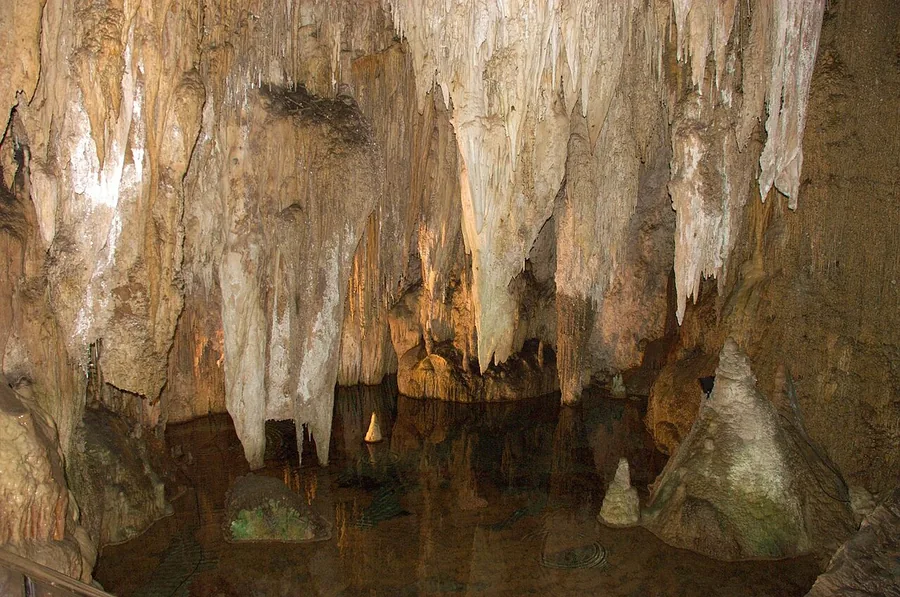
The contrast between smooth draped deposits and finer clustered growth is the main visual interest. Follow the managed cave route and use the geological interpretation to distinguish the formations. The river and cave are related parts of the landscape, but a river excursion has separate access and operating arrangements.
Furong Cave was discovered in 1993 and opened to tourists in 1994. It was rated a national 4A tourist attraction in 2002. Joint Sino-British and Sino-British-American scientific expeditions investigated the cave system between 1994 and 2001, eventually mapping its extensive underground river network. In June 2007 the cave was listed, together with the Furong River, as part of the South China Karst UNESCO World Heritage Site, the first cave in China included on the World Heritage list, and in 2011 it was rated a national 5A tourist attraction.
The cave is 2846 metres long and 30 to 50 metres wide, and is divided into three sections: the first features colourful subterranean formations, while the other two focus on the science of cave formation. It contains more than 30 named features, including a stone waterfall (巨型石) 15.76 and 21.04 metres high, at the foot of which coral-like mineral projections extend up to 120 centimetres. Within an area of about 20 square kilometres around the cave there are more than 50 vertical shafts deeper than 100 metres, including the 920-metre Steam Shaft (汽坑洞), the deepest in Asia.
What to look for
- The large stone-waterfall formation spreads over the cave wall.
- Coral-like mineral growth provides a finer contrast to the broad deposits and chambers.
Location & getting there
Getting to Furong Cave
Travel by road to the Furong Cave Tourist Centre in Jiangkou Town, Wulong, near the meeting of the Furong and Wu rivers. Confirm the managed transfer included in your cave visit before continuing uphill.
Combine your visit
Suggested order for the visit:
-
Cave entrance
Read the visitor-route and geological information.
-
Large chambers
Observe the scale of the underground spaces.
-
Stone waterfall and finer formations
Compare the different mineral shapes along the managed path.
This is an editorial sequence of named spaces or places. It does not imply a verified walking connection or promise opening, ticket availability or a journey time.
Find Furong Cave
芙蓉洞 · 武隆
The pin marks the area, not the entrance.
More places nearby
Approximate straight-line distances between map pins, not travel distances.
Wulong Karst 武隆喀斯特
13 km awayWulong Karst is a group of separate landscapes rather than one continuous park entrance. The Three Natural Bridges show limestone on a monumental outdoor scale, while Furong Cave reveals mineral formations inside the rock. The…
View guide →Ayi River 阿依河
21 km awayThe Ayi River cuts a wooded limestone canyon outside Pengshui, with cliff paths, caves and water-based excursions offering different ways to explore it. Qinglong Valley is the place to focus on the rock walls and vegetation from…
View guide →Wulong Three Natural Bridges 武隆天生三桥
26 km awayThe Three Natural Bridges form a sequence of large limestone arches within Wulong’s karst landscape. Named Tianlong, Qinglong and Heilong, the bridges span spaces cut into the rock by water and collapse. Their different shapes…
View guide →Sources & visit information
The sources below support the place-specific description and arrival information. Suggested combinations are editorial planning ideas; confirm current opening, entry arrangements and transport services for your date.
- Furong Cave ↗
- Wikivoyage: Wulong ↗
- Chinese Wikipedia: 芙蓉洞 (revision 64693852, 2021-03-09) ↗
- English Wikipedia: Furong Cave (revision 1365733429, 2026-07-24) ↗
Visitor information adapted and edited from Wikipedia contributors, “Furong Cave” · CC BY-SA 4.0. Source revision 1365733429.
Visitor information adapted and edited from Wikivoyage contributors, Wulong · CC BY-SA 4.0. Source revision 5340122.
Background paragraphs translated and condensed from Wikipedia contributors, "芙蓉洞", Chinese Wikipedia · CC BY-SA 4.0. Source revision 64693852.
Background paragraphs condensed from Wikipedia contributors, "Furong Cave", English Wikipedia · CC BY-SA 4.0. Source revision 1365733429.