

Photo adjustments
Proportionally resized and converted to WebP without cropping, retouching or changing the photographed subject.
Explore the region
About Sanfang Qixiang
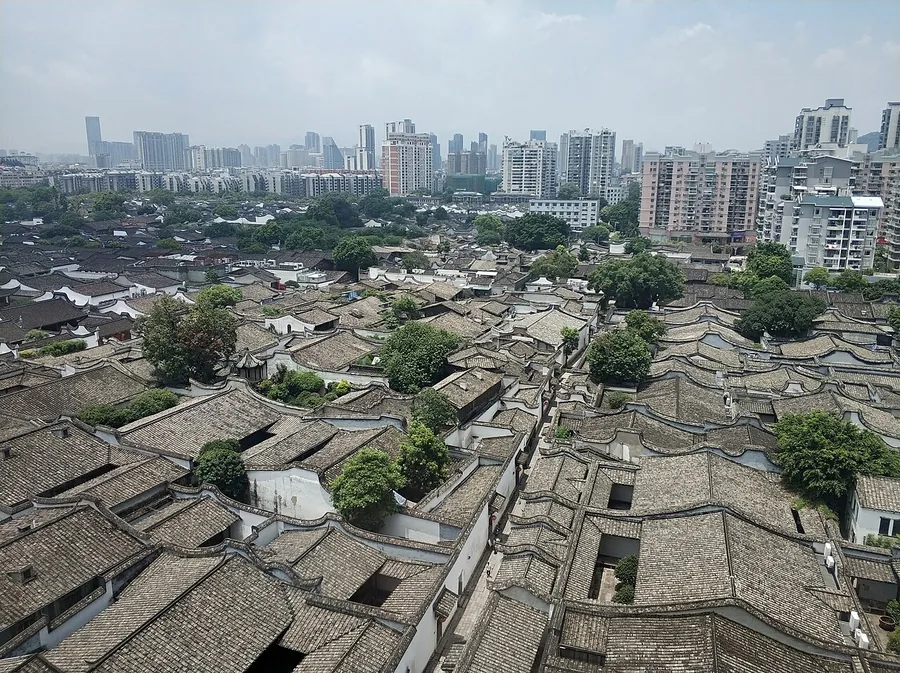
The contrast between the commercial spine and enclosed courtyard houses makes the old ward layout easy to read. Yijin Lane contains a residence with a waterside theatre, while Wenru Lane recalls the scholarly households once concentrated here. Restoration has shaped much of the present visitor setting, and some houses remain private, so enter only buildings explicitly open to visitors.
People arriving from the Central Plains (中原) settled outside the old city's southern gate at the end of the Western Jin dynasty. The area was brought within Fuzhou's outer wall in the late Tang dynasty, following the residential-ward layout of Chang'an. The Southern Song gazetteer Sanshan Zhi (三山志) recorded nine of the present lanes, by then an area of scholar-official households. The collective name Sanfang Qixiang began to appear during the middle of the Qing dynasty.
In 2006, the district and the buildings of Zhuzi Fang (朱紫坊) were listed in the sixth batch of Major Historical and Cultural Sites Protected at the National Level (全国重点文物保护单位). Protection and restoration work formally began at the end of that year. The district joined the first group of China's Historic and Cultural Streets (中国历史文化名街) in 2009 and the World Heritage Tentative List (世界遗产预备名单) in 2013. It received a national 5A tourist attraction (国家5A级旅游景区) rating in 2015.
What to look for
- The contrast between Nanhou Street’s shopfronts and the enclosed residential lanes.
- Yijin Lane’s waterside theatre and the courtyard-house setting of Wenru Lane.
The surrounding area
The provincial capital offers historic residences and a specific broth-and-snack food culture.
Location & getting there
Getting to Sanfang Qixiang
Approach Nanhou Street from Yangqiao Road at the northern end or from the Dongjiekou area to the east. Use No 4 Yijin Lane for the theatre residence, checking its separate entry arrangements.
Combine your visit
A suggested sequence linking the specific features of this visit.
-
Nanhou Street
Read the north-south commercial spine of the quarter.
-
Yijin Lane
Seek the waterside theatre in the publicly accessible residence.
-
Wenru Lane
Compare the quieter courtyard-house street with the main shopping axis.
This order is editorial. Confirm access and any transfers between stops; it does not establish a walking route, same-day connection or common admission ticket.
Find Sanfang Qixiang
三坊七巷 · 福州市
The pin marks the area, not the entrance.
More places nearby
Approximate straight-line distances between map pins, not travel distances.
Lin Zexu Memorial Museum 林则徐纪念馆
Less than 1 km awayThe Lin Zexu memorial occupies the ancestral shrine built in his honour on Aomen Road. Courtyards, ceremonial halls and inscriptions frame an account of the Fuzhou-born official whose career included the campaign against the…
View guide →Wu Mountain 乌山
Less than 1 km awayWu Mountain is a compact hill of rock ledges, inscriptions and shaded paths in central Fuzhou. The Black Pagoda marks its lower slopes, while calligraphy cut into the stone turns the climb into a record of the city’s literary…
View guide →Yu Mountain 于山
1 km awayYu Mountain is a small hill in central Fuzhou with a concentration of temples, inscriptions and memorial buildings. The White Pagoda marks its lower approach, while Qi Gong Shrine connects the site with the memory of the Ming…
View guide →Sources & visit information
The sources below support the place-specific description and arrival information. Suggested combinations are editorial planning ideas; confirm current opening, entry arrangements and transport services for your date.
- www.wikidata.org ↗
- 三坊七巷 ↗
- Sanfang Qixiang ↗
- Fuzhou ↗
- Chinese Wikipedia: 三坊七巷 (revision 92057113, 2026-03-27) ↗
Visitor information adapted and edited from Wikipedia contributors, “三坊七巷” · CC BY-SA 4.0. Source revision 92057113.
Visitor information adapted and edited from Wikipedia contributors, “Sanfang Qixiang” · CC BY-SA 4.0. Source revision 1365995995.
Visitor information adapted and edited from Wikivoyage contributors, listing “Three Lanes and Seven Alleys” · CC BY-SA 4.0.
Background paragraphs translated and condensed from Wikipedia contributors, "三坊七巷", Chinese Wikipedia · CC BY-SA 4.0. Source revision 92057113.