

Explore the region
A small hill with several kinds of history
Yu Mountain is one of central Fuzhou’s traditional “Three Hills”, alongside Wushan and Pingshan. It is not a remote mountain excursion. Its paths rise quickly from the city and pass between trees, exposed rock, pavilions and separate historic compounds. That compact scale makes it useful for an hour or two of close looking: you can see a landmark associated with Fuzhou’s old skyline, military memory connected with Qi Jiguang, and writing carved into the living rock in one visit.
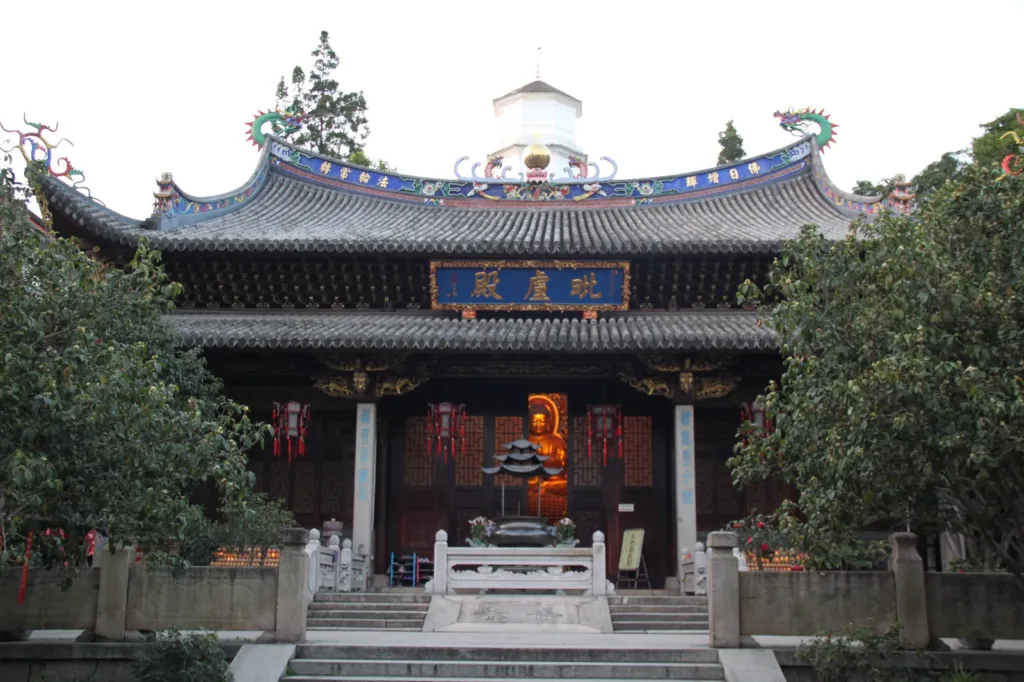
Begin on the White Pagoda and Dingguang Temple side. The White Pagoda is a seven-storey, octagonal tower within the temple complex; its pale surface is the reason the familiar name “White Pagoda” took hold. Treat the pagoda as a visual anchor, not as proof that every temple building or tower interior is open. The restored approach from the temple side includes the Ming-city-wall staircase, while the park’s improvement works also connected the Dingguang Temple side with the hill paths.
What to look for on the climb
At Qi Jiguang Shrine, look for the way a memorial building turns a military story into a local place of remembrance. The shrine commemorates Qi Jiguang’s campaign in Fujian against coastal raiders; the present hall dates to around 1918, according to a local historical account. Read the displays and inscriptions as part of the site’s later memory, and keep the shrine’s role as a memorial distinct from the older rock-carving landscape around it.
The cliff inscriptions are the best reason to slow down. Yu Mountain retains 110 inscriptions dating from the Song period to modern times, distributed around Aofeng Peak, Lion Rock, Kuoran Terrace, the orchid garden and Qi Jiguang Shrine. The earliest identified Song-period carving is a 990 inscription by Lü Wenzhong at Aofeng Peak; the large Inscription on the Training Ground Hall on the southern side is reported as 3.3 metres high. Do not look only for a single “famous stone”. Compare the scripts, dates and relationship between lettering and rock surface, and read the carvings in place rather than touching, tracing or climbing on them.
A sensible first visit is to enter from the Wuyi North Road side, find the White Pagoda and Dingguang Temple setting, then follow signed paths to the shrine and the inscription areas that are open. This is an observing sequence, not a guaranteed continuous route: the hill contains steps, separate compounds and structures with their own access conditions. Check signs at each gate, wear shoes suitable for stone steps, and avoid entering closed areas or using the carved rocks as seats.
Getting there and returning
For public transport, take Fuzhou Metro Line 1 or Line 2 to Nanmendou Station (南门兜站). A local transport guide lists Exit G1 for the southern/western approach, about 300 metres to the south or west gates, and Exit A1 for the northern approach, about 600 metres to the north gate; exits and pedestrian links can change, so confirm the station signs on the day. The latest Gulou District route article identifies Nanmendou as the metro station for the Wushan–Yu Mountain area and describes the Wuyi North Road side as the Yu Mountain approach.
Buses listed for the Yu Mountain (Union Hospital) / 于山(协和医院) stop include K3, 8, 16, 86, 97, 101, 103, 106, 122, 125, 133, 173 and 303, with the guide associating it with the south and west gates. The Longhua Overpass / 龙华天桥 stop is listed for the north and east sides, with routes including K1, K3, 2, 19, 51, 52, 60, 64, 69, 74, 76, 80, 86, 88, 106, 122, 129, 130, 133, 301 and 303. These route lists come from a 2021 local guide, so check the current stop display and service before boarding.
Return through the signed gate you used and retrace the route to Nanmendou Station, or use the corresponding bus stop on the same side of the hill. Do not assume that every gate leads to the same street or that a temple-side path remains open after a particular building closes. The current Gulou feature describes the Three Hills as free public parks, but opening hours, reservation requirements and building-level access should be checked in the current notice before setting out.
Combine your visit
A suggested sequence linking the specific features of this visit.
-
White Pagoda
Begin with the hill’s most visible landmark.
-
Qi Gong Shrine
Connect the visit with the memory of Qi Jiguang.
-
Rock-inscription paths
Look for the literary carvings along the open hill route.
This order is editorial. Confirm access and any transfers between stops; it does not establish a walking route, same-day connection or common admission ticket.
Find Yu Mountain
于山 · 福州市
The pin marks the area, not the entrance.
More places nearby
Approximate straight-line distances between map pins, not travel distances.
Lin Zexu Memorial Museum 林则徐纪念馆
1 km awayThe Lin Zexu memorial occupies the ancestral shrine built in his honour on Aomen Road. Courtyards, ceremonial halls and inscriptions frame an account of the Fuzhou-born official whose career included the campaign against the…
View guide →Sanfang Qixiang 三坊七巷
1 km awaySanfang Qixiang is organised around Nanhou Street, with residential lanes extending to either side. The contrast between the commercial spine and enclosed courtyard houses makes the old ward layout easy to read. Yijin Lane…
View guide →Wu Mountain 乌山
1 km awayWu Mountain is a compact hill of rock ledges, inscriptions and shaded paths in central Fuzhou. The Black Pagoda marks its lower slopes, while calligraphy cut into the stone turns the climb into a record of the city’s literary…
View guide →Sources & visit information
Sources checked on 2 November 2026. Hours, tickets, reservations and transport can change; confirm with the operator before you go.
Image credits & notes (1)
- Front façade of Dingguang Pagoda Temple, with the White Pagoda rising above the roof on Yu Mountain, Fuzhou. Photo: Gary Todd (page credits Gary Todd @ Flickr)Photo: Public domain