

Photo adjustments
Proportionally resized and converted to WebP without cropping, retouching or changing the photographed subject.
Explore the region
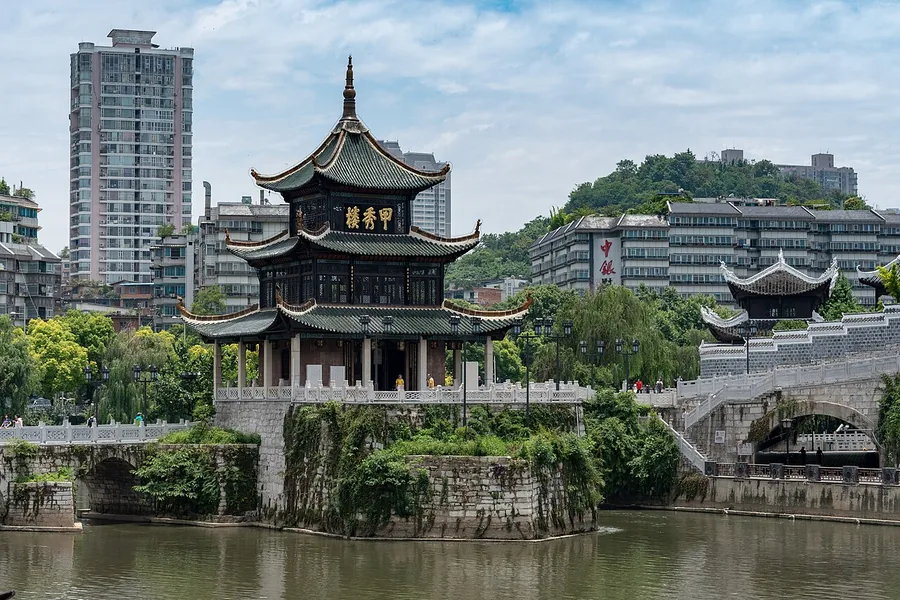
About Jiaxiu Tower
The bridge’s Hanbi Pavilion and the nearby Cuiwei Garden turn the tower into a short sequence of waterside architecture. Look first from the riverbank to see the whole composition, then move towards the bridge for the changing relationship between water, stone and timber. Interior access is separate from enjoying the exterior and river views.
The tower was first built in 1597, during the Wanli era (万历) of the Ming dynasty, when Guizhou governor Jiang Dongzhi (江东之) built a dike linking Aoji Rock (鳌矶石) to the south bank of the Nanming River (南明河) and raised a tower named 'Jiaxiu' for the hope of examination success. It burned down in 1621 and was rebuilt by governor-general Zhu Xieyuan (朱燮元) under the name 'Laifeng Ge' (来凤阁); governor Tian Wen (田雯) rebuilt it again in 1689 and restored its original name. The tower was rebuilt once more in 1909, the form that stands today.
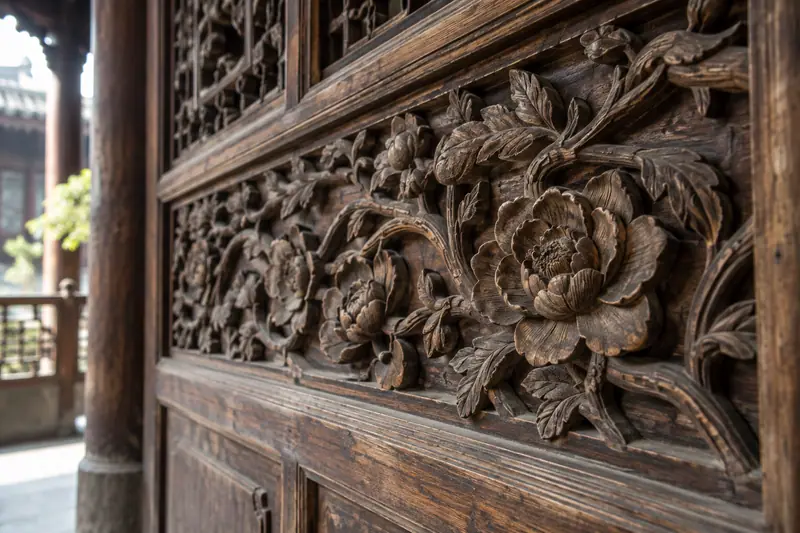
In the Qing dynasty, 'Aoji Fuyu' (鳌矾浮玉) was named one of the eight scenic sights of Guiyang. On 25 May 2006 the State Council approved the tower's inclusion, as a Ming-dynasty building, in the sixth batch of Major Historical and Cultural Sites Protected at the National Level (全国重点文物保护单位). The tower houses numerous stone and wood carvings and works of calligraphy and painting, including a long couplet by the Guiyang scholar Liu Yunliang (刘韫良), ranked alongside similar long couplets at Kunming's Daguan Tower and Chengdu's Wangjiang Tower.
What to look for
- Jiaxiu Tower stands above the river on its rock foundation.
- Fuyu Bridge and Hanbi Pavilion frame the approach to the tower.
The surrounding area
A food-and-city chapter with contemporary cafés, local snacks and river walks.
Location & getting there
Getting to Jiaxiu Tower
Use 8 Cuiwei Lane, Nanming District, as the arrival address. Approach the tower through the riverbank and Fuyu Bridge area, following any current controls on access to the buildings.
Combine your visit
Suggested order for the visit:
-
Riverbank view
See the tower in its river setting.
-
Fuyu Bridge and Hanbi Pavilion
Look at the connected bridge architecture.
-
Cuiwei Garden
Add the neighbouring garden when open.
This is an editorial sequence of named spaces or places. It does not imply a verified walking connection or promise opening, ticket availability or a journey time.
Find Jiaxiu Tower
甲秀楼 · 贵阳
The pin marks the area, not the entrance.
More places nearby
Approximate straight-line distances between map pins, not travel distances.
Guiyang Wenchang Pavilion 贵阳文昌阁
Less than 1 km awayGuiyang’s Wenchang Pavilion stands near the former East Gate, with a roofline that rewards a careful look from below. Its square lower storey changes to nine-sided upper levels, and the repeated roof corners give the building an…
View guide →Yangming Shrine 阳明祠
1 km awayYangming Shrine sits on the lower slopes of Fufeng Hill and commemorates the philosopher Wang Yangming. Its courtyards and corridors preserve a collection of inscriptions, including portraits and texts associated with Wang and…
View guide →Qianling Park 黔灵山公园
4 km awayQianling Park rises through wooded hills within Guiyang. Hongfu Temple and the surrounding hilltop outlooks add architectural and scenic stops, while tea gardens provide a slower part of the visit. Wild monkeys also inhabit the…
View guide →Sources & visit information
The sources below support the place-specific description and arrival information. Suggested combinations are editorial planning ideas; confirm current opening, entry arrangements and transport services for your date.
- 甲秀楼 ↗
- Wikivoyage: Guiyang ↗
- Guizhou People’s Congress: Jiaxiu Tower landscape ↗
- AMap: Jiaxiu Tower ↗
- Chinese Wikipedia: 甲秀楼 (revision 93820075, 2026-08-09) ↗
Visitor information adapted and edited from Wikipedia contributors, “甲秀楼” · CC BY-SA 4.0. Source revision 93820075.
Visitor information adapted and edited from Wikivoyage contributors, Guiyang · CC BY-SA 4.0. Source revision 5250338.
Background paragraphs translated and condensed from Wikipedia contributors, "甲秀楼", Chinese Wikipedia · CC BY-SA 4.0. Source revision 93820075.