

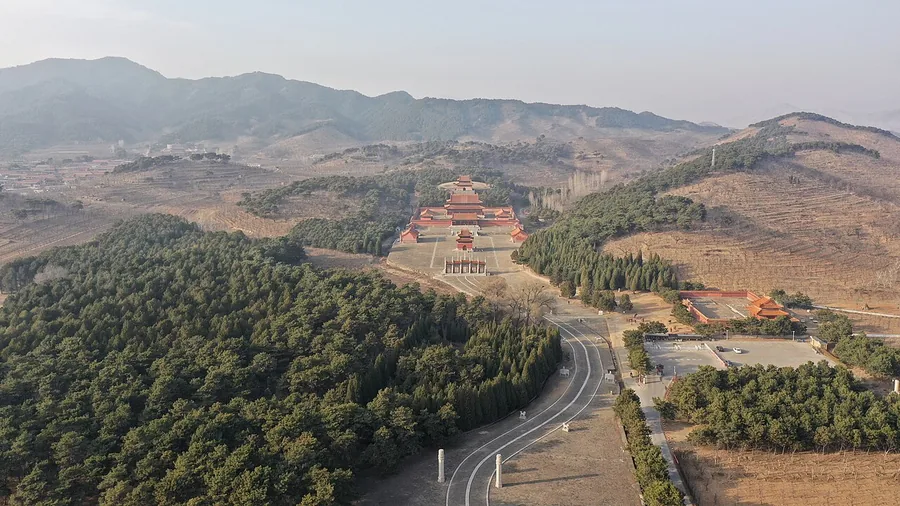
Photo adjustments
Proportionally resized and converted to WebP without cropping, retouching or changing the photographed subject.
Explore the region
About Eastern Qing tombs
The spirit road, ceremonial halls and burial mounds form a sequence intended for imperial ritual, with different compounds repeating and elaborating that pattern. Xiaoling establishes the overall design; Qianlong's Yuling is particularly known for Buddhist carvings and inscriptions in its burial chambers, while Cixi's tomb has richly decorated halls. Choose a few compounds and confirm their current opening arrangements, since this is an extensive necropolis rather than one building.
The Eastern Qing Tombs lie in Zunhua, in the Changrui Mountain area 125 kilometers northeast of Beijing, and were the largest of the Qing dynasty's three major mausoleum complexes. The complex holds five imperial tombs, four empress tombs, five consort tombs and eight princes' tombs, along with further burial sites, some lying across the boundary in Tianjin; all were built during the Qing dynasty, with the last two burials taking place in 1935.
Xiaoling, the first tomb in the complex, was completed in 1663 (Kangxi 2). During construction the Qing court demolished nearby sections of the Great Wall and any earlier temple structures, sparing only a single Erlang Temple, and later barred anyone outside the imperial family from building, gathering firewood or burying the dead within the tomb district. After the fall of the Qing the tombs were looted repeatedly, most seriously by the warlord Sun Dianying in 1928, and were placed under organized state protection in 1952.
Given this troubled history, the complex was nonetheless listed as a Major Historical and Cultural Site Protected at the National Level (全国重点文物保护单位) in 1961, and it was inscribed on the World Heritage List on 30 November 2000, decades after the looting of the early twentieth century.
What to look for
- Xiaoling's spirit-road sculptures and ceremonial approach.
- Yuling's carved Buddhist imagery and inscriptions, when its underground chambers are open.
- The ornate halls of Cixi's tomb compound.
The surrounding area
An eastern provincial city with its own regional snacks and contemporary food-and-leisure districts.
Location & getting there
Getting to Eastern Qing tombs
Use 清东陵景区 in Zunhua, Tangshan. Select the main visitor reception point before proceeding to individual tomb compounds.
- Confirm the current internal transport and open chambers at reception; the burial sites are dispersed across the wider grounds.
Combine your visit
Suggested order within this visit:
-
Xiaoling spirit road
Understand the ceremonial pattern used by the later tombs.
-
Yuling
Examine Qianlong's tomb and its carved chambers if accessible.
-
Cixi's tomb compound
Compare its elaborate hall decoration with the earlier imperial approach.
This sequence is an editorial suggestion based on the features described in the sources. Access to individual buildings or areas should be checked locally; no travel time or shared admission is implied.
Find Eastern Qing tombs
清东陵 · 唐山市
The pin marks the area, not the entrance.
More places nearby
Approximate straight-line distances between map pins, not travel distances.
Jinshanling Great Wall 金山岭长城
64 km awayJinshanling follows a rugged ridge near the boundary of Luanping and Beijing's Miyun area. Its closely spaced towers, barrier walls and changes in masonry give a walk here a strong military-architecture focus as well as broad…
View guide →Kailuan National Mine Park 开滦国家矿山公园
78 km awayKailuan's mine park explains how coal extraction, railway building and company finance helped shape industrial Tangshan. The museum's Black River exhibition starts with the formation of coal and moves into the machinery…
View guide →South Lake Park (Tangshan) 唐山南湖
79 km awayTangshan South Lake occupies former mining-subsidence land that was reshaped into a large urban water-and-garden landscape. It later hosted the 2016 horticultural exposition. The park is divided among named lakes rather than one…
View guide →Sources & visit information
The linked encyclopedia sources support background and place descriptions. Current opening hours, ticket prices, booking rules and transport schedules have not been independently verified for this guide. Confirm them with the venue or operator before travelling.
Visitor information adapted and edited from Wikipedia contributors · CC BY-SA 4.0. Source revision 1370409514.
Background paragraphs translated and condensed from Wikipedia contributors, "清东陵", Chinese Wikipedia · CC BY-SA 4.0. Source revision 90901403.