

Photo adjustments
Wikimedia thumbnail; fitted to the ranking-card frame.
Explore the region
About Putuo Zongcheng Temple
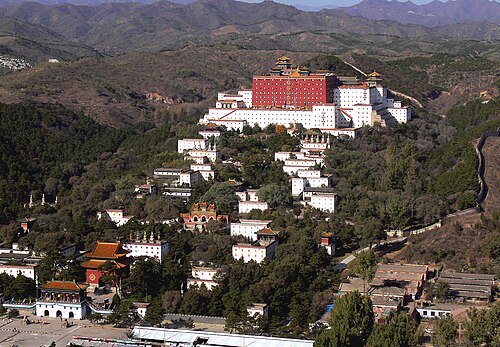
A sequence of gateways and stepped white buildings rises towards the great red terrace, enclosing Wanfaguiyi Hall and its gilded roof. Built for the Qianlong emperor in the eighteenth century, the complex combined Buddhist functions with the reception of visitors from across the empire. Its strongest impression comes from moving gradually up through the grounds and seeing how the smaller gateways prepare for the immense upper mass.
Construction of Putuo Zongcheng Temple began in the third month of the thirty-second year of the Qianlong era (乾隆) of the Qing dynasty (1767) and finished in the eighth month of 1771. Qianlong built it to celebrate the eightieth birthday of his mother, the Empress Dowager Chongqing (崇庆皇太后), and commemorated it with an inscribed stele, the Putuo Zongcheng Zhi Miao Bei (普陀宗乘之庙碑). It was modelled on the Potala Palace in Lhasa, giving it the popular name 'Little Potala Palace'; the names Putuo Zongcheng and Potala share the same origin, meaning 'sacred place of Avalokiteshvara'.
The complex covers about 220,000 square metres and contains more than sixty buildings enclosed by a winding palace wall, arranged according to the slope of the terrain. A five-arch stone bridge crosses the Shizi Gully in front of the temple, leading to a plaza before the main gate.
The temple was listed in the first group of Major Historical and Cultural Sites Protected at the National Level (全国重点文物保护单位) in 1961, and in 1994 it was inscribed, with the Chengde Mountain Resort and its Outlying Temples, as a UNESCO World Heritage Site.
What to look for
- The Five Pagodas Gate and glazed gateway along the approach.
- The great red terrace surrounding Wanfaguiyi Hall's golden roof.
The surrounding area
Northern provincial base for the Mountain Resort and outlying temples; an imperial-landscape itinerary.
Location & getting there
Getting to Putuo Zongcheng Temple
Use 普陀宗乘之庙 north of Chengde Mountain Resort. This is the large Potala-inspired complex, separate from the nearby Xumi Fushou Temple.
- The visit climbs through a hillside arrangement of terraces; check the current route if stairs are a concern.
Combine your visit
Suggested order within this visit:
-
Five Pagodas Gate
Read the lower ceremonial approach.
-
Glazed gateway and ascent
Follow the progression towards the main terrace.
-
Great red terrace and Wanfaguiyi Hall
See the architectural centre of the complex.
This sequence is an editorial suggestion based on the features described in the sources. Access to individual buildings or areas should be checked locally; no travel time or shared admission is implied.
Find Putuo Zongcheng Temple
普陀宗乘之庙 · 承德市
The pin marks the area, not the entrance.
More places nearby
Approximate straight-line distances between map pins, not travel distances.
Xumi Fushou Temple 须弥福寿之庙
1 km awayXumi Fushou Temple was built in 1780 for the Sixth Panchen Lama's visit to the Qianlong emperor, taking inspiration from Tashilhunpo Monastery. Its red terrace encloses Miaogao Zhuangyan Hall, whose gilded roof carries large…
View guide →Chengde Museum 承德博物馆
1 km awayChengde's museum beside Puning Road provides an indoor counterpart to the Mountain Resort and surrounding temples. Its displays explore imperial garden culture, Qing court life and Tibetan-Han Buddhist art, helping explain the…
View guide →Puning Temple (Chengde) 普宁寺
2 km awayPuning Temple combines two different spatial traditions on a single rising axis. The front courts follow a Chinese Buddhist hall arrangement; behind them, a Tibetan-inspired mandala composition surrounds the towering Dacheng…
View guide →Sources & visit information
The linked encyclopedia sources support background and place descriptions. Current opening hours, ticket prices, booking rules and transport schedules have not been independently verified for this guide. Confirm them with the venue or operator before travelling.
Visitor information adapted and edited from Wikipedia contributors · CC BY-SA 4.0. Source revision 1366901335.
Background paragraphs translated and condensed from Wikipedia contributors, "普陀宗乘之庙", Chinese Wikipedia · CC BY-SA 4.0. Source revision 93284675.