

Explore the region
Tap any red Chinese text to hear it in Mandarin.
Why visit
The museum gives the surrounding heritage a useful indoor context. Instead of treating the Mountain Resort and the temples as a collection of unrelated monuments, its displays connect imperial garden design, Qing court life and the Buddhist art preserved in Chengde. The current institution was formed in 2022 by merging the former Mountain Resort Museum, the cultural-relics archive and information centre with Chengde Museum; it was recognised as a national first-grade museum in 2024.
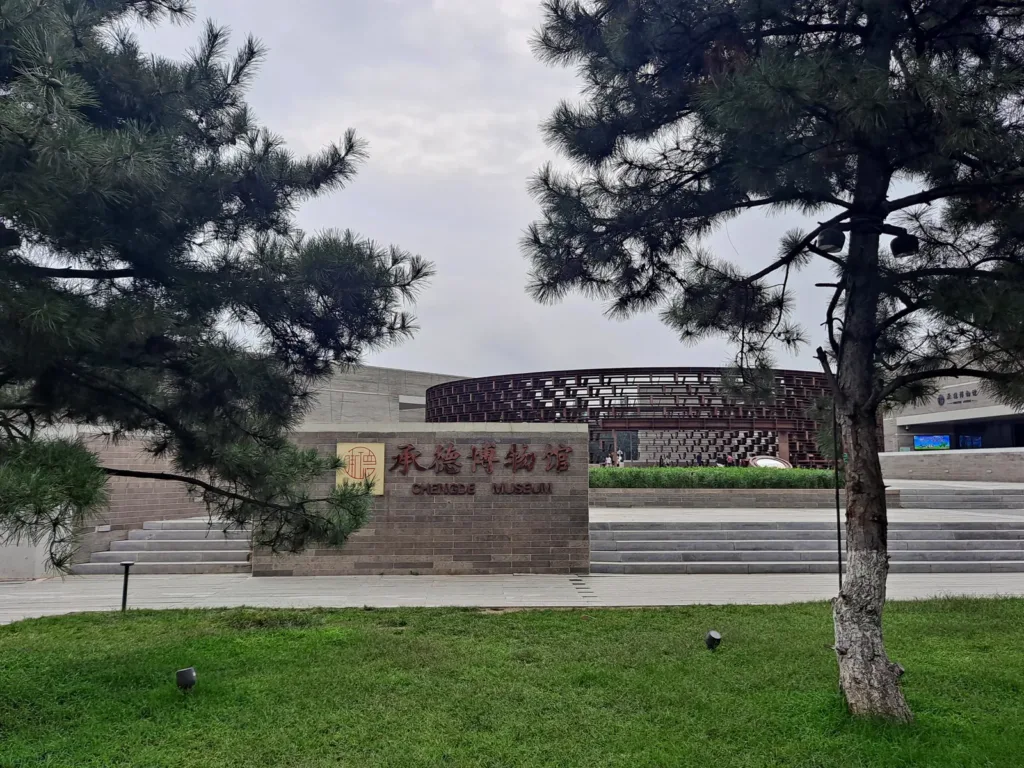
The building is deliberately quiet in scale. The official architectural account describes a horizontally spread, garden-like plan that borrows the stepped platforms of Chengde’s historic buildings without competing with the Mountain Resort. The pedestrian entrance is on Puning Road, reached by a rising sequence of steps; the entrance view is framed toward Qingchui Peak (磬锤峰).
What to look for
Start with “Solidified Time — Qing Imperial Life” (凝固的时光——清代帝后生活展), a permanent exhibition in the west part of the basement. Its sections use clothing, dining objects, political routine, study, entertainment and palace life to show how rank and daily behaviour were materialised in the Qing court. The online display includes a brown silk dragon robe, a Qianlong celadon washer, a large doucai dish and a bronze luduan incense burner; the point is not simply luxury, but the rules and uses encoded in ordinary-looking court objects.
The permanent “Treasured Qing Palace — Tibetan-Han Buddhist Art” (清宫秘藏——藏汉合璧的佛教艺术珍品展) occupies the south-west part of the basement. Look closely at the difference between calm, human-looking images and the many-armed or wrathful forms used in esoteric Buddhist art. The display also includes Buddhist shrines, ritual implements and a four-armed Avalokitesvara; these objects help explain the relationship between Qing court patronage, the Buddhist halls in the Mountain Resort and the separate temple complex around the city.
The large “Looking Beyond the Great Wall — A Record of Ethnic Unity in the High Qing” (望长城内外——清盛世民族团结实录) display is associated with one of the museum’s signature objects: a 305-centimetre Qing copper-bodied enamel pagoda on a zitanwood base. Its many doors, gilt dragons, bells and painted decoration reward a slow look at construction as well as symbolism. The museum identifies it as a national first-grade cultural relic; a 2025 Chengde government report also describes it as the exhibition’s centrepiece and relates it to the Qianlong emperor and the Sixth Panchen Lama.
These exhibitions are a companion to, not a substitute for, the Mountain Resort and the independent temple sites. The museum building on Puning Road is a separate venue from galleries inside the Mountain Resort. Plan the indoor visit when you want objects, labels and a quieter explanation of the city’s imperial and Buddhist landscape.
Plan your visit
The museum’s official visitor page says admission is free but advance reservation is required, through the “承德博物馆” WeChat account or the museum’s published reservation link. It also lists 0314-2379999 as the reservation telephone number. The page does not explain a separate foreign-passport booking or entry procedure, so international visitors should contact the museum before relying on the online form.
The published hours are Tuesday to Sunday, 09:00–17:00, with entry stopping at 16:00. Monday is the regular closing day, except when a statutory holiday changes the arrangement. Recheck the official notice for your date, especially around a holiday or a temporary exhibition change.
Security rules are practical rather than unusual: food, drinks and pets are not admitted; visitors must cooperate with security checks; flash photography, selfie sticks and tripods are prohibited; exposed objects must not be touched. The museum also asks visitors with limited mobility or potential health problems to come with an accompanying person.
Getting there and back
Use this Chinese destination in a map or ride-hailing app: 承德博物馆,承德市双桥区普宁路与环城北路十字路口东北角. The main pedestrian entrance is on 普宁路 Pǔníng Lù. This wording is preferable to entering only “承德避暑山庄博物院”, which can point to a different premises within the larger institution.
The museum’s own transport guide lists city buses 6路、11路、19路 as routes that reach the museum. It does not publish a current stop-direction diagram, timetable or fare on that page, so confirm the live stop display and the direction with the operator on the day. For the return, check the same Chinese destination and the opposite-direction service locally rather than assuming the first bus you see is returning toward your accommodation.
There is no metro instruction in the museum’s published guidance. If you arrive at 承德站 (Chengde Railway Station) or 承德南站 (Chengde South Railway Station), the dependable visitor-facing instruction is to use a taxi or ride-hailing car to the Chinese destination above; the latter is a current railway-and-bus interchange, but the museum does not publish a direct rail-to-museum transfer. For the return journey, set the named station in Chinese in the app and confirm the pickup point at the museum entrance. The city’s 2024 transport report confirms the bus interchange beside 承德南站 and its station name, without establishing a direct service to the museum.
Combine your visit
Suggested order within this visit:
-
Puning Road entrance courtyards
Read the building's stepped approach and local architectural references.
-
Garden-culture displays
Establish the Mountain Resort's role and design context.
-
Buddhist-art displays
Connect the collection with Chengde's surrounding temple traditions.
This sequence is an editorial suggestion based on the features described in the sources. Access to individual buildings or areas should be checked locally; no travel time or shared admission is implied.
Find Chengde Museum
承德博物馆 · 承德市
The pin marks the area, not the entrance.
More places nearby
Approximate straight-line distances between map pins, not travel distances.
Puning Temple (Chengde) 普宁寺
Less than 1 km awayPuning Temple combines two different spatial traditions on a single rising axis. The front courts follow a Chinese Buddhist hall arrangement; behind them, a Tibetan-inspired mandala composition surrounds the towering Dacheng…
View guide →Xumi Fushou Temple 须弥福寿之庙
1 km awayXumi Fushou Temple was built in 1780 for the Sixth Panchen Lama's visit to the Qianlong emperor, taking inspiration from Tashilhunpo Monastery. Its red terrace encloses Miaogao Zhuangyan Hall, whose gilded roof carries large…
View guide →Putuo Zongcheng Temple 普陀宗乘之庙
1 km awayPutuo Zongcheng translates the visual language of Lhasa's Potala Palace into Chengde's imperial setting. A sequence of gateways and stepped white buildings rises towards the great red terrace, enclosing Wanfaguiyi Hall and its…
View guide →Sources & visit information
Sources checked on 25 October 2026. Hours, tickets, reservations and transport can change; confirm with the operator before you go.
Image credits & notes (1)
- The Puning Road frontage of Chengde Museum, with the museum name visible among pine trees. Photo: H2v5o68z (Wikimedia Commons)Photo: CC0 1.0