

Photo adjustments
Resized and WebP compressed; subject not altered.
Explore the region
About Xumi Fushou Temple
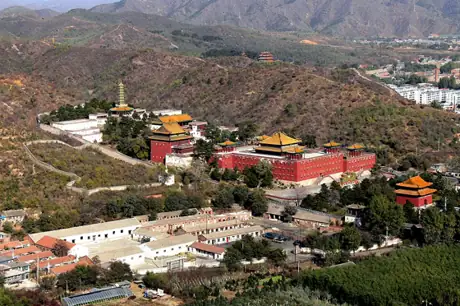
Its red terrace encloses Miaogao Zhuangyan Hall, whose gilded roof carries large dragon ornaments. Behind it, the arrangement changes to white-walled courts and a glazed longevity pagoda. The complex gives a different perspective from neighbouring Putuo Zongcheng: its design connects a visiting religious leader's residence, teaching hall and ceremonial setting within one compact hillside composition.
The temple was built in 1780, in the Qianlong era (乾隆), to house the Sixth Panchen Lama (六世班禅) during his journey from Tibet to Rehe (热河, present-day Chengde) for the Qianlong Emperor's seventieth birthday. The building was intended as a summer residence, as Rehe and Beijing were hotter than Tibet. On the Panchen Lama's arrival, Qianlong welcomed him at the Chengde Mountain Resort (避暑山庄) and visited him at the temple. Qianlong later held a dharma assembly in the Miaogao Zhuangyan Hall (妙高庄严殿), where the Panchen Lama preached, translated by Zhangjia Guoshi (章嘉国师). The temple stands on the south-facing slope of Shizigou (狮子沟), north of the Chengde Mountain Resort and east of the Putuo Zongcheng Temple (普陀宗乘之庙), facing south across an area of 37,920 square meters.
Its mountain gate has three arched doorways below a tower bearing a plaque inscribed by Qianlong with the temple's name, and a nearby stele pavilion holds a stele erected in 1780. Behind the Miaogao Zhuangyan Hall, a courtyard called Wanhua Zhongyuan (万花仲院), comprising the Jinhe Hall (金贺堂) and Wanfa Zongyuan Hall (万法宗源殿), forms the temple's rear section. The temple was listed among the first group of Major Historical and Cultural Sites Protected at the National Level (全国重点文物保护单位) in 1961. In 1994, UNESCO (联合国教科文组织) recognized it, together with the Chengde Mountain Resort and its surrounding temples (承德避暑山庄及其周围寺庙), as a World Heritage Site.
What to look for
- Miaogao Zhuangyan Hall and its dragon-decorated gilded roof.
- The red terrace, white rear courts and glazed Wanshou Pagoda.
The surrounding area
Northern provincial base for the Mountain Resort and outlying temples; an imperial-landscape itinerary.
Location & getting there
Getting to Xumi Fushou Temple
Use 须弥福寿之庙 on the southern slope of Shizigou, north of Chengde Mountain Resort and east of Putuo Zongcheng Temple.
- Enter through the temple's own south-facing approach; do not assume a direct internal passage from the neighbouring complex.
Combine your visit
Suggested order within this visit:
-
Glazed ceremonial gateway
Begin on the central approach.
-
Red terrace and Miaogao Zhuangyan Hall
See the principal teaching and ceremonial space.
-
Rear courts and Wanshou Pagoda view
Follow the change in colour and building form towards the rear.
This sequence is an editorial suggestion based on the features described in the sources. Access to individual buildings or areas should be checked locally; no travel time or shared admission is implied.
Find Xumi Fushou Temple
须弥福寿之庙 · 承德市
The pin marks the area, not the entrance.
More places nearby
Approximate straight-line distances between map pins, not travel distances.
Puning Temple (Chengde) 普宁寺
Less than 1 km awayPuning Temple combines two different spatial traditions on a single rising axis. The front courts follow a Chinese Buddhist hall arrangement; behind them, a Tibetan-inspired mandala composition surrounds the towering Dacheng…
View guide →Chengde Museum 承德博物馆
1 km awayChengde's museum beside Puning Road provides an indoor counterpart to the Mountain Resort and surrounding temples. Its displays explore imperial garden culture, Qing court life and Tibetan-Han Buddhist art, helping explain the…
View guide →Putuo Zongcheng Temple 普陀宗乘之庙
1 km awayPutuo Zongcheng translates the visual language of Lhasa's Potala Palace into Chengde's imperial setting. A sequence of gateways and stepped white buildings rises towards the great red terrace, enclosing Wanfaguiyi Hall and its…
View guide →Sources & visit information
The linked encyclopedia sources support background and place descriptions. Current opening hours, ticket prices, booking rules and transport schedules have not been independently verified for this guide. Confirm them with the venue or operator before travelling.
Visitor information adapted and edited from Wikipedia contributors · CC BY-SA 4.0. Source revision 93284654.
Background paragraphs translated and condensed from Wikipedia contributors, "須彌福壽之廟", Chinese Wikipedia · CC BY-SA 4.0. Source revision 93284654.