

Photo adjustments
Full frame retained; proportionally resized and converted to WebP. No retouching or changes to the photographed subject. Card displays may crop the view.
Explore the region
About Fengxue Temple
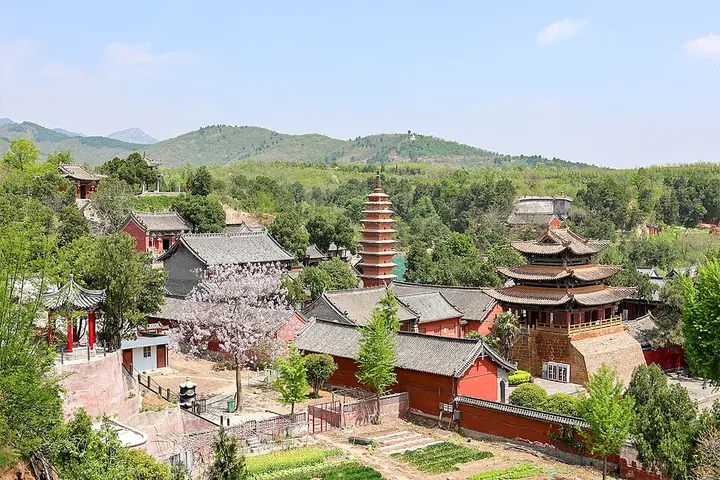
The Tang-period Qizu Pagoda stands among buildings from several later dynasties, while the central Buddha hall and bell tower add contrasting forms. Memorial towers on the surrounding slopes extend the architectural sequence beyond the main compound. The variety of surviving periods is the main reason to slow down here.
The temple was founded in the Northern Wei period as Xiangji Temple (香积寺); it was renamed Qianfeng Temple (千峰寺) in the Sui dynasty and expanded and renamed Baiyun Temple (白云寺) in the Tang. It stands on the south slope of Shaoshi Mountain (少室山), a spur of Mount Song; a cave on the mountain's southeast side emits wind when the weather changes, giving the mountain the name Fengxue Mountain (风穴山) and the temple its common name. In 1988 the temple and its pagoda forest were listed among the third batch of Major Historical and Cultural Sites Protected at the National Level (全国重点文物保护单位).
The Qizu Pagoda (七祖塔), the temple's oldest surviving structure, was built in 738 and named by Emperor Xuanzong of Tang; it is a nine-story, square, multi-eaved brick pagoda 24.17 meters tall, its outline curving like a shuttle, with wind bells hung from each story. The bell tower, first built in the Northern Song and repaired in 1584 and 1741, is a triple-eaved pavilion on a 6-meter stone platform holding a Northern Song iron bell cast in 1125 that weighs about 800 kilograms. On the surrounding slopes, two groups of pagodas that once numbered 115 now preserve 83 examples from the Yuan, Ming and Qing dynasties, the third-largest such collection in China.
What to look for
- Qizu Pagoda, a square brick tower with closely stacked eaves dating to the Tang period.
- The central Buddha hall and hillside Pagoda Forest, showing different forms of religious architecture.
Location & getting there
Getting to Fengxue Temple
Approach from Fengxue Road northeast of Ruzhou; the listed temple address is 985 Fengxue Road. Arrange the final road transfer to the temple entrance below the hills, then follow the designated paths through the compound.
Combine your visit
A suggested sequence linking the specific features of this visit.
-
Qizu Pagoda
Begin with the temple’s oldest surviving major structure.
-
Central Buddha hall
Compare the pagoda with the timber architecture of the main worship spaces.
-
Pagoda Forest
Continue to the memorial towers if the hillside visitor route is open.
This order is editorial. Confirm access and any transfers between stops; it does not establish a walking route, same-day connection or common admission ticket.
Find Fengxue Temple
风穴寺 · 平顶山市
The pin marks the area, not the entrance.
More places nearby
Approximate straight-line distances between map pins, not travel distances.
Mount Song 嵩山
27 km awaySongshan is a mountain range with distinct Taishi and Shaoshi sectors, rather than one summit path. Its exposed rock sequences are important to geology, while temples and academies occupy the lower slopes. Shaolin belongs to the…
View guide →Gaocheng Astronomical Observatory 观星台
30 km awayGaocheng Observatory makes astronomical measurement visible in brick and stone. Its Yuan-period platform supported a horizontal bar whose shadow fell along a long stone measuring scale extending northward. Water channels helped…
View guide →Zhongyue Temple 中岳庙
30 km awayZhongyue Temple lies below the eastern side of Taishi Mountain at Dengfeng. It is a Taoist temple associated with the sacred Central Mountain and imperial mountain worship.
View guide →Sources & visit information
The sources below support the place-specific description and arrival information. Suggested combinations are editorial planning ideas; confirm current opening, entry arrangements and transport services for your date.
- Pingdingshan ↗
- 风穴寺 ↗
- Chinese Wikipedia: 风穴寺 (revision 92447448, 2026-04-28) ↗
- English Wikipedia: Qizu Pagoda (revision 1367637598, 2026-08-04) ↗
Visitor information adapted and edited from Wikipedia contributors, “风穴寺” · CC BY-SA 4.0. Source revision 92447448.
Visitor information adapted and edited from Wikivoyage contributors, listing “Fengxue Temple” · CC BY-SA 4.0.
Background paragraphs translated and condensed from Wikipedia contributors, "风穴寺", Chinese Wikipedia · CC BY-SA 4.0. Source revision 92447448.
Background paragraphs condensed from Wikipedia contributors, "Qizu Pagoda", English Wikipedia · CC BY-SA 4.0. Source revision 1367637598.