


Photo adjustments
Proportionally resized and converted to WebP without cropping, retouching or changing the photographed subject.
Explore the region
About Kang Baiwan's Mansion
The estate developed over generations from the late Ming and early Qing periods.
Buildings rise along the slope in a fortified compound characteristic of the region’s wealthy landed families. Its terrain and defensive form are as important as the individual residential courtyards.
The Kang family's fortune began in the salt trade: under the Ming, the sixth-generation ancestor Kang Shaojing (康绍敬) held posts over local transport, salt and taxation. Under the Qing the family won a decade-long contract supplying cloth for the court's campaign against the White Lotus, and profited from shipbuilding and landholding, with property in eight counties across Shandong, Shaanxi and Henan reported at 180,000 mu (亩). After the Eight-Nation Alliance invaded Beijing in 1900, Empress Dowager Cixi fled the following year to Xi'an; on her return journey to Beijing, passing through Kangdian, the family manager Kang Hongyou (康鸿猷) donated funds to the Qing court.
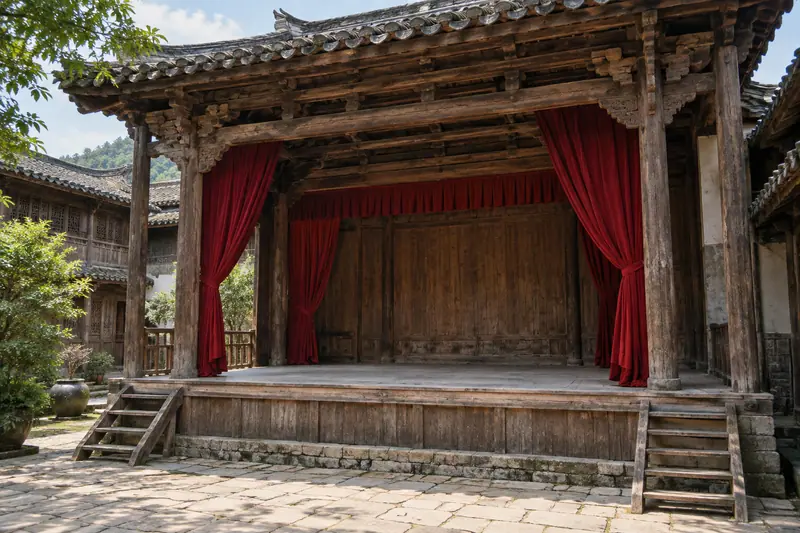
The estate functioned as a self-contained small society, combining finance, production, land management, logistics and education with a mill, granary and pharmacy. It comprises nineteen building complexes: the north holds the Sigou (寺沟) and Zhanggou (张沟) residential quarters, the Kang ancestral hall (康家祠堂), Fulu Hall (福禄堂) and an opera stage (戏楼), while the south has Jingu Fort (金谷寨), an orchard and a forestry area.
The mansion is counted as one of China's three great landlord estates. It was listed as a Henan provincial protected site in June 1963, as a Major Historical and Cultural Site Protected at the National Level (全国重点文物保护单位) in June 2001, and was approved as a national 4A tourist attraction (中国4A级旅游景区) in 2005.
What to look for
- Courtyards climb the slope within a fortified family estate.
- The relationship between hill and river explains the compound’s defensive and residential arrangement.
The surrounding area
Provincial capital base for Henan Museum and regional transfers; urban sightseeing is distinct from Dengfeng.
Location & getting there
Getting to Kang Baiwan's Mansion
Travel to Kangdian in Gongyi, on the Luo River side of Mangshan, and approach the named manor compound.
- Confirm the visitor entrance and access to the named areas before departure.
Combine your visit
A suggested sequence through the named features described in the source.
-
Lower residential courtyards
Begin with the domestic spaces in the lower part of the estate.
-
Upper slope compound
Compare the upper compound’s position with the slope and defensive layout.
The order is an editorial suggestion. Internal opening arrangements and transfers between sectors need checking; no walking duration or access entitlement is implied.
Find Kang Baiwan's Mansion
康百万庄园 · 郑州市
The pin marks the area, not the entrance.
More places nearby
Approximate straight-line distances between map pins, not travel distances.
Erlitou Xia Capital Site Museum 二里头夏都遗址博物馆
25 km awayThe Erlitou museum brings the finds of an early Bronze Age centre back beside its archaeological landscape. Turquoise-inlaid bronze plaques and jade blades show the specialised craftsmanship associated with the site, while the…
View guide →Shaolin Temple 少林寺
29 km awayShaolin Temple occupies the foot of Wuru Peak in the Songshan range. Beyond its martial-arts reputation, the visit follows a monastic axis of gates and halls, with buildings from different periods and later reconstructions…
View guide →Pagoda Forest at Shaolin Temple 少林寺塔林
29 km awayShaolin’s Pagoda Forest is a cemetery of memorial towers west of the monastery. Brick and stone structures from successive dynasties vary in plan, height, tiers and carved detail. Their inscriptions preserve the names and…
View guide →Sources & visit information
The linked encyclopedia sources support background and place descriptions. Current opening hours, ticket prices, booking rules and transport schedules have not been independently verified for this guide. Confirm them with the venue or operator before travelling.
Visitor information adapted and edited from Wikipedia contributors, “康百万庄园” · CC BY-SA 4.0. Source revision 93276380.
Background paragraphs translated and condensed from Wikipedia contributors, "康百万庄园", Chinese Wikipedia · CC BY-SA 4.0. Source revision 93276380.