

Photo adjustments
Proportionally resized and converted to WebP without cropping, retouching or changing the photographed subject.
Explore the region
About Meidaizhao
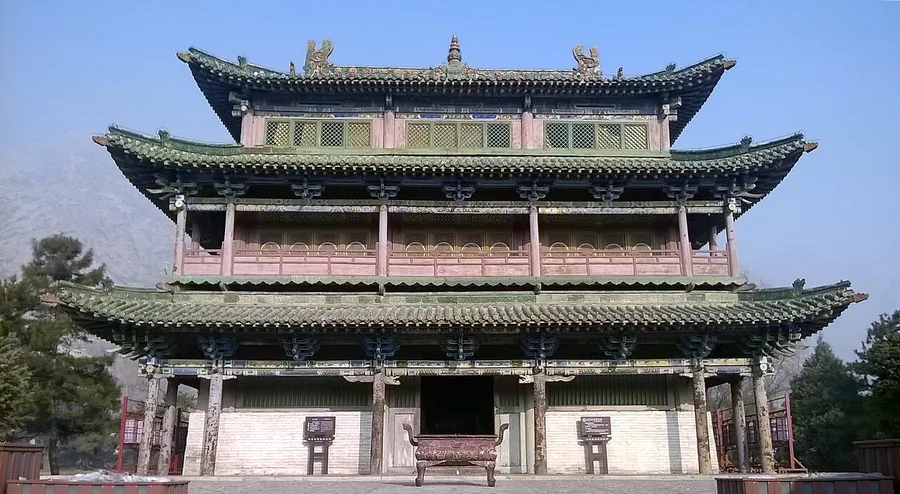
Taihe Gate gives the first clue to its civic scale, while the halls inside show Chinese roof forms alongside Tibetan and Mongolian religious traditions. The Mahavira Hall's murals include Buddhist narratives and Mongolian donors in historical dress. Reading the walls, gate and paintings together reveals how political residence and religious life shared the same space on the Tumed plain.
Meidaizhao originated within Da Bansheng City (大板升城), which the Mongol leader Altan Khan (俺答汗) built in Tumed Chuan as he rose to power in the mid-to-late Ming dynasty. After the Ming conferred on him the title King of Shunyi in 1571, he began building the Linjue Temple (灵觉寺) within Da Bansheng City in 1572, later renamed Shouling Temple (寿灵寺) under the Qing. In 1606 Bahan Biji (把汉比吉), widow of Altan Khan's son, sponsored the Mahavira Hall's front hall and the Taihe Gate (泰和门), and the temple became popularly known as Meidaizhao after the resident Maidari Khutugtu (迈达哩呼图克图).
During the Cultural Revolution a three-story hip-roofed tower was demolished and the halls were used as a granary, damaging the site's relics and scriptures; from the early twenty-first century the government funded repairs that restored most of the buildings to their original appearance.
The temple compound covers about 30,000 square meters, enclosed by a square earthen outer wall about 5 meters high and 6 meters wide, with corner towers set on platforms projecting about 11 meters from the wall. Meidaizhao was listed as a Major National Historical and Cultural Site (全国重点文物保护单位) in 1996.
What to look for
- Taihe Gate and the stone-faced enclosure walls.
- The Mahavira Hall murals, especially the donor figures and Buddhist narrative scenes.
The surrounding area
Western city base with a separate monastery excursion to Wudangzhao.
Location & getting there
Getting to Meidaizhao
Go to Meidaizhao Village in Meidaizhao Town, Tumed Right Banner, east of Baotou.
- Use the visitor approach by the southern Taihe Gate; check photography rules before entering the mural halls.
Combine your visit
Suggested order within this visit:
-
Enclosure and Taihe Gate
Begin with the fortified settlement.
-
Mahavira Hall
Examine the paintings and mixed architectural forms.
-
Liuli Hall exterior
Continue to the residential and ceremonial side of the complex.
This sequence is an editorial suggestion based on the features described in the sources. Access to individual buildings or areas should be checked locally; no travel time or shared admission is implied.
Find Meidaizhao
美岱召 · 包头
The pin marks the area, not the entrance.
More places nearby
Approximate straight-line distances between map pins, not travel distances.
Wudang Lamasery 五当召
39 km awayWudang Lamasery, also called Badekar Monastery, spreads up a mountain valley northeast of Baotou. White, flat-roofed buildings form a Tibetan architectural ensemble, with larger teaching and assembly halls set among smaller…
View guide →Chunkun Mountain 春坤山
45 km awayChunkun Mountain rises into high meadow country northeast of Guyang. Its main summit, Hongqi Peak, reaches 2,340 metres, and the open upper slopes give a very different outlook from the industrial city of Baotou to the south…
View guide →Baotou Museum 包头博物馆
74 km awayBaotou Museum connects the city's trading history with the older cultures of the Yinshan region. Its rock-art collection is especially useful: animal figures, hunting and pastoral scenes preserve a visual record that differs…
View guide →Sources & visit information
The sources below support the place-specific description and arrival information. Suggested combinations are editorial planning ideas; confirm current opening, entry arrangements and transport services for your date.
Visitor information adapted and edited from Wikipedia contributors · CC BY-SA 4.0. Source revision 93285013.
Background paragraphs translated and condensed from Wikipedia contributors, "美岱召", Chinese Wikipedia · CC BY-SA 4.0. Source revision 93285013.