

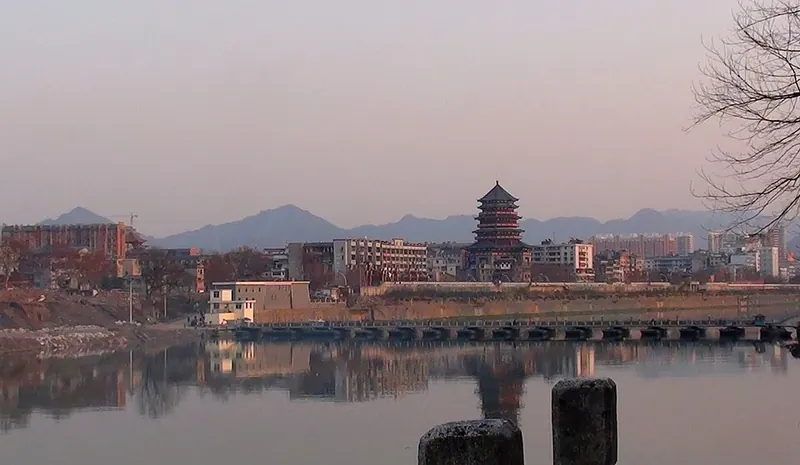
Photo adjustments
Full frame retained; proportionally resized and converted to WebP. No retouching or changes to the photographed subject. Card displays may crop the view.
Explore the region
About Jingdezhen
At the Imperial Kiln site, excavated fragments reveal the exacting production of court wares. Taoxichuan preserves a later industrial world of factory buildings and chimneys, now occupied by cultural spaces and ceramic businesses. Visiting both gives a more layered picture of the porcelain city than concentrating only on finished objects in shops.
The area belonged to the state of Chu in the Spring and Autumn and Warring States periods, then to Fan County of Jiujiang Commandery under the Qin and to Poyang County of Yuzhang Commandery under the Han. Its first recorded name, Xinping, dates from the Eastern Jin; the town was later called Changnan, then renamed Fuliang in 742 and Jingdezhen, after the reign era of the Song emperor Zhenzong, in 1004. In the Ming and Qing dynasties it was counted as one of China's four great towns, alongside Foshan, Hankou and Zhuxian.
In 1855, Taiping forces destroyed all 9,000 kilns in Jingdezhen; they were rebuilt after the war, in 1866. Jingdezhen was separated from Fuliang County in 1949 and upgraded to a city; although the customary designation would have replaced 'zhen' (town) with 'shi' (city) in its name, the town's noted history of porcelain-firing led to 'Jingdezhen' being retained in full as the city's proper name.
Jingdezhen lies in northeastern Jiangxi in the transitional zone between low hills and the Poyang Lake plain. The Chang River (昌江) flows north to south through the city, and the Le'an River (乐安江) crosses the south. Jingdezhen is a National Historical and Cultural City (国家历史文化名城), and in 2026 its porcelain-industry heritage sites were inscribed on the World Heritage List.
What to look for
- The Imperial Kiln site’s archaeology and restored porcelain fragments.
- Taoxichuan’s former factory buildings, chimneys and ceramic-art spaces.
Background & history
It is known as the "Porcelain Capital" because it has been producing Chinese ceramics for at least 1,000 years, and for much of that period Jingdezhen porcelain was the most important and finest quality in China. The city has a well-documented history that stretches back over 2,000 years.
Excerpt from Wikipedia: Jingdezhen · Wikipedia contributors · CC BY-SA 4.0. Selected introductory sentences; formatting simplified. Background information, not current visitor-service advice.
The surrounding area
A craft-city stay combining kiln history with contemporary ceramics and adapted industrial spaces.
Location & getting there
Getting to Jingdezhen
Jingdezhen North railway station serves the city’s high-speed rail connections. Arrange an onward transfer to the Imperial Kiln area on Zhushan Middle Road or to Taoxichuan on Xinchang West Road; these are separate urban districts.
Combine your visit
A suggested sequence linking the specific features of this visit.
-
Imperial Kiln archaeological park景德镇御窑厂国家考古遗址公园
Begin with the remains of production for the imperial court.
-
Taoxichuan陶溪川文创街区
Continue to the industrial and contemporary chapters of the porcelain city.
This order is editorial. Confirm access and any transfers between stops; it does not establish a walking route, same-day connection or common admission ticket.
Find Jingdezhen overview
景德镇 · 景德镇市
The pin marks the area, not the entrance.
More places nearby
Approximate straight-line distances between map pins, not travel distances.
Jingdezhen Imperial Kiln National Archaeological Remains Park 景德镇御窑厂国家考古遗址公园
Less than 1 km awayThe Imperial Kiln archaeological park occupies the production ground where ceramics were made for the Ming and Qing courts. Excavated kiln remains and large quantities of rejected porcelain fragments reveal processes that a…
View guide →Jingdezhen Ancient Kiln and Folk Cultures Museum 景德镇古窑民俗博览区
2 km awayJingdezhen’s Ancient Kiln and Folk Cultures Museum grew around the preserved Qing-period Zhen kiln. A nearby temple honours Tong Bin, a kiln worker remembered in local ceramic traditions.
View guide →Samryu Temple Old Street 三闾庙古街
2 km awaySanlümiao’s old street and landing preserve the transport side of Jingdezhen’s porcelain story. Stone paving leads towards a riverside wharf built in levels to accommodate changing water. The landing helped connect the ceramic…
View guide →Sources & visit information
The sources below support the place-specific description and arrival information. Suggested combinations are editorial planning ideas; confirm current opening, entry arrangements and transport services for your date.
- Jingdezhen ↗
- Jingdezhen ↗
- www.jdz.gov.cn ↗
- jdz.gov.cn ↗
- Chinese Wikipedia: 景德镇市 (revision 94241118, 2026-09-08) ↗
- English Wikipedia: Jingdezhen (revision 1367312552, 2026-08-02) ↗
Visitor information adapted and edited from Wikivoyage contributors, “Jingdezhen” · CC BY-SA 4.0.
Visitor information adapted and edited from Wikipedia contributors, “Jingdezhen” · CC BY-SA 4.0. Source revision 1367312552.
Background paragraphs translated and condensed from Wikipedia contributors, "景德镇市", Chinese Wikipedia · CC BY-SA 4.0. Source revision 94241118.
Background paragraphs condensed from Wikipedia contributors, "Jingdezhen", English Wikipedia · CC BY-SA 4.0. Source revision 1367312552.