

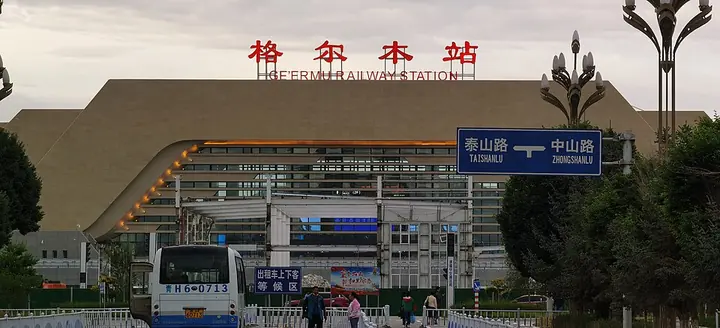
Photo adjustments
Full frame retained; proportionally resized and converted to WebP. No retouching or changes to the photographed subject. Card displays may crop the view.
Explore the region
About Golmud
The city is the starting point for very different excursions: Qarhan’s industrial salt landscape to the north and the Kunlun corridor to the south. These are separate road journeys, not a cluster of attractions within the built-up streets.
Golmud was founded in 1954, when transportation regiments of the Qinghai-Tibet Corps set up a small food-distribution base at the site, and construction of the Qinghai-Tibet Highway began that same year. Scientific exploration of the mineral resources of Qarhan (察尔汗) in the 1950s led to the discovery of potash and gas fields there, and industrial exploitation followed from the 1980s once a railway had been built; the first oil pipeline and a potassium-fertiliser factory opened in 1989.
The name Golmud derives from Oirat Mongolian, meaning 'rivers,' plural of 'gol.' Within the city's territory, the 5856-square-kilometre Qarhan Salt Lake (察尔汗盐湖) is described as China's largest potassium-magnesium salt deposit, and it is because of this that Golmud is also known as China's Salt Lake City (中国盐湖城).
The city's administrative area covers nearly 120,000 square kilometres, though its built-up urban area is only about 72 square kilometres. It sits in the south-central Qaidam Basin, on the alluvial plain of the Golmud River (格尔木河), at an average elevation of 2780 metres. A large southern exclave is administered as the town of Tanggula, separated from the rest of the county by a panhandle of Yushu Tibetan Autonomous Prefecture; the area borders Xinjiang to the north and the Tibet Autonomous Region to the south.
What to look for
- The city’s development is linked to plateau transport and mineral resources.
- Qarhan introduces the salt-flat economy north of the city.
- The Kunlun corridor leads towards a contrasting high-mountain landscape.
Background & history
Golmud is a county-level city in the Haixi Mongol and Tibetan Autonomous Prefecture of Qinghai Province, China. It is now the second-largest city in Qinghai and the third largest on the Tibetan Plateau (after Xining and Lhasa). The population in 2020 was 221,863.
Excerpt from Wikipedia: Golmud · Wikipedia contributors · CC BY-SA 4.0. Selected introductory sentences; formatting simplified. Background information, not current visitor-service advice.
Location & getting there
Getting to Golmud
Use Golmud railway station or airport for arrival, then arrange the actual excursion from the city. Confirm the return journey and all current access requirements before setting out into the wider Qaidam or Kunlun region.
Combine your visit
Choose from these complementary stops when planning your visit.
-
Golmud city base格尔木市区
Arrange transport and supplies for the chosen direction.
-
Qarhan Salt Lake察尔汗盐湖
Choose a dedicated salt-landscape outing.
-
Kunlun corridor昆仑山公路走廊
Plan this separately with suitable time and current access information.
This is a suggested combination, not a timed route; confirm the opening and transport arrangements for your date.
Find Golmud overview
格尔木 · 海西州
The pin marks the area, not the entrance.
More places nearby
Approximate straight-line distances between map pins, not travel distances.
Kunlun Sacred Spring 昆仑圣泉
68 km awayKunlun Sacred Spring, also known as Nachitai Spring, is a roadside water feature on the Qinghai–Tibet corridor southwest of Golmud. Water emerges within an enclosed spring setting against the dry mountain landscape. Local…
View guide →Qarhan Salt Lake 察尔汗盐湖
71 km awayQarhan is an extensive salt-flat system containing several brine lakes, rather than one uninterrupted lake. Dabusun is a major component, and the wider landscape supports large-scale mineral production. The visitor area presents…
View guide →Kunlun Pass 昆仑山口
115 km awayKunlun Pass is a high mountain crossing on the Qinghai–Tibet road south of Golmud. Broad exposed terrain and distant peaks distinguish it from the lower spring and valley stops on the approach. The corridor also contains…
View guide →Sources & visit information
The sources below support the place-specific description and arrival information. Suggested combinations are editorial planning ideas; confirm current opening, entry arrangements and transport services for your date.
- Golmud Government: separate city, salt-lake and Kunlun visitor corridors ↗
- Golmud — Wikipedia geographic and historical reference ↗
- Chinese Wikipedia: 格尔木市 (revision 93641053, 2026-07-25) ↗
- English Wikipedia: Golmud (revision 1374269128, 2026-09-10) ↗
Geographic and historical facts selectively adapted from Wikipedia contributors, Golmud · CC BY-SA 4.0. Source revision 1370867801.
Background paragraphs translated and condensed from Wikipedia contributors, "格尔木市", Chinese Wikipedia · CC BY-SA 4.0. Source revision 93641053.
Background paragraphs condensed from Wikipedia contributors, "Golmud", English Wikipedia · CC BY-SA 4.0. Source revision 1374269128.