

Photo adjustments
Proportionally resized and converted to WebP without cropping, retouching or changing the photographed subject.
Explore the region
About Qutan Temple
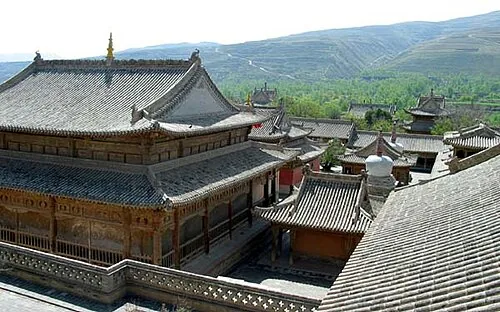
The scale of Longguo Hall and the sequence of courts show a strong relationship with Chinese palace and temple architecture. The surrounding mountains and Qutan River give the compound a more enclosed setting than the open plateau monasteries. Follow the main court sequence and look closely at the timber structure and decorated surfaces in areas open to visitors.
The temple was founded in 1392 (the twenty-fifth year of the Hongwu era), when the monk Sanluo Lama Sandan Luozhui (三罗喇嘛三丹罗追) built a small chapel and sought recognition from the Ming court. In 1393 the Ming founder Zhu Yuanzhang (朱元璋) named it Qutan Temple and made Sandan Luozhui head of the Xining Buddhist registry. Four Ming emperors issued seven edicts and sent eunuchs to direct craftsmen who completed the complex over 36 years, expanding the senior monks' religious and economic privileges under the Yongle, Hongxi and Xuande emperors.
The temple stands within a square earthen enclosure called the 'New City' (新城); the temple's 1.5-hectare footprint, two-thirds of the enclosure, has a built area of about 10,000 square metres, arranged in front, middle and back courtyards facing southeast. The main axis holds Qutan Hall (瞿昙寺殿), built in 1392 and rebuilt in 1782; four corner stupas, the oldest called the Tara Stupa (度母塔); and Longguo Hall (隆国殿), modeled on the Hall of Supreme Harmony in Beijing's Forbidden City, completed in 1427 as the complex's tallest building at about 900 square metres.
A mural corridor known as the 'seventy-two chambers' (七十二间走水厅) holds murals of about 400 square metres depicting Buddhist legends. The temple also keeps a Ming-dynasty bilingual Chinese-Tibetan imperial stele, ten Ming and Qing plaques, and a bronze bell cast in 1427.
What to look for
- Longguo Hall is a principal monument of the Ming-period complex.
- Successive courtyards reveal the temple’s formal layout.
- The valley setting connects the buildings with the Qutan River and surrounding hills.
Location & getting there
Getting to Qutan Temple
The temple is in Qutan town, south of Ledu District’s urban centre in Haidong. Arrange the onward road journey from Ledu to the temple entrance and confirm the return connection before entering.
Combine your visit
Choose from these complementary stops when planning your visit.
-
Temple approach瞿昙寺入口
Take in the relationship between the compound and valley.
-
Main courtyards中轴院落
Follow the progression of halls.
-
Longguo Hall隆国殿
Study the building from the permitted visitor area.
This is a suggested combination, not a timed route; confirm the opening and transport arrangements for your date.

Find Qutan Temple
瞿昙寺 · 海东
The pin marks the area, not the entrance.
More places nearby
Approximate straight-line distances between map pins, not travel distances.
Xining Caojiabao Airport 西宁曹家堡国际机场
30 km awayXining Caojiabao Airport is Qinghai’s main air gateway, located east of the city in Haidong. The expanded T3 terminal and its ground-transport centre changed the arrival layout in August 2025. China Eastern and Hainan Airlines…
View guide →Dongguan Mosque 东关清真大寺
53 km awayDongguan Mosque is a major centre of Muslim religious life in Xining’s eastern old-city area. Its courtyard and prayer hall are the useful architectural focus, set within a neighbourhood where worship and everyday commerce…
View guide →Xining Nanshan Park 西宁南山公园
55 km awayNanshan Park covers the slopes of Phoenix Mountain south of central Xining. The Phoenix Terrace area provides city views, while wooded paths, flower gardens and the Puning Friendship Garden make it a local place for a hillside…
View guide →Sources & visit information
The linked encyclopedia sources support background and place descriptions. Current opening hours, ticket prices, booking rules and transport schedules have not been independently verified for this guide. Confirm them with the venue or operator before travelling.
- 瞿昙寺 — Wikipedia geographic and historical reference ↗
- Chinese Wikipedia: 瞿昙寺 (revision 91958217, 2026-03-20) ↗
Geographic and historical facts selectively adapted from Wikipedia contributors, 瞿昙寺 · CC BY-SA 4.0. Source revision 91958217.
Background paragraphs translated and condensed from Wikipedia contributors, "瞿昙寺", Chinese Wikipedia · CC BY-SA 4.0. Source revision 91958217.