

Photo adjustments
Full frame retained; EXIF orientation normalized, proportionally resized to at most 800 pixels and converted to WebP. No generated pixels or subject changes. Cards may crop the display.
Explore the region
About Huaqing Palace and Mount Li
The heritage administration's description sets out the site's history. It says Huaqing Pool, also called Huaqing Palace, stands on the old site of the Tang palace and was built over repeatedly after King You of Zhou raised the Li Palace there, that Qin built the Lishan Tang and Han called the place the Li Palace, and that the Tang called it first the Tangquan Palace and then the Wenquan Palace. In the sixth year of the Tianbao reign, in 747, the emperor Xuanzong ordered palaces laid out around the mountain with a wall around the whole and gave the place the name Huaqing Palace, and because the palace stood over hot springs it was also called Huaqing Pool. From 745 to 755 the emperor moved his court there each winter to handle state affairs, discuss government business and receive foreign envoys, and the palace was then named with the Daming Palace and the Xingqing Palace in Chang'an as the three palaces and called a second Chang'an. After the An Lushan rebellion it gradually lost its status as a travelling palace, and it was repaired and extended under the Song, Yuan, Ming and Qing and into modern times.
The same page records the site's designations. Huaqing Pool was included among the first batch of national key scenic areas in 1982, and in February of that year the Xi'an Incident site, the Five-Room Hall, was listed in the second batch of nationally protected cultural relics units. In 1996 the State Council declared the Tang Huaqing Palace site a nationally protected cultural relics unit of the fourth batch. The scenic area's own page calls the area a national 5A-level tourist scenic area in the first batch, where the heritage administration's page, dated 2011, gives a 4A rating in 2000; the two pages are of different dates and this entry repeats neither rating.
The heritage administration's page gives the spring's figures and the excavation. The hot spring has three outlets, a flow of 114 cubic metres an hour and a constant temperature of 43 degrees Celsius unaffected by the weather, and its water is of the neutral sodium chloride sulphate type. Building work at Huaqing Pool in 1982 uncovered large quantities of ancient building material, and excavation and sorting over several years cleared five stone-lined bathing pools within a 4,600-square-metre area and recovered more than 2,000 items of building material, among them lotus-pattern square bricks, plain grey bricks, bricks stamped with craftsmen's marks, pottery drains, lotus-pattern bluestone column bases and lotus-pattern eaves tiles. The page records that the five pools are the royal baths of the emperor Xuanzong and his consort Yang Yuhuan, the Lotus-Flower Pool and the Crabapple Pool among them, and that the Crabapple Pool, commonly called the Consort's Pool, was built in 747 and takes its name from a plan shaped like an open crabapple blossom. The site was restored in place and opened as the Tang Huaqing Pool Royal Hot-Spring Site Museum in 1990.
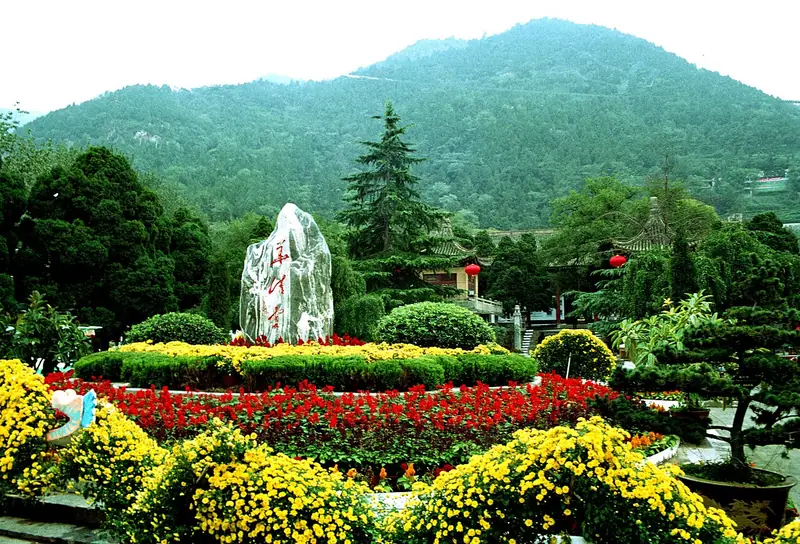
The scenic area's own page describes the grounds and the mountain. It places the area 30 kilometres east of Xi'an, next to the Terracotta Army, and records that emperors of successive dynasties, the Zhou, Qin, Han, Sui and Tang among them, built detached palaces there. It lists the Tang Royal Hot-Spring Site Museum, the Xi'an Incident site at the Five-Room Hall, the Jiulong and Furong lake areas and the Tang Liyuan Site Museum among the area's cultural areas, and the Feishuang, Wanshou, Changsheng, Huanyuan and Yuwang buildings among its landmark building groups. Mount Li stands at 1,302 metres, and its named points include Laomu Hall, Laojun Hall, the beacon tower, the Bingjian Pavilion, the Shiweng Temple and the Yuxian Bridge; the page records the evening glow at Mount Li as one of the famous eight scenes of the Guanzhong plain. Neither page states an opening arrangement for any individual hall, pool or site.
What to look for
- The five stone-lined Tang bathing pools cleared within a 4,600-square-metre area, which the heritage administration's page records as the royal baths of the emperor Xuanzong and his consort Yang Yuhuan, the Lotus-Flower Pool and the Crabapple Pool among them
- The Crabapple Pool, commonly called the Consort's Pool, built in 747 and named on that page for a plan shaped like an open crabapple blossom
- The Tang Royal Hot-Spring Site Museum, which the heritage administration's page records was restored in place and opened in 1990
- The Xi'an Incident site at the Five-Room Hall, listed in 1982 in the second batch of nationally protected cultural relics units
- Mount Li, which the scenic area's page gives as 1,302 metres high, with Laomu Hall, Laojun Hall, the beacon tower, the Bingjian Pavilion, the Shiweng Temple and the Yuxian Bridge among its named points
- The Feishuang, Wanshou, Changsheng, Huanyuan and Yuwang buildings and the Jiulong and Furong lake areas, which the scenic area's page lists among the area's landmark buildings and cultural areas
Location & getting there
Getting to Huaqing Palace and Mount Li
Check which interiors and courtyards are accessible. Active places of worship and protected monuments may have different visitor rules.
- Search for 华清宫与骊山 with 西安市 and 临潼区.
Find Huaqing Palace and Mount Li
华清宫与骊山 · 临潼区
No reliable map pin yet: search by the Chinese name.
Sources & visit information
The linked sources support the identity and background described in this introduction. Opening hours, admission, activity availability and exact arrival arrangements have not been comprehensively checked. Confirm current visitor information with the venue; the original catalogue locality and editorial review flag are retained.