

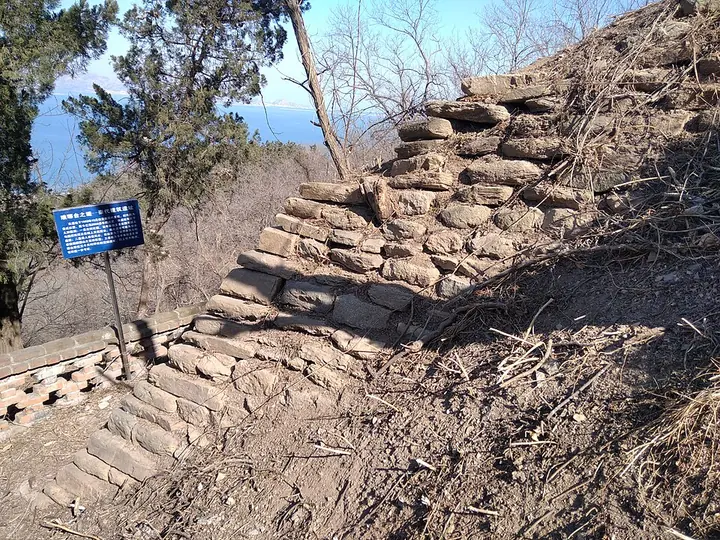
Photo adjustments
Full frame retained; proportionally resized and converted to WebP. No retouching or changes to the photographed subject. Card displays may crop the view.
Explore the region
About Langyatai Platform
Archaeology has revealed a substantial Qin building complex subsequently repaired in the Han period, including terraces and an unusually elaborate drainage system. The visit combines the hilltop setting with the site museum, where archaeological material helps distinguish the ancient remains from later commemorative structures. Excavation discoveries do not mean every excavated area is open to visitors.
The site lies on Langyatai hill (琅琊台山) behind Taixitou village (台西头村) in Langya town (琅琊镇), Huangdao District. It is classified as an ancient site (古遗址) and was named a Shandong provincial protected cultural site on June 12, 1992, before being listed as a Major Historical and Cultural Site Protected at the National Level (全国重点文物保护单位) in May 2013.
The stone floor drain in a room beside the platform was assembled from rectangular, trapezoidal and triangular slabs around a central opening. Ceramic pipes were laid during construction and wrapped in clay, with perforated bricks near their openings to filter debris. Open channels and stone-paved roads also carried away rainwater, protecting the rammed-earth base.
What to look for
- The elevated platform setting, overlooking the coast where imperial journeys were commemorated.
- Langyatai Museum, interpreting the site through Qin bricks, Han tiles and other archaeological finds.
The surrounding area
Coastal city base; Badaguan and the wider Laoshan area are separate outings.
Location & getting there
Getting to Langyatai Platform
Approach via Dengtai Road in Taixitou Village, Langya Town, Huangdao District. Arrange the road journey to the Langyatai scenic entrance; this coastal site is separate from central Qingdao and its urban waterfront.
Combine your visit
A suggested sequence linking the specific features of this visit.
-
Langyatai Museum
Read the archaeological context before seeing the hill.
-
Platform hill
Relate the elevated setting to the documented Qin and Han complex.
-
Coastal outlook
Finish with the sea landscape that gives this imperial site its distinctive setting.
This order is editorial. Confirm access and any transfers between stops; it does not establish a walking route, same-day connection or common admission ticket.

Find Langyatai Platform
琅琊台 · 青岛市
The pin marks the area, not the entrance.
More places nearby
Approximate straight-line distances between map pins, not travel distances.
Wanpingkou 万平口
41 km awayWanpingkou is a long public beach landscape on Rizhao’s Yellow Sea coast, arranged around squares, planted areas and different stretches of sand. The main Ecological Square anchors the southern visitor area, while Zhulang Bridge…
View guide →Golden Beach (Qingdao) 黄岛金沙滩
45 km awayGolden Beach stretches in a broad crescent along the southern side of Huangdao’s Xuejiadao peninsula. Its fine yellow sand and open Yellow Sea setting give it a different character from the compact bathing beaches below…
View guide →Zhanqiao 栈桥
59 km awayZhanqiao projects from Qingdao’s old waterfront into the bay, turning a former landing pier into one of the city’s most recognisable public spaces. At the seaward end, Huilan Pavilion rises above a semicircular breakwater with…
View guide →Sources & visit information
The sources below support the place-specific description and arrival information. Suggested combinations are editorial planning ideas; confirm current opening, entry arrangements and transport services for your date.
- Qingdao ↗
- www.qingdao.gov.cn ↗
- www.qingdao.gov.cn ↗
- 琅琊台 ↗
- Chinese Wikipedia: 琅琊台 (revision 92456407, 2026-04-29) ↗
- 琅琊台遗址:见证秦汉帝王东抚壮举 ↗
Visitor information adapted and edited from Wikipedia contributors, “琅琊台” · CC BY-SA 4.0. Source revision 92456407.
Visitor information adapted and edited from Wikivoyage contributors, listing “Langyatai Platform” · CC BY-SA 4.0.
Background paragraphs translated and condensed from Wikipedia contributors, "琅琊台", Chinese Wikipedia · CC BY-SA 4.0. Source revision 92456407.