

Photo adjustments
Proportionally resized and converted to WebP without cropping, retouching or changing the photographed subject.
Explore the region
About Sheshan
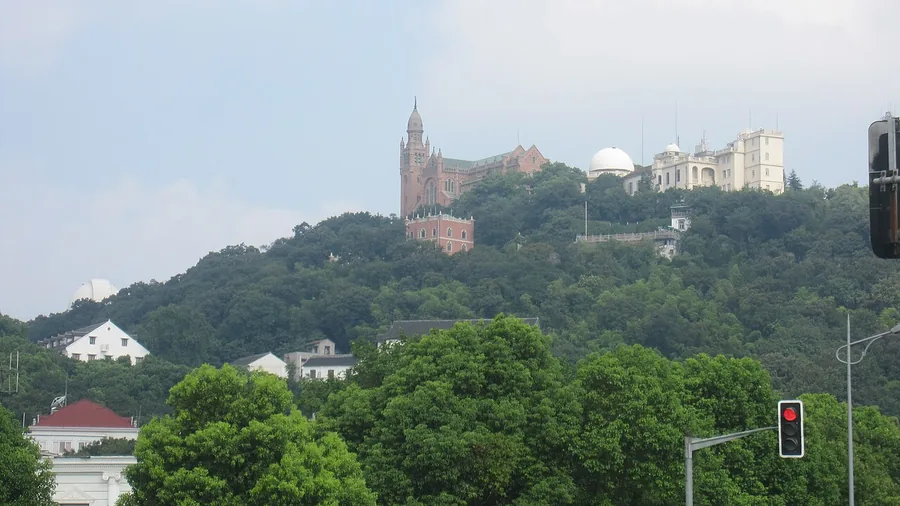
The western hill combines a Catholic pilgrimage landscape with the historic observatory.
The basilica and the route associated with the Stations of the Cross give the ascent a religious context. The observatory introduces the hill’s scientific history as a separate museum visit. Select the relevant hill entrance and allow for stairs and gradients; the basilica and observatory should not be assumed to share access arrangements.
French Jesuits began buying land on the hill in the early 1860s, building a sanitarium, a small church, and later a pavilion with a statue of Mary. During the Taiping Rebellion, Catholics there pledged to build a church dedicated to Mary if spared from the fighting, and Jesuits began a hilltop church in 1864, dedicated in the early 1870s. It was replaced by the present basilica, built between 1922 and 1936. In 1982 the Sheshan seminary opened with Aloysius Jin Luxian as its rector, the first seminary of the patriotic church to open during the Reform era.
The basilica's services are held in Chinese and Latin, and pilgrims visit the chapel and the hilltop road every May. The hill also has an observatory founded in 1900 by Jesuit priests, which displays scientific instruments together with a replica of a Han dynasty seismoscope, a jar mounted with dragon heads and an internal pendulum: when an earthquake occurred, the pendulum would swing, causing a dragon to release a ball from its mouth and indicate the quake's direction. The observatory was renovated and reopened as a museum in May 2023.
What to look for
- Sheshan Basilica crowns the western hill’s pilgrimage setting.
- The historic observatory adds a separate astronomical-history subject.
Background & history
Sheshan (literally, "She Mountain"), known in Shanghainese as Zose, is a pair of hills in Songjiang District in western Shanghai, China. The two hills are distinguished as East and West Sheshan, although the more important western hill is also called Sheshan on its own. East Sheshan has an elevation of 100.8 m (331 ft) and West Sheshan has an elevation of 118 m (387 ft), it is the highest point in Shanghai, there is a small valley between them. The area around the two hills is a forest park.
Excerpt from Wikipedia: Sheshan · Wikipedia contributors · CC BY-SA 4.0. Selected introductory sentences; formatting simplified. Background information, not current visitor-service advice.
Location & getting there
Getting to Sheshan
Approach the Sheshan forest-park area at 9258 Waiqingsong Highway. Sheshan station is a regional rail approach, followed by a local connection to the chosen hill entrance.
Combine your visit
A suggested sequence linking the specific features of this visit.
-
Western-hill pilgrimage route
Read the ascent in relation to the Stations of the Cross.
-
Basilica exterior
Examine the hilltop Catholic landmark.
-
Historic observatory museum
Add the hill’s scientific history if separately open to visitors.
This order is editorial. Confirm access and any transfers between stops; it does not establish a walking route, same-day connection or common admission ticket.
Find Sheshan
佘山 · 松江区
The pin marks the area, not the entrance.
More places nearby
Approximate straight-line distances between map pins, not travel distances.
Chenshan Botanical Garden 辰山植物园
2 km awayChenshan Botanical Garden occupies a broad landscape in Sheshan, Songjiang. Its botanical collections are organized into themed gardens and greenhouse displays, with conservation areas forming another part of the site.
View guide →Guangfulin Cultural Relics Park 广富林文化遗址
3 km awayGuangfulin Cultural Relics Park is in northern Songjiang, Shanghai. The archaeological heritage is central to the district’s presentation of Shanghai’s early history. The visitor site began trial operation in June 2018 and…
View guide →Huzhu Pagoda 护珠塔
5 km awayHuzhu Pagoda stands on Tianmashan in Songjiang. Built in 1079 during the Northern Song period, it survives from a Buddhist complex that was damaged by successive fires.
View guide →Sources & visit information
The sources below support the place-specific description and arrival information. Suggested combinations are editorial planning ideas; confirm current opening, entry arrangements and transport services for your date.
Visitor information adapted and edited from Wikipedia contributors, “Sheshan” · CC BY-SA 4.0. Source revision 1334836330.
Visitor information adapted and edited from Wikivoyage contributors, listing “Sheshan” · CC BY-SA 4.0.
Background paragraphs condensed from Wikipedia contributors, "Sheshan", English Wikipedia · CC BY-SA 4.0. Source revision 1334836330.