


Get to know Songjiang District

- Administrative area
- District · 市辖区
- Part of
- Shanghai
- Chinese name
- 松江区
- Local areas
- District guide
Area & population
- Area
- 605.64 km²
- Population · 2020
- 1,909,713
Source: English Wikipedia, as of the dates shown.
Songjiang is a large municipal district on Shanghai’s southwestern side, with a current official directory area of about 604 square kilometres. Its territory includes an old town, newer urban districts and the Sheshan resort landscape, so a district label on the map does not mean the attractions are close together. The current civil-affairs list records six subdistricts and 11 towns under Songjiang. Plan by cluster and check local transfers between them rather than treating the area as a single pedestrian circuit.
The old town: choose a garden and follow the historic details
For a first look at Songjiang’s historic core, start with Fangta Garden (方塔园). The Northern Song pagoda is the visual centre of a designed garden that also gathers structures from later periods: the site inventory names the Song-era Wangxian Bridge, a Ming brick-carved screen and the Tianfei Palace among its heritage features. Look beyond the pagoda itself for carved brickwork, stone figures and the changing rooflines around the paths. The He Lou Xuan pavilion is another distinctive structure noted by the municipal visitor guide. This is a garden visit, not access to an excavated city street.

A second, quieter garden option is Zuibaichi (醉白池). Its ponds, bridges, halls and covered passages make the visit about moving through a sequence of garden views rather than ticking off a single monument. The district’s tourism guide describes it as one of Shanghai’s five major classical gardens; the local site inventory lists buildings from several historical periods and historic calligraphy and stele collections. Give it a dedicated garden visit, or combine it with another old-town stop only if you have time for the local transfer.
The nearby historic core also has active religious sites, including Xilin Chan Temple (西林禅寺). Treat the temple as a functioning place of worship as well as a heritage landmark; check access locally and be considerate during services. Do not assume that religious buildings, museum spaces and the gardens share opening rules.
How to organize it: choose Fangta Garden for its pagoda-centred garden and architectural details, or Zuibaichi for a more enclosed classical-garden sequence. Confirm each venue’s current admission arrangements before setting out. The government listing gives Fangta Garden’s address as 235 East Zhongshan Road; Zuibaichi is at 64 Renmin South Road.
Guangfulin: archaeology in a modern waterside setting
Guangfulin Cultural Relics Park (广富林文化遗址) sits in northern Songjiang New City. Think of it as an archaeological and cultural landscape rather than an intact ancient town. The district describes a protected archaeological core within a broad park, with designated areas for cultural displays, folk-life interpretation, services and agricultural-landscape conservation. On a visit, look at the relationship between the preserved site and exhibition spaces, including the cultural exhibition hall set on Fulin Lake. The distinctive modern architecture is part of the contemporary visitor experience, not itself evidence of the age of the archaeological remains.
The official Shanghai visitor guide lists the address as Alley 3260 Guangfulin Road. The park’s own website provides visitor and transport guides and exposes reservation and online-ticketing services. On 21 October 2026, the pages opened for this research did not establish a dependable current price, which areas require separate admission, today’s hours or same-day closures. Confirm those details in the official booking channel before travelling; older static notices and third-party ticket listings should not be treated as today’s rules.
Guangfulin works well as its own half-day or longer visit, depending on how much time you give to the exhibitions and grounds. Pair it with the historic centre only if you have planned the transfer; the district’s scale makes a same-day combination less effortless than a map may suggest.
Sheshan and Chenshan: hills, basilica and plant collections
The Sheshan area offers a different side of Shanghai’s landscape. Sheshan National Forest Park (佘山国家森林公园) comprises several named hill parks, including East and West Sheshan, Tianmashan and Xiaokunshan. The forested slopes are unusual in a municipality otherwise associated with a broad, low plain. At West Sheshan, the Basilica of Our Lady of Sheshan (佘山进教之佑圣母大殿) is both a prominent historic building and a Catholic pilgrimage church. The municipal visitor guide describes its mix of Roman arches, Greek-style colonnades and Gothic features; approach it as an active religious site, not just a viewpoint.
Nearby Shanghai Chenshan Botanical Garden (上海辰山植物园) is a separate destination, not another part of the forest-park walking route. Its collections include themed outdoor gardens and a group of large display greenhouses; the district’s 2026 tourist-attractions listing describes tropical-fruit, succulent and unusual-plant houses. Check its official visitor information for seasonal displays and entry terms, then allow enough time for the grounds rather than adding it as a quick stop after climbing the hills.
Choose one focus if your time is limited: the wooded slopes and basilica for a landscape-and-architecture day, or the botanical garden for plant collections and greenhouse displays. They are in the wider resort area but have separate gates and visit patterns. Check each operator’s current opening, ticket and transit information; no current prices or hours were independently confirmed here on 21 October 2026.
Arriving and moving around
Check your rail ticket carefully: Shanghai Songjiang Railway Station is in Songjiang District and the municipal station guide lists Metro Line 9 as its connection. It is a transport arrival point, not an attraction or proof that your chosen garden or park is beside the station. Enter the exact Chinese name of the destination in a map app, and plan the local leg separately.
For a practical itinerary, make the old-town garden(s), Guangfulin, and Sheshan/Chenshan separate map clusters. Spend one outing in the historic core, then choose either the archaeological park or the western resort area for another. Before departure, confirm live opening and booking information with the specific venue; prices, exhibition access and temporary closures can change independently across the district.
Guide sources
- Shanghai administrative districts
- Shanghai administrative division codes on 27 July 2026
- Songjiang District tourist attractions
- Customized guide for visitors to Songjiang district
- Guide to railway stations in Shanghai
- Guangfulin Cultural Relics Park official website
- Guangfulin Cultural Exhibition Hall on Fulin Lake
Explore Songjiang District
Core places to explore, with English and Chinese names.
Places to explore around Songjiang District
 The Sheshan Observatory dome and Basilica rise above the wooded ridge in this 2005 photograph by Christopher; historical supporting image, not a current-condition view. Photo: Christopher · CC BY 2.0
Sheshan佘山
Sheshan is a rare wooded-hill landscape in Shanghai’s Songjiang District. East Sheshan is the quieter choice for shaded paths and summit viewpoints; West Sheshan combines a living Catholic pilgrimage setting with the historic observatory museum. Treat the two garden areas, the basilica and the museum as distinct stops: their entrances, access rules and opening information are not interchangeable.
Read the place guide →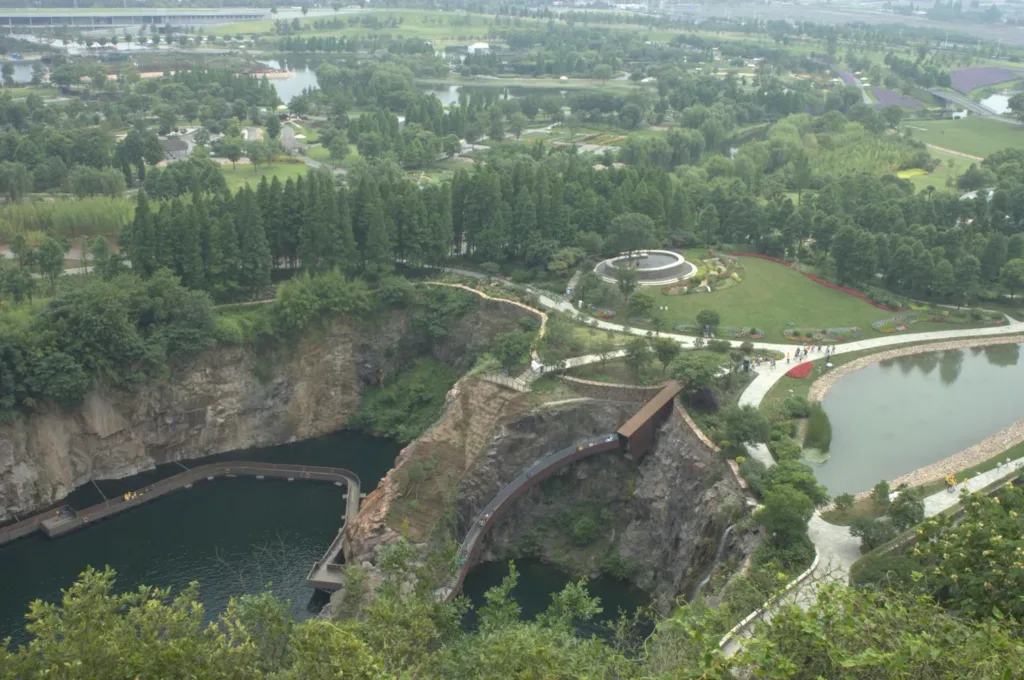 Chenshan’s former quarry reworked as a garden, with exposed rock faces, pools and paths at different levels. Photo: Brookqi · CC BY-SA 4.0
Chenshan Botanical Garden辰山植物园
Set aside a spacious day for Chenshan Botanical Garden in Songjiang, where specialist plant collections and exhibition greenhouses meet a striking reclaimed quarry landscape. The Quarry Garden’s exposed rock, water and layered paths make a particularly distinctive stop; choose a few garden areas rather than trying to cover the entire 207-hectare site.
Read the place guide → Low roof forms meet the water at Guangfulin Cultural Relics Park. The photograph is a supporting panorama, not a detailed architectural view. Photo: coolmanjackey · CC BY-SA 3.0
Guangfulin Cultural Relics Park广富林文化遗址
At Guangfulin in Songjiang, archaeological interpretation sits beside water-facing museum roofs and the park’s retained rural landscape. Start with the pottery-inspired Archaeological Museum, compare it with the partly submerged Cultural Museum, then explore the park landscape. Check which halls are open and what each costs before travelling; published schedules and tariffs found for this guide are dated, not confirmed 2026 terms.
Read the place guide → Pond-side pavilion at Zuibaichi, photographed on 12 October 2019. Photo: Szalai.laci · CC BY-SA 4.0
Zuibaichi醉白池
Zuibaichi (醉白池), or Zuibaichi Garden, is a historic garden in Songjiang rather than central Shanghai. Its pond, covered verandas, rockeries and halls reward a slow circuit focused on framed water views and the changing relationship between buildings and planting. The public garden preserves layers of Song-, Ming- and Qing-period history, but access to individual historic interiors can vary.
Read the place guide → Square Pagoda above the garden canopy, photographed in 2013. The tower is clear, although its timberwork is dark in shadow. Photo: Humanclose · CC BY-SA 4.0
Fangta pagoda松江方塔园
In Songjiang’s old town, Fangta Garden pairs the slender Northern Song Square Pagoda with a Ming brick-carved screen, an old stone bridge, and historic halls set within a twentieth-century garden planned by architect Feng Jizhong. Come for the contrast between a tall, tiered tower and the garden’s quieter water, bamboo and relocated buildings—not for a preserved temple compound left untouched by time.
Read the place guide → Huzhu Pagoda viewed from within its protected perimeter. Photo: Narjuko · CC BY-SA 4.0
Huzhu Pagoda护珠塔
On Tianmashan’s wooded middle peak in Songjiang, Huzhu Pagoda is a seven-tier, octagonal brick tower whose marked lean makes its history of fire and repair visible at a glance. Walk the hill for the tower’s silhouette and its setting beside an old ginkgo; check the current park map and entry arrangements before setting out, because published trail descriptions do not identify a guaranteed pagoda route.
Read the place guide → Thames Town’s central streetscape, photographed in October 2006. Archival view; not a representation of current conditions. Photo: Huai-Chun Hsu · CC BY 2.0
Thames Town泰晤士小镇
Thames Town is a residential district in Songjiang built around an English-inspired town centre, not a preserved British settlement. Walk the small stone-paved lanes and mixed-use façades around the church-centred square, then look toward the broader lakeside setting; treat homes and individual venues as separate premises with their own access rules.
Read the place guide →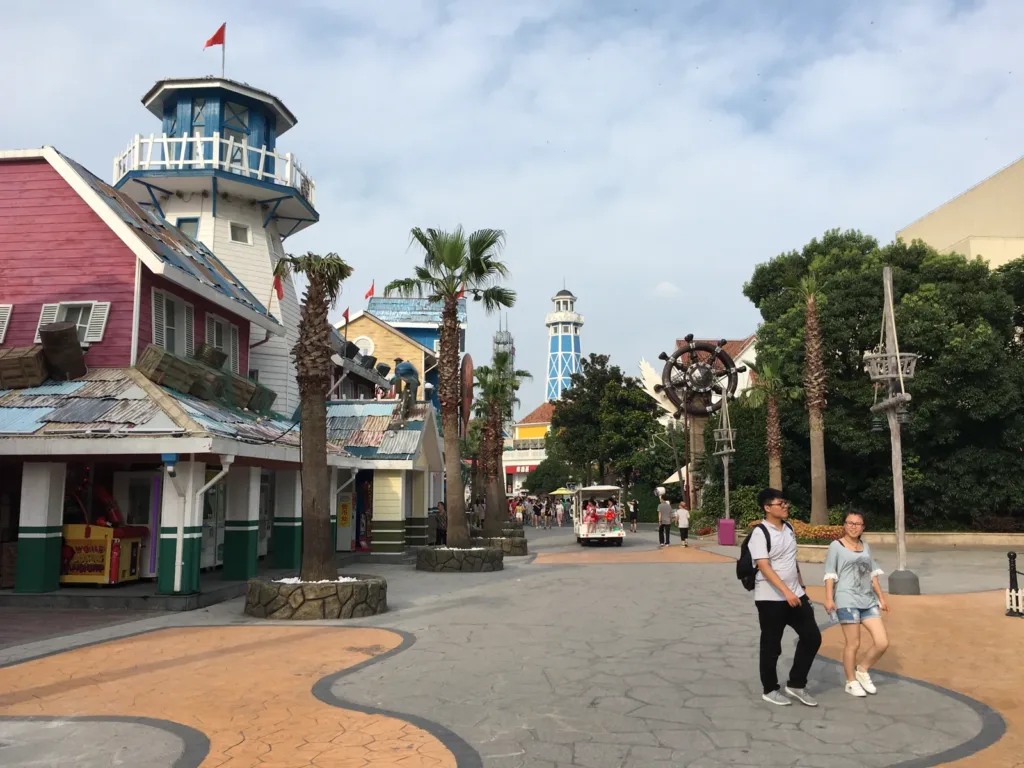 Shanghai Happy Valley’s themed pedestrian area. This older photograph illustrates the park’s staged streetscape, not the current ride lineup or operating status. Photo: Szalai.laci · CC BY-SA 4.0
Shanghai Happy Valley上海欢乐谷
Shanghai Happy Valley is a large, purpose-built theme park in Songjiang’s Sheshan resort area, with seven themed zones ranging from the Shanghai-styled streets of Shanghai Bund to Happy Ocean and Hurricane Bay. Its defining draw is the mix of major coasters, water rides, family attractions and seasonal entertainment; check live ride operations before choosing a route, since the full ride list is not a daily guarantee.
Read the place guide →Local life & food
Songjiang District local specialties
松江区特色美食 · 1 specialties to discover
 Yexie soft rice cake 叶榭软糕AI illustration · AI 示意图
A Songjiang specialty made from finely milled rice, Yexie soft rice cake is steamed into a tender, lightly springy cake. Look for plain or filled versions; bean paste and red-and-green winter-melon strips are traditional accompaniments, while recipes differ between makers.
Source ↗Read the dish guide →All dish names · 全部菜名 (1)
More dishes from across Shanghai are in the Shanghai food guide.
Plan your visit
Getting there
Songjiang District is about 35 km (straight-line distance) from central Shanghai. Search for 松江区 in a map app to find stations and your accommodation.
Where to stay →Build your route
Sheshan and Chenshan Botanical Garden are about 2 km apart (straight-line distance). The linked place guides have entrance and visit details.
Continue with Shanghai →More in Shanghai
Sources & geographic information
Administrative names and parent areas: Official geographic directory (dmfw.mca.gov.cn) · Reference date 2026-09-06.
Background text adapted from Songjiang, Shanghai — Wikipedia contributors, under CC BY-SA 4.0. Text has been shortened and reorganized; source revision 1370723189.
Map data © OpenStreetMap contributors. Pins mark approximate centres, not entrances or boundaries.
Image credits & notes (2)
- Xilin Chan Temple seen from its drum tower in Songjiang District, Shanghai. Photo: 2019-10-12 14:18:57.Photo: Szalai.laci · CC BY-SA 4.0Resized for the web; the photo itself has not been edited. Thumbnails may show a cropped view.
- Tianfei Palace in Fangta Garden, Songjiang. No changes made. Photo: EnderPro31415Photo: CC BY-SA 4.0
