

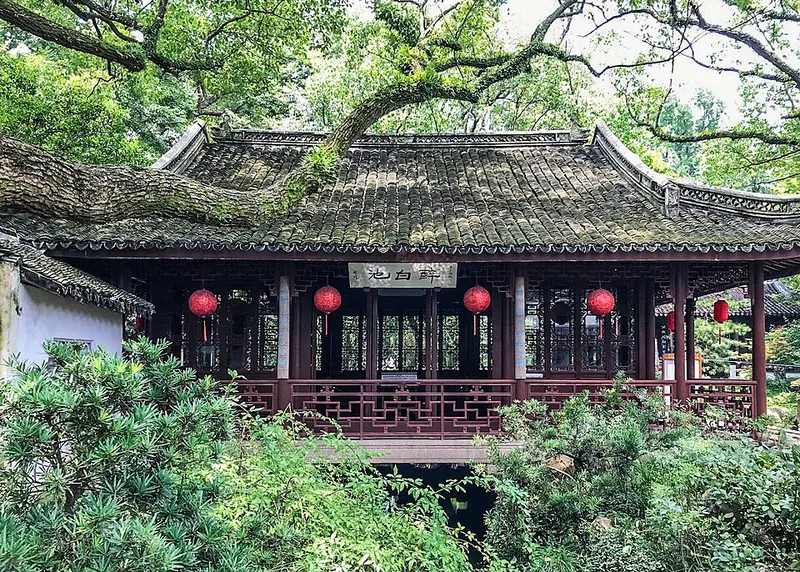
Photo adjustments
Full frame retained; proportionally resized and converted to WebP. No retouching or changes to the photographed subject. Card displays may crop the view.
Explore the region
About Zuibaichi
Winding paths create changing views of water, planting and buildings.
The Ancient Long Gallery and Crane Pavilion offer two distinct architectural stops, while Xuehai Hall adds a larger interior volume to the ensemble. Focus on these relationships rather than the garden’s uncertain name legends. Seasonal flowers change the character of the grounds, but the pond-and-building composition is the stable reason to visit.
According to the Songjiang gazetteer, the garden was first built as a private residence, Guyang Garden (谷阳园), by the Song dynasty scholar Zhu Zhichun after his retirement, and the Ming painter Dong Qichang later composed poetry there. In the Shunzhi era of the Qing dynasty, Gu Dashen (顾大申) enlarged the garden in homage to the Song chancellor Han Qi's devotion to the poet Bai Juyi, naming it Zuibaichi; its present layout largely follows this Qing dynasty arrangement.
The garden was used as a foundling hospital from 1797 until it was repaired and reopened to the public in 1959. On 26 December 1912, Sun Yat-sen attended a banquet in Xuehai Hall (雪海堂) during an inspection of Songjiang and delivered four speeches there. The garden survived the Anti-Japanese War largely intact, though it was occupied by Japanese forces, and was damaged again during the Cultural Revolution. In 1958 it was transferred to local authorities and its outer garden was expanded for public leisure.
Zuibaichi is a national AAAA-rated tourist attraction (国家AAAA级旅游景区) and a Shanghai municipal cultural relic protection site (上海市文物保护单位). After the Cultural Revolution its Japanese-era decoration was removed and damaged plaques were re-inscribed by the Songjiang painter Cheng Shifa (程十发). In 2020 the garden held an exhibition of cultural relics and documents marking the 95th anniversary of Sun Yat-sen's death.
What to look for
- The pond is framed by winding paths, pavilions and planted scenery.
- The Ancient Long Gallery and Crane Pavilion provide contrasting garden structures.
Background & history
Zuibaichi (Chinese: 醉白池; lit. 'Drunken Bai Pond') is a Chinese garden in Shanghai's suburban Songjiang District that dates back to the Song Dynasty. It occupies an area of 5 hectares and is one of the five ancient Chinese gardens in Shanghai, along the Guyi Garden, the Yu Garden, the Garden of Autumn Vapors, and the Garden of Zigzag Stream.
Excerpt from Wikipedia: Zuibaichi · Wikipedia contributors · CC BY-SA 4.0. Selected introductory sentences; formatting simplified. Background information, not current visitor-service advice.
Location & getting there
Getting to Zuibaichi
Use Zuibaichi Park station and approach the garden on Renmin South Road in Songjiang.
Combine your visit
A suggested sequence linking the specific features of this visit.
-
Central pond
Begin with the water feature that organizes the garden.
-
Ancient Long Gallery
Follow the sequence of framed views along the covered structure.
-
Crane Pavilion
Compare a compact pavilion with the gallery and pond setting.
This order is editorial. Confirm access and any transfers between stops; it does not establish a walking route, same-day connection or common admission ticket.
Find Zuibaichi
醉白池 · 松江区
The pin marks the area, not the entrance.
More places nearby
Approximate straight-line distances between map pins, not travel distances.
Fangta pagoda 松江方塔园
1 km awayFangta Park surrounds the Square Pagoda on the former Xingshengjiao Temple site in old Songjiang. The modern park brings together the pagoda with historic structures and fragments from several periods.
View guide →Thames Town 泰晤士小镇
5 km awayThames Town is a modern planned neighbourhood in Songjiang inspired by English market-town architecture. Its terraces, shopfronts and church-centred square were created as part of the new-town development.
View guide →Guangfulin Cultural Relics Park 广富林文化遗址
8 km awayGuangfulin Cultural Relics Park is in northern Songjiang, Shanghai. The archaeological heritage is central to the district’s presentation of Shanghai’s early history. The visitor site began trial operation in June 2018 and…
View guide →Sources & visit information
The sources below support the place-specific description and arrival information. Suggested combinations are editorial planning ideas; confirm current opening, entry arrangements and transport services for your date.
- Zuibaichi ↗
- Shanghai/Songjiang ↗
- Chinese Wikipedia: 醉白池 (revision 92089632, 2026-03-29) ↗
- English Wikipedia: Zuibaichi (revision 1365914002, 2026-07-25) ↗
Visitor information adapted and edited from Wikipedia contributors, “Zuibaichi” · CC BY-SA 4.0. Source revision 1365914002.
Visitor information adapted and edited from Wikivoyage contributors, listing “Zuibai Pond Garden” · CC BY-SA 4.0.
Background paragraphs translated and condensed from Wikipedia contributors, "醉白池", Chinese Wikipedia · CC BY-SA 4.0. Source revision 92089632.
Background paragraphs condensed from Wikipedia contributors, "Zuibaichi", English Wikipedia · CC BY-SA 4.0. Source revision 1365914002.