

Photo adjustments
Wikimedia thumbnail; fitted to the ranking-card frame.
Explore the region
About Mount Qingcheng
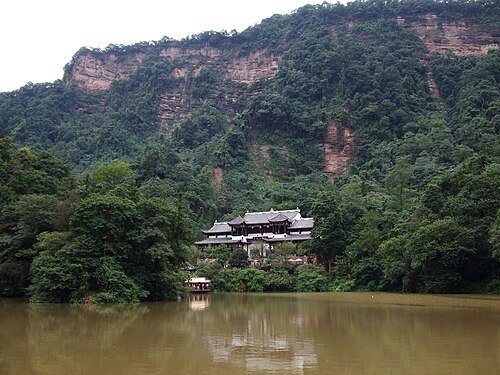
Jianfu Palace marks the lower approach, while higher halls connect the walk with the mountain’s long religious history. The experience is as much about moving through shaded paths and courtyards as reaching a summit. The back mountain is a separate scenic route focused more on valleys and streams, so choose the side that matches your interests before arranging transport.
Mount Qingcheng is counted among the birthplaces of Taoism. In 142 AD Zhang Daoling developed the Way of the Five Pecks of Rice, and Taoist temples built on the mountain during the Jin and Tang dynasties shaped later Taoist practice. Its present name derives from a Tang dynasty decree: after a dispute between Buddhist and Taoist establishments on the mountain, Emperor Xuanzong (唐玄宗) ruled that Buddhist temples move outside the mountain while Taoist monasteries remained, and his decree, preserved on a stele on the mountain, changed the name's character.
The mountain's 36 peaks are arranged in a ring, with sharp ridges; the dense greenery enclosing the ring like a city wall gave the mountain its name. It forms the eastern branch of the southern Qionglai Mountains (邛崃山脉), shaped by strong compression during the range's uplift 180 million years ago. The mountain lies in southwest Dujiangyan, Chengdu, about 10 km southwest of the Dujiangyan Irrigation System (都江堰水利工程); its main peak, Laoxiao Peak (老霄顶), rises to 1600 m.
Mount Qingcheng was inscribed on the World Heritage List with the Dujiangyan Irrigation System in 2000 and is a national key scenic area (国家重点风景名胜区). Its Qing-to-Republic-era building complex was listed as a Major Historical and Cultural Site Protected at the National Level (全国重点文物保护单位) in 2013. The mountain was affected by the 2008 Wenchuan earthquake.
What to look for
- Taoist halls and courtyards punctuate the forested front-mountain route.
- Jianfu Palace introduces the mountain’s religious landscape at the lower approach.
Location & getting there
Getting to Mount Qingcheng
Use Qingchengshan railway station and arrange the onward connection to the front-mountain visitor entrance. The railway station, front mountain and back mountain are distinct locations. Check operating cableways and the return route before deciding how far to climb.
Combine your visit
Choose from these complementary stops when planning your visit.
-
Jianfu Palace建福宫
Begin with the lower temple precinct.
-
Front-mountain paths青城前山步道
Follow the open forest and temple route.
-
Shangqing Palace上清宫
Add the higher religious precinct if your route and time allow.
This is a suggested combination, not a timed route; confirm the opening and transport arrangements for your date.
Find Mount Qingcheng
青城山 · 都江堰市
The pin marks the area, not the entrance.
More places nearby
Approximate straight-line distances between map pins, not travel distances.
Shangqing Palace 青城山上清宫
Less than 1 km awayShangqing Palace is a major temple stop high on Qingcheng’s front mountain. Its halls bring together Taoist worship, inscribed religious texts and local traditions associated with Magu Pool and the paired Yuanyang wells. The…
View guide →Jianfu Palace 青城山建福宫
2 km awayJianfu Palace stands at Qingcheng’s front-mountain approach, offering a compact introduction to the mountain’s Taoist tradition. The surviving layout centres on two courtyards and three halls, with gardens and small landscape…
View guide →Insect Museum of West China 成都华希昆虫博物馆
4 km awayHuaxi Insect Museum near Qingcheng Mountain makes the variety of insects visible through carefully arranged specimen displays. Butterfly groups, beetles, dragonflies and stick insects allow comparisons of colour, form and…
View guide →Sources & visit information
The sources below support the place-specific description and arrival information. Suggested combinations are editorial planning ideas; confirm current opening, entry arrangements and transport services for your date.
- UNESCO: Qingcheng’s Taoist temples and wooded mountain setting ↗
- Chinese Wikipedia: 青城山 (revision 91861070, 2026-03-12) ↗
- English Wikipedia: Mount Qingcheng (revision 1365737847, 2026-07-24) ↗
Background paragraphs translated and condensed from Wikipedia contributors, "青城山", Chinese Wikipedia · CC BY-SA 4.0. Source revision 91861070.
Background paragraphs condensed from Wikipedia contributors, "Mount Qingcheng", English Wikipedia · CC BY-SA 4.0. Source revision 1365737847.