


Get to know Dujiangyan

- Administrative area
- County-level city · 县级市
- Part of
- Chengdu
- Chinese name
- 都江堰市
- Local areas
- County-level city guide
Area & population
- Area
- 1,208.00 km²
- Population · 2020
- 710,056
- Administrative seat
- Guankou Subdistrict
Source: English Wikipedia, as of the dates shown.
Two distinct visitor areas
Dujiangyan is a county-level city administered by Chengdu, not one single attraction. Its best-known visits fall into two separated areas: the urban Min River and irrigation-works district, and Mount Qingcheng to the southwest, about 16 km from the city centre according to Chengdu's visitor guide. Plan them as separate stops rather than assuming one entrance or one walk serves both.
In the urban area, the UNESCO-listed Dujiangyan Irrigation System is a working landscape, not simply a monument. The Yuzui (Fish-Mouth Levee) divides the river flow; Feishayan (Flying-Sand Weir) helps discharge floodwater and sediment; and Baopingkou (Bottle-Neck Channel) directs water into the irrigation network. Walk the scenic area to see these elements in sequence and use the crossing and elevated viewpoints to understand how the river is divided and managed. Erwang Temple and Fulong Temple connect the hydraulic works with their long history of maintenance and local memory. The system still irrigates the Chengdu Plain.
Nearby Guanxian old-town streets form a distinct urban heritage and leisure area, with Nanqiao, the old city wall and the Confucian Temple among the municipal tourism page’s named features. Treat it as a separate walk from the waterworks route, and check admission separately for any individual venue. Do not assume a particular evening lighting display or water-colour effect is guaranteed.
Mount Qingcheng is a separate wooded mountain-and-temple visit. Its front-mountain route includes Jianfu Palace, Tianshi Cave and Shangqing Palace, with steep paths, steps and forest shade; it rewards a slower uphill visit rather than a quick photo stop. Chengdu's visitor page also lists Yuecheng Lake and Laojun Pavilion among the main sights. Qingcheng is associated with early Taoist history and its temple architecture; it is not interchangeable with the water-engineering story in the city centre.
Tickets and current status
Chengdu’s visitor directory pages dated April 2026 list both areas as open 08:00–17:00. A separate municipal tourism page gives seasonal hours for the irrigation scenic area (08:00–17:30 in winter and 08:00–18:00 in summer), so the official pages do not agree. Use the current “悦游都江堰” channel or on-site notice for the visit date. The pages reproduce an ¥80 admission figure and senior concessions explicitly dated to 2018; that is a historical listing, not a verified current 2026 price. Check current entry slots, closures and price before setting out; a QR code on a directory page does not itself prove a particular slot is available.
Getting there
Urban irrigation works and Guanxian old town: From Chengdu, take Metro Line 2 to Xipu (犀浦), then transfer to the Chengdu–Dujiangyan intercity train to Lidui Park (离堆公园) or another Dujiangyan station. Search and book the rail leg in China Railway 12306; this is a railway connection, not a metro ride through to Dujiangyan. Xipu station is served by Metro Line 2 and the Chengdu–Dujiangyan intercity railway. The 12306 query page opened for Xipu–Lidui Park did not expose departures in its text extraction, so verify current train and ticket availability for the travel date. From Lidui Park station, follow station wayfinding toward the Dujiangyan Scenic Area’s Lidui Park visitor entrance; station exit numbers and a measured walking distance are not confirmed here. Chengdu's visitor directory identifies local buses 1 and 4 and a scenic shuttle as options for the scenic area, but does not identify a verified boarding stop in the page; use only a currently posted stop and destination display.
For a taxi or ride-hail, enter 都江堰景区离堆公园入口 Dūjiāngyàn Jǐngqū Líduī Gōngyuán Rùkǒu (Dujiangyan Scenic Area, Lidui Park entrance; the official guide describes the approach via 公园路, but gives no verified street number) for the irrigation works, or 灌县古城南桥 Guànxiàn Gǔchéng Nánqiáo (Guanxian Old Town, Nanqiao) for the riverfront. Use a signed public drop-off or legal roadside bay near the visitor approach; do not ask a driver to stop on a bridge, in a restricted lane, or at a closed gate. The municipal directory describes the road approach via Yingbin Road, Taiping Street, Jiang'an Road, Tianyi Street and Gongyuan Road, but does not verify a designated taxi bay.
Mount Qingcheng: Qingchengshan (青城山) is a station on the intercity railway, but the opened 12306 query did not expose departures; confirm date-specific trains and return availability before planning around it. Chengdu's visitor page confirms bus 101 between the city area and Qingcheng Mountain but does not specify a dependable stop name or current timetable; confirm the destination sign and return service locally before relying on it. For a taxi, enter 青城山景区前山山门 (Mount Qingcheng Scenic Area, front-mountain entrance; an exact street number is not confirmed). Set down only at an authorised visitor drop-off point; do not assume a driver can enter the scenic area. The visitor guide gives the road approach via Qingcheng Bridge and Zhongxing Town.
Do not confuse the urban Dujiangyan railway station, Lidui Park station and Qingchengshan station. None is a Chengdu Metro station. The district is broad, so select the destination by the area you intend to visit rather than using “Dujiangyan” alone.
Guide sources
- Chengdu Government visitor guide: Dujiangyan
- Chengdu Government visitor guide: Mount Qingcheng
- UNESCO World Heritage Centre: Mount Qingcheng and the Dujiangyan Irrigation System
- China Railway 12306 route query: Xipu to Lidui Park
- Xipu station: Metro Line 2 and Chengdu–Dujiangyan rail connections
- Dujiangyan Municipal Government tourism map and visitor guide
Explore Dujiangyan
Core places to explore, with English and Chinese names.
Dujiangyan Irrigation System 都江堰水利工程
Mount Qingcheng 青城山
Dujiangyan Panda Base 都江堰中华大熊猫苑
Qingcheng Back Mountain 青城山·后山
Tai'an Ancient Town 泰安古镇
Guanxian Ancient Town 灌县古城
Panda Valley 熊猫谷
Erwang Temple 二王庙
Yulei Mountain Park 玉垒山公园
Insect Museum of West China 成都华希昆虫博物馆
Dujiangyan South Bridge 都江堰南桥
Lingyan Temple 都江堰灵岩寺
Puzhao Temple 都江堰普照寺
Jianfu Palace 青城山建福宫
Shangqing Palace 青城山上清宫
Places to explore around Dujiangyan
 Dujiangyan Irrigation System · 都江堰水利工程
Dujiangyan Irrigation System都江堰水利工程
See how the Min River is divided, excess water and sediment are shed, and a carved channel meters irrigation flow at Dujiangyan, a working third-century-BCE system on Chengdu’s western plain.
Read the place guide →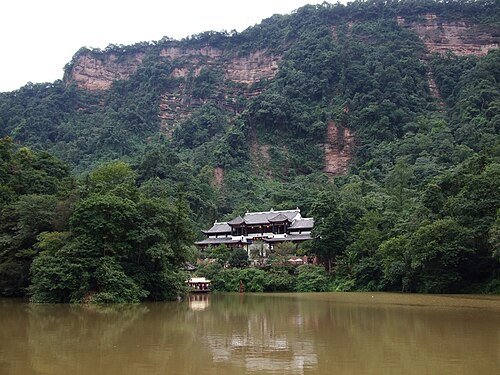 Lake and lower cableway station on Qingcheng Mountain.
Mount Qingcheng青城山
Walk into the wooded Taoist landscape of Qingcheng Mountain’s Front Mountain, where temples including Jianfu Palace, Tianshi Cave and Shangqing Palace link a steep mountain path with the history of Taoism. It is in Dujiangyan, within Chengdu Municipality, and is distinct from the separate Back Mountain area.
Read the place guide → AI illustration; an interpretive view, not a photograph. AI 示意图,非景点实拍。
Dujiangyan Panda Base都江堰中华大熊猫苑
Dujiangyan Panda Base, also called 都江堰中华大熊猫苑, is a China Conservation and Research Center for the Giant Panda facility in Qingchengshan Town, Dujiangyan. It is a different institution and location from Panda Valley. The Centre announced that this base closed on 23 April 2026 for an upgrade, with reopening to be announced; do not plan a visit or rely on historic ticket information until an official reopening notice is issued.
Read the place guide →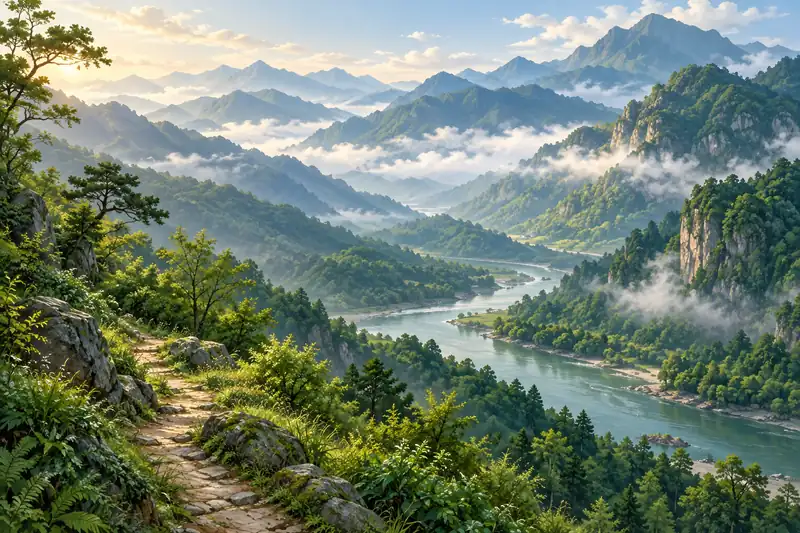 AI illustration · AI 示意图(仅供参考,非该地点实拍)
Qingcheng Back Mountain青城山·后山
West of central Chengdu in Dujiangyan, Qingcheng Back Mountain is a forested hiking area approached through Tai’an Ancient Town. Follow the valleys and streamside paths on foot; it is a different outing from the temple-focused Front Mountain.
Read the place guide → Tai'an Ancient Town · 泰安古镇
Tai'an Ancient Town泰安古镇
A small foothill gateway in Dujiangyan for the forested trails of Qingcheng Back Mountain. Walk the town’s lanes, then use it as a base for a separately planned mountain outing; current tickets, trail access and onward transport should be checked before departure.
Read the place guide →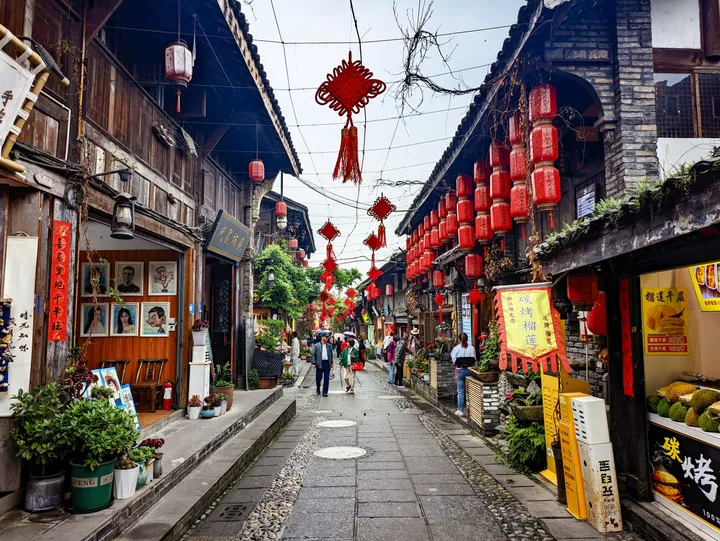 West Street in Guanxian Ancient Town, Dujiangyan, decorated with red lanterns · 都江堰灌县古城西街,挂满红灯笼 Source-recorded photograph date: 2024-05-01 11:34:23.
Guanxian Ancient Town灌县古城
A walkable old-town district in Dujiangyan, where the former county name survives in the street identity. Explore Xuanhua Gate, West Street and the lanes around Yangliu River, then continue toward South Bridge for a view of the river setting beside the irrigation works.
Read the place guide → A giant panda at Panda Valley scenic area, Dujiangyan · 都江堰市熊猫谷景区大熊猫 Source-recorded photograph date: 2024-03-07 10:31:15.
Panda Valley熊猫谷
Panda Valley is Chengdu’s Dujiangyan-based giant-panda conservation and reintroduction centre, where a forested walking route brings visitors past panda habitats and a red-panda area. Reserve through the official Panda Valley channel and plan a rail-and-taxi journey from Chengdu; there is no metro station at the park.
Read the place guide → The main gate of Erwang Temple in Dujiangyan, with its signboard reading '二王庙' above the entrance stairway · 都江堰二王庙山门,牌匾书'二王庙' Source-recorded photograph date: 2024-12-24.
Erwang Temple二王庙
A hillside temple within the Dujiangyan Irrigation System precinct, Erwang Temple commemorates Li Bing and his son. Its timber halls, inscribed stone texts and views over the working waterworks make it a meaningful stop on a walk across the Anlan Suspension Bridge.
Read the place guide → Yulei Mountain Park · 玉垒山公园
Yulei Mountain Park玉垒山公园
A wooded hillside above Dujiangyan’s old town, where uphill paths lead past the Chenghuang Temple (城隍庙) and offer views toward the irrigation works and West Street. Treat it as part of the wider Dujiangyan visit: current listings indicate that a parent scenic-area ticket may be required.
Read the place guide →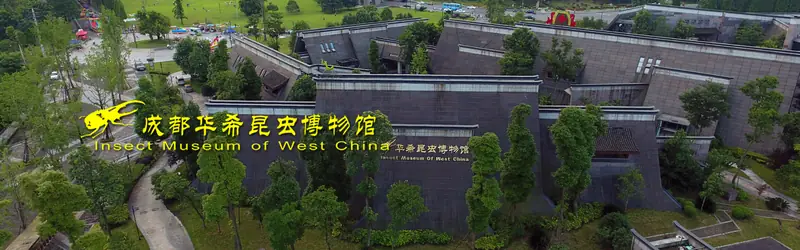 Insect Museum of West China · 成都华希昆虫博物馆
Insect Museum of West China成都华希昆虫博物馆
A specialist museum at the foot of Qingcheng Mountain, with systematically arranged Chinese butterflies and other insects, fossil specimens, and striking examples such as a record-length stick insect. Reach it from Qingchengshan railway station by local bus 101 and a short walk.
Read the place guide →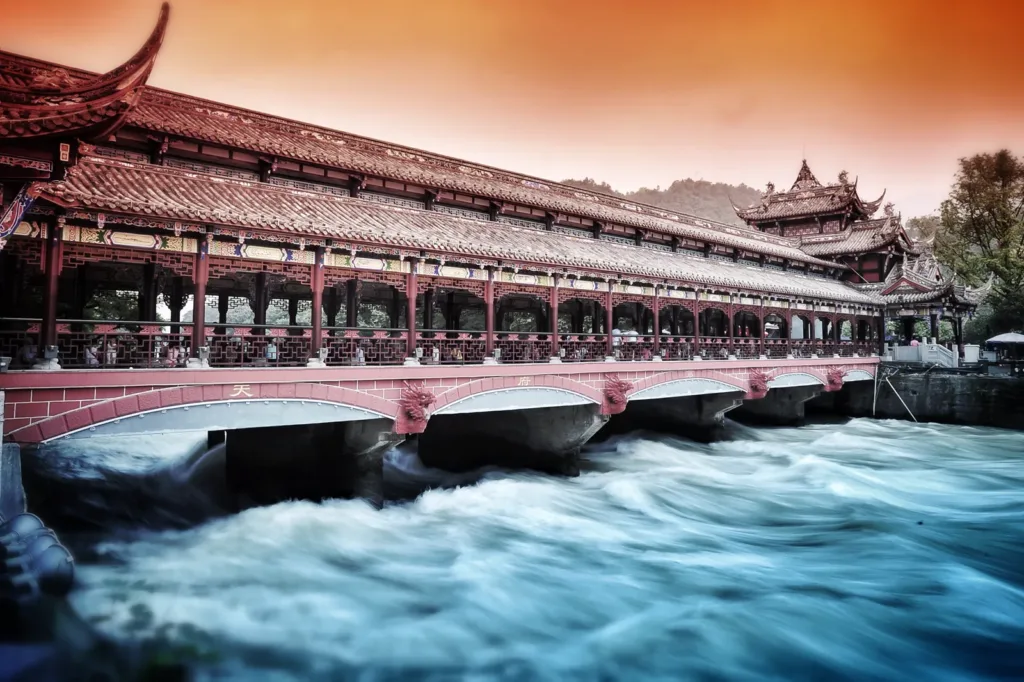 South Bridge spans the Min River inner channel at Dujiangyan, with its covered corridor above the fast water. Photo: 蒋亦炯 (EXIF copyright: CalvinJ) · CC BY-SA 3.0
Dujiangyan South Bridge都江堰南桥
An ornate covered bridge over the Min River’s inner channel, South Bridge joins the old streets of Guanxian with the entrance to the Dujiangyan irrigation-works area. Look up at its painted roof and carved figures, then pause over the fast water; after dark, explore the riverside lights if they are operating.
Read the place guide →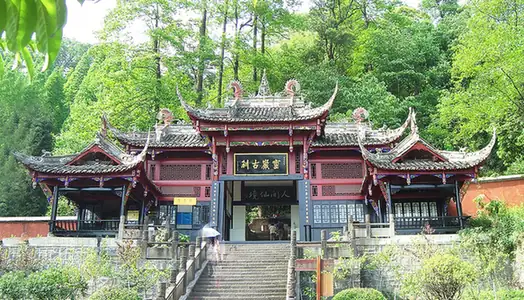 Lingyan Temple · 都江堰灵岩寺
Lingyan Temple都江堰灵岩寺
A nationally designated heritage group in Dujiangyan, where an uphill temple precinct and a carved stone stupa preserve layers of Buddhist history. Current public entry is not confirmed; check before travelling.
Read the place guide →Gate pavilion and entrance stairway of Puzhao Temple, Dujiangyan · 都江堰普照寺山门及石阶 Source-recorded photograph date: 2013-11-19 10:12:07.Puzhao Temple都江堰普照寺
A Qing-era Buddhist monastery in Dujiangyan’s Qingcheng Outer Mountain, known for its forested setting and surviving historic buildings. Check access before making the rural trip; current opening and transport details are not confirmed by an official live notice.
Read the place guide →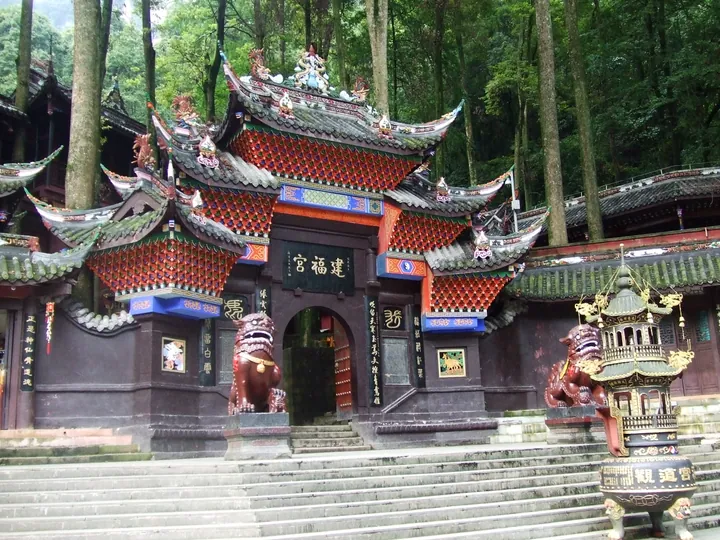 The main gate of Jianfu Palace on Mount Qingcheng · 青城山建福宫山门 Source-recorded photograph date: Taken on 21 August 2011.
Jianfu Palace青城山建福宫
At the lower entrance to Qingcheng Mountain’s Taoist front-mountain route, Jianfu Palace offers a compact introduction to the mountain’s temple tradition. Look for its three halls and the celebrated 394-character couplet before deciding whether to continue uphill.
Read the place guide →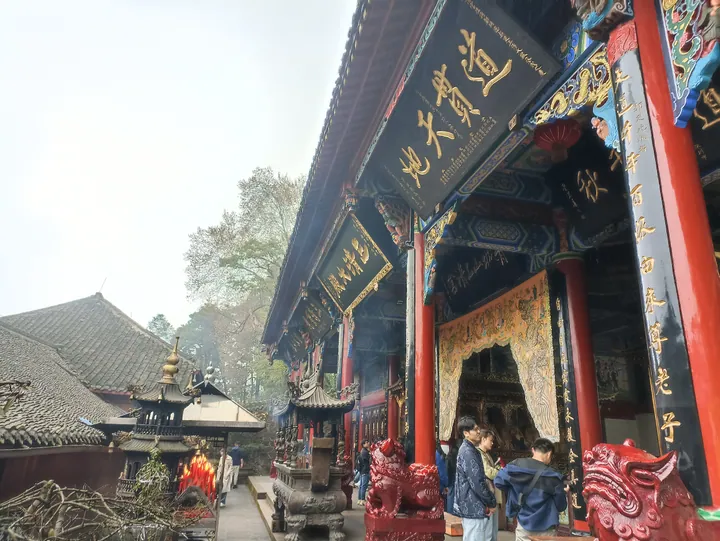 A courtyard hall at Shangqing Palace on Mount Qingcheng · 青城山上清宫殿堂庭院 Source-recorded photograph date: 2023-03-19 13:38:29.
Shangqing Palace青城山上清宫
A Taoist temple in Qingcheng Mountain’s wooded Front Mountain scenic area, Shangqing Palace rewards visitors who follow the signed mountain paths for temple architecture and a close encounter with the living religious landscape of Qingcheng.
Read the place guide →Plan your visit
Getting there
Dujiangyan is about 55 km (straight-line distance) from central Chengdu. Search for 都江堰市 in a map app to find stations and your accommodation.
Where to stay →Build your route
Dujiangyan Irrigation System and Mount Qingcheng are about 10 km apart (straight-line distance). The linked place guides have entrance and visit details.
Continue with Chengdu →More in Chengdu
Sources & geographic information
Administrative names and parent areas: Official geographic directory (dmfw.mca.gov.cn) · Reference date 2026-09-06.
Background text adapted from Dujiangyan City — Wikipedia contributors, under CC BY-SA 4.0. Text has been shortened and reorganized; source revision 1357672576.
Photo: Dujiangyan Irrigation System · 星星 · CC BY-SA 4.0. Wikimedia Commons image, fitted to the card frame.

Photo: Mount Qingcheng · Nyx Ning · CC BY-SA 3.0. Wikimedia Commons image, fitted to the card frame.

Photo: Tai'an Ancient Town · show.meitu.com. Resized for the web; the photo itself has not been edited.
Photo: Guanxian Ancient Town · Kcx36 · CC BY-SA 4.0. Resized for the web; the photo itself has not been edited. Thumbnails may show a cropped view.

Photo: Panda Valley · Funmoring46 · CC BY 4.0. Resized for the web; the photo itself has not been edited. Thumbnails may show a cropped view.

Photo: Erwang Temple · 纳瓦拉的亨利 · CC BY-SA 4.0. Resized for the web; the photo itself has not been edited. Thumbnails may show a cropped view.

Photo: Yulei Mountain Park · cn.tripadvisor.com. Resized for the web; the photo itself has not been edited.
Photo: Insect Museum of West China · asia-insect.com. Resized for the web; the photo itself has not been edited.
Photo: Lingyan Temple · Nekitarc · CC BY-SA 3.0. Resized for the web; the photo itself has not been edited.

Photo: Puzhao Temple · BODHICITTA · CC BY 2.0. Resized for the web; the photo itself has not been edited. Thumbnails may show a cropped view.

Photo: Jianfu Palace · Nyx Ning · CC BY-SA 3.0. Resized for the web; the photo itself has not been edited. Thumbnails may show a cropped view.

Photo: Shangqing Palace · Kcx36 · CC BY-SA 4.0. Resized for the web; the photo itself has not been edited. Thumbnails may show a cropped view.

Map data © OpenStreetMap contributors. Pins mark approximate centres, not entrances or boundaries.
Image credits & notes (1)
- The wooded approach and temple entrance at Puzhao Temple in Dujiangyan. Photo: 2013-11-19 10:12:07.Photo: BODHICITTA · CC BY 2.0Resized for the web; the photo itself has not been edited. Thumbnails may show a cropped view.