

Photo adjustments
Proportionally resized and converted to WebP without cropping, retouching or changing the photographed subject.
City & district guides
About Dule Temple
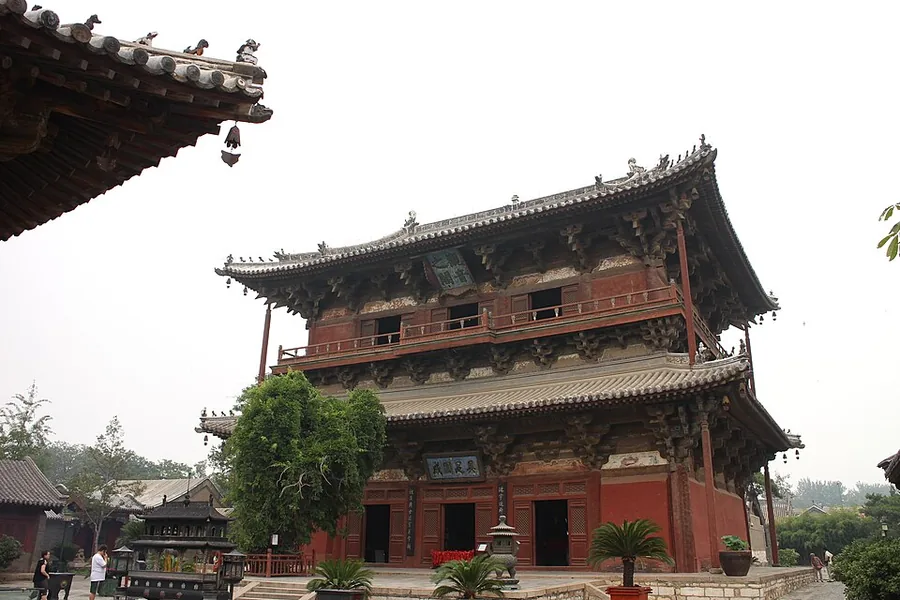
The pavilion shelters a colossal clay image of eleven-headed Guanyin, making the relationship between sculpture and wooden building especially powerful. The site's earlier origins do not mean that its present structures are Tang originals; the surviving gate and pavilion are associated with the rebuilding of 984. A compact visit can therefore focus on construction, brackets, scale and the way the pavilion encloses its principal image.
Also known as the Dafo Temple (大佛寺), Dule Temple is one of three surviving Liao-dynasty temples. In 755 An Lushan (安禄山) rallied his troops here at the start of his rebellion against the Tang, and according to the most widely circulated of several local traditions, the temple's name, meaning 'solitary joy', comes from his wish to enjoy the moment alone. The temple was looted in 1900 and occupied by Japanese troops in 1939.
The surviving mountain gate and Guanyin Pavilion were rebuilt in the second year of the Tonghe era (984); other buildings, including an east-side temporary imperial lodge built in 1753, date from the Ming dynasty or later. The pavilion stands 23 meters tall, the oldest surviving timber-framed pavilion in China, built with twenty-four kinds of bracket and joinery work and no nails. Inside, a clay statue of eleven-headed Guanyin rises 16 meters through a three-story central well to the roof.
Dule Temple is designated a Major Historical and Cultural Site Protected at the National Level (全国重点文物保护单位) and a special-protection-grade historical building by the Tianjin municipal government. The 1976 Tangshan earthquake damaged plaster and an iron band on the Guanyin statue but left the main halls intact.
What to look for
- The Liao-period timber mountain gate.
- Guanyin Pavilion and its large eleven-headed Guanyin sculpture.
- The structural relationship between timber framing and the tall devotional image.
The surrounding area
Northern municipal district for Dule Temple; not central Tianjin.
Location & getting there
Getting to Dule Temple
Dule Temple is at 41 Wuding Street in Jizhou's old town.
- Use Jizhou as the destination district when arranging transport from Tianjin; this is a separate northern excursion from the central Haihe sights.
Combine your visit
Suggested order within this visit:
-
Mountain gate
Begin with the first surviving timber structure.
-
Guanyin Pavilion
Compare the larger framing system and the sculpture it protects.
-
Wuding Street
Return through the old-town street after the temple visit.
This sequence is an editorial suggestion based on the features described in the sources. Access to individual buildings or areas should be checked locally; no travel time or shared admission is implied.
Find Dule Temple
独乐寺 · 蓟州区
The pin marks the area, not the entrance.
More places nearby
Approximate straight-line distances between map pins, not travel distances.
Mount Pan盘山
12 km awayMount Pan combines wooded slopes, distinctive boulders and temple sites in western Jizhou. Its traditional description divides the mountain into lower water scenery, middle rock scenery and upper pine scenery. Tiancheng Temple's…
View guide →Huangyaguan黄崖关长城
21 km awayHuangyaguan takes its name from the yellowish cliffs around a Great Wall pass in northern Jizhou. The defenses combine a mountain ridge, towers and a water pass, so the visit shows how the wall handled both steep land and…
View guide →Guangji Temple in Baodi宝坻广济寺
35 km awayBaodi's Guangji Temple, also called the West Great Temple, has a history reaching back to the Liao dynasty, but the present complex is a modern reconstruction. The earlier temple was demolished in 1947 and rebuilding took place…
View guide →Sources & visit information
The sources below support the place-specific description and arrival information. Suggested combinations are editorial planning ideas; confirm current opening, entry arrangements and transport services for your date.
- Wikipedia: Dule Temple ↗
- Wikivoyage: Tianjin/Jizhou ↗
- Chinese Wikipedia: 独乐寺 (revision 92854906, 2026-05-30) ↗
Visitor information adapted and edited from Wikipedia contributors · CC BY-SA 4.0. Source revision 1368260704.
Visitor information adapted and edited from Wikivoyage contributors · CC BY-SA 4.0. Source revision 5216358.
Background paragraphs translated and condensed from Wikipedia contributors, "独乐寺", Chinese Wikipedia · CC BY-SA 4.0. Source revision 92854906.
Background paragraphs condensed from Wikipedia contributors, "Dule Temple", English Wikipedia · CC BY-SA 4.0. Source revision 1368260704.