

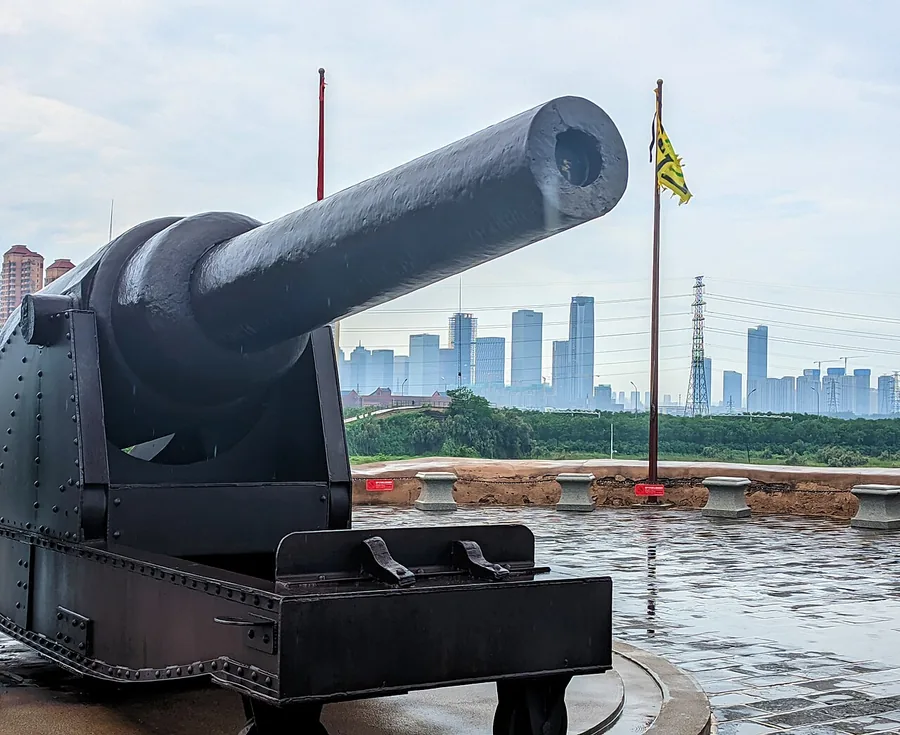
Photo adjustments
Proportionally resized and converted to WebP without cropping, retouching or changing the photographed subject.
Explore the region
About Taku Forts
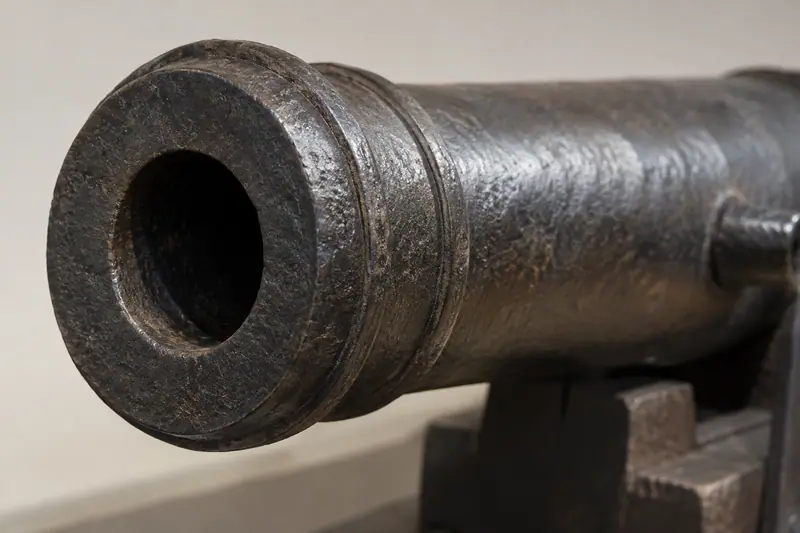
Most of the defenses were dismantled afterward, so today's visit combines surviving remains, a restored Wei Fort and museum interpretation rather than an intact ring of nineteenth-century fortifications. Cannons and objects recovered from the ruins make the maritime-defense story concrete. Study the displays before viewing the earthworks: the difference between an excavated remnant and a reconstructed form is central to understanding what survives.
The forts originated as Ming-dynasty coastal defenses first built during the Jiajing era under Qi Jiguang (戚继光), who had earlier been stationed at Tianjin. The Qing government repaired them in 1841 and expanded them further in 1858, adding three forts on the south bank and two on the north, named Wei, Zhen, Hai, Men and Gao (威, 震, 海, 门, 高); by then the site had six large forts, twenty-five small forts and sixty-four guns.
Following the Qing defeat in 1900, the Boxer Protocol (辛丑条约) required the forts to be demolished; only one blockhouse survived on each bank of the Haihe, both too far from the shoreline to serve a defensive purpose. The site was designated a Major Historical and Cultural Site Protected at the National Level (全国重点文物保护单位) in 1988 and a national patriotic-education demonstration base in 2005, and is now organized as the Taku Forts Museum and Ruins Park, one of the 'Ten Scenes of Jinmen' (津门十景).
What to look for
- Cannons and recovered objects in the Dagukou Fort Ruins Museum.
- The restored Wei Fort, distinguished from the original nineteenth-century appearance.
- The estuary setting that explains the defenses' strategic position.
The surrounding area
Separate coastal municipal area with maritime and modern cultural attractions.
Location & getting there
Getting to Taku Forts
Use 1 Paotai Road in the eastern Tanggu area of Binhai.
- Binhai Railway Station is a regional arrival anchor; arrange the remaining road leg to Dagukou Fort Ruins Museum.
Combine your visit
Suggested order within this visit:
-
Fort Ruins Museum
Establish the changing defensive system and its conflicts.
-
Wei Fort and remains
Compare the reconstructed fort with the surviving evidence.
This sequence is an editorial suggestion based on the features described in the sources. Access to individual buildings or areas should be checked locally; no travel time or shared admission is implied.
Find Taku Forts
大沽口炮台 · 滨海新区
The pin marks the area, not the entrance.
More places nearby
Approximate straight-line distances between map pins, not travel distances.
Binhai Library 滨海图书馆
4 km awayBinhai Library is known for a luminous spherical auditorium surrounded by sweeping white terraces in its central atrium. Designed by MVRDV with local partners and opened in 2017, the building turns the idea of shelves into a…
View guide →Tianjin Polar Ocean Park 天津极地海洋公园(原海昌)
6 km awayTianjin Polar Ocean Park is the marine-animal attraction in Xiangluowan, also found in older sources under the Haichang Polar Ocean World name. The main building has a whale-like outline, and its visitor areas combine…
View guide →Dongjiang Bay Beach 东疆湾沙滩
11 km awayDongjiang Bay is a constructed sandy beach on the eastern side of Tianjin's port peninsula. Breakwaters enclose the waterfront, giving it a different character from an undeveloped open-coast beach. The broad sandy shore is the…
View guide →Sources & visit information
The sources below support the place-specific description and arrival information. Suggested combinations are editorial planning ideas; confirm current opening, entry arrangements and transport services for your date.
- Wikipedia: Taku Forts ↗
- Wikivoyage: Tianjin/Binhai ↗
- Chinese Wikipedia: 大沽口炮台 (revision 93353651, 2026-07-07) ↗
Visitor information adapted and edited from Wikipedia contributors · CC BY-SA 4.0. Source revision 1368780335.
Visitor information adapted and edited from Wikivoyage contributors · CC BY-SA 4.0. Source revision 5238066.
Background paragraphs translated and condensed from Wikipedia contributors, "大沽口炮台", Chinese Wikipedia · CC BY-SA 4.0. Source revision 93353651.
Background paragraphs condensed from Wikipedia contributors, "Taku Forts", English Wikipedia · CC BY-SA 4.0. Source revision 1368780335.