

Entry & permits for Tibet (Xizang)
Foreign tourists need Tibet entry approval, commonly called a Tibet Travel Permit, and an organised visit arranged through a specialist travel agency in China. Confirm your approved route before booking transport. Requirements differ for Taiwan residents and for travellers using mainland or Hong Kong/Macao Chinese resident documents; check the document guide before you book.
Check the travel-document requirements →Policy scope verified: 2026-09-06. UK FCDO: China regional travel advice ↗ State Council Taiwan Affairs Office: Tibet entry approval ↗ Xizang Department of Culture and Tourism: Medog border permit notice ↗
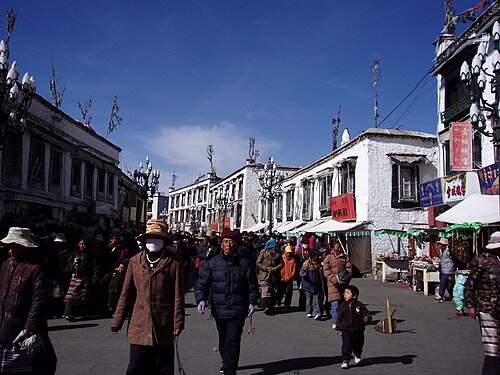
Photo adjustments
Wikimedia thumbnail; fitted to the ranking-card frame.
Explore the region
About Barkhor
Its eastern, southern, western and northern sections still combine religious movement with the commercial life of old Lhasa. The visit is about following that relationship: look at the temple-facing spaces, then the shops and older street fronts beyond them. Walk clockwise with the pilgrimage flow and allow people making prostrations room to continue their practice.
The street originated in the seventh century, after Songtsen Gampo and Princess Wencheng led a migration to Lhasa and built the Jokhang; Buddhist pilgrims circling the temple gradually wore a path that became the Barkhor, whose ring road runs about 1,000 meters in circumference. It forms the middle of Lhasa's three pilgrimage circuits, between the inner circuit inside the Jokhang, called Nangkuo (囊廓), and the outer circuit around the old city, including the Potala, called Lingkhor (林廓). Tibetans call the Barkhor the 'holy road', since the Tibetan word for circuit, 'kor', gives the street its name.
The older Chinese name 'Baijiao Jie' (八角街, 'Eight-Corner Street') arose because exchange between Tibetan and Han areas was then led through Sichuan, where 'jiao' (角) is pronounced 'guo' in the local dialect, producing that transliteration. The name is now rendered in Mandarin as 'Baguo Jie' (八廓街), though a closer transliteration would be 'Pargor' (帕廓): 'par' meaning middle and 'kor' meaning to circumambulate.
What to look for
- The four connected Barkhor streets, which together form the pilgrimage circuit around the Jokhang.
- The overlap of devotional activity, trading streets and preserved old-town façades around the temple.
The surrounding area
Palaces, monasteries, museums and a working old city with a strong tea-house culture.
Location & getting there
Getting to Barkhor
Begin at Barkhor Square on the west side of the Jokhang. From there, follow the circuit clockwise through the northern, eastern and southern streets before returning west.
- Leave space for pilgrims and ask before photographing people at close range; the circuit is an active religious route.
Combine your visit
Suggested order for this visit:
-
Barkhor Square and western temple frontage
Orient the walk around the Jokhang's position.
-
Northern and eastern Barkhor streets
Follow the clockwise circuit through its old-town trading sections.
-
Southern and western return
Complete the temple circuit without cutting against the pilgrimage flow.
This is an editorial sequence based on the features described in the sources. Confirm access locally; no walking time, shared admission or guaranteed interior access is implied.
Find Barkhor
八廓街 · 拉萨
The pin marks the area, not the entrance.
More places nearby
Approximate straight-line distances between map pins, not travel distances.
Jokhang Temple 大昭寺
Less than 1 km awayJokhang Temple faces west onto Barkhor Square in Lhasa’s old town. Founded in the seventh century and enlarged over many generations, the temple is especially associated with the Jowo Shakyamuni image, traditionally linked with…
View guide →Former Qing Resident Commissioners’ Office 清政府驻藏大臣衙门旧址
Less than 1 km awayThis restored three-storey Tibetan courtyard northeast of the Jokhang housed an early Qing resident commissioner's office. Its local name, Chongsai Kang, refers to seeing the market: the south-facing windows overlook the Barkhor…
View guide →Ramoche Temple 小昭寺
Less than 1 km awayRamoche stands north of the Barkhor and is traditionally paired with the Jokhang as one of Lhasa's two great early temples. Its central object of devotion is a gilded image representing Shakyamuni at eight years old, giving this…
View guide →Sources & visit information
The linked encyclopedia sources support background and place descriptions. Current opening hours, ticket prices, booking rules and transport schedules have not been independently verified for this guide. Confirm them with the venue or operator before travelling.
Visitor information adapted and edited from Wikipedia contributors · CC BY-SA 4.0. Source revision 91956044.
Background paragraphs translated and condensed from Wikipedia contributors, "八廓", Chinese Wikipedia · CC BY-SA 4.0. Source revision 91956044.
Background paragraphs condensed from Wikipedia contributors, "Barkhor", English Wikipedia · CC BY-SA 4.0. Source revision 1351198085.