

Entry & permits for Tibet (Xizang)
Foreign tourists need Tibet entry approval, commonly called a Tibet Travel Permit, and an organised visit arranged through a specialist travel agency in China. Confirm your approved route before booking transport. Requirements differ for Taiwan residents and for travellers using mainland or Hong Kong/Macao Chinese resident documents; check the document guide before you book.
Check the travel-document requirements →Policy scope verified: 2026-09-06. UK FCDO: China regional travel advice ↗ State Council Taiwan Affairs Office: Tibet entry approval ↗ Xizang Department of Culture and Tourism: Medog border permit notice ↗
Explore the region
Why visit
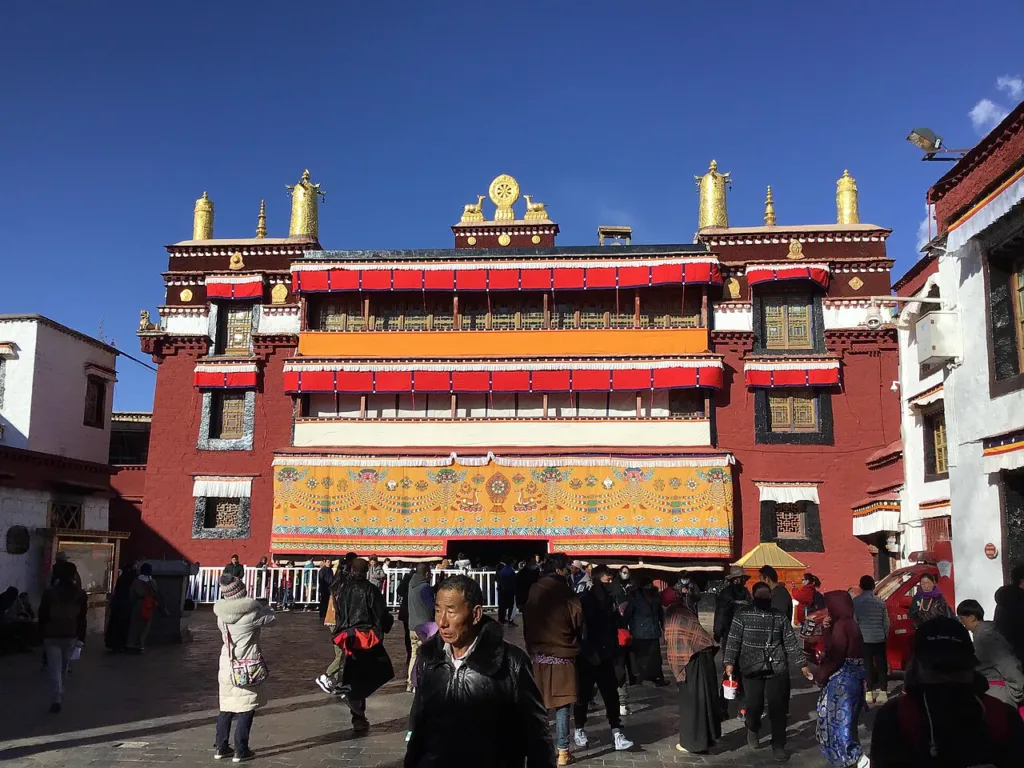
Ramoche is one of the old city’s quieter counterparts to Jokhang. Local official descriptions place it about 500 metres north of Barkhor and identify its central object of devotion as a gilded, life-sized image representing Shakyamuni at eight years old. The site is also listed as a national key cultural heritage site, so this is both an active religious place and a protected historic building.
The building rewards close, respectful looking rather than a quick “smaller Jokhang” comparison. A regional official description records an east-facing entrance, a three-storey main building and a lower level divided into a gate area, scripture hall and Buddha hall. It also describes a surrounding prayer corridor with painted images of Amitayus. Which rooms and images are accessible can change; treat the description as a guide to what to notice, not a promise of interior access.
A layered history
The familiar local account dates Ramoche’s beginnings to the seventh century and credits Wencheng Princess with its construction. A 2022 research article from the China Tibetology Research Center questions that simplified story: it argues that the early complex was first a palace built by Songtsen Gampo for Wencheng Princess, later expanded for a Buddhist image and gradually transformed into a temple. These are historical interpretations rather than details a visitor can prove on site, but they explain why the building carries both palace and temple associations.
The temple’s name and its connection with the “two Jokhangs” also have a complicated history. The site is traditionally associated with the eight-year Shakyamuni image, while the better-known twelve-year image is associated with Jokhang. Focus on the shrine and the building in front of you, and let the religious setting—not a simplified origin story—set the pace of the visit.
Visiting respectfully
Ramoche remains a place of worship and monastic practice, not a staged historic interior. Keep your voice low, follow signs and instructions, do not touch images or ritual objects, and ask before taking photographs. FCDO travel advice specifically tells visitors to ask before photographing in Buddhist monasteries. Avoid photographing worshippers without permission.
Tibet entry approval is separate from temple admission
For a foreign visitor, the regional entry rule comes first. Current FCDO guidance says that travellers to Tibet and the Tibet Autonomous Region must obtain a permit through a specialist travel agent in China and travel on an organised tour. This is a Tibet entry and travel-arrangement requirement, not Ramoche’s own admission ticket. A temple ticket, if charged, does not prove that independent travel in Tibet is permitted, and the sources reviewed here do not establish a passport-holder’s venue-level booking or inspection process. Confirm the approved route, temple visit and any identity requirements with your China-based specialist agency before booking transport. Do not attempt to bypass checks.
Current Ramoche opening hours, ticket prices and venue-specific reservation arrangements were not independently verified in the sources reviewed. Do not carry over an old price or assume that a Jokhang reservation also admits you here; check the temple, your authorised tour operator or the current local notice before setting out.
Location and getting there
Ramoche Temple is at 49 Remuqi Road (热木齐路49号), Jibenggang Subdistrict, Chengguan District, Lhasa. It is north of Barkhor, about 500 metres according to the Chengguan District government description; the regional official description places it about 1 kilometre from Jokhang. Use the full Chinese name and address because Jokhang is a different temple farther south.
There is no verified metro or fixed bus route to list for this address in the sources reviewed. The practical final leg is a taxi or ride-hailing car to 小昭寺,拉萨市城关区热木齐路49号, followed by the signed or locally indicated walk to the entrance. If you are already at Barkhor, walk north through the old-city streets and confirm the entrance locally rather than relying on an approximate map pin. Keep the Chinese destination ready for the driver.
Plan the return before entering: walk back towards Barkhor and arrange onward transport from there, or ask the driver to wait or collect you at the temple area. Do not assume a particular departure time, pickup point or same-day interior access without checking locally.
Combine your visit
Suggested order for this visit:
-
Ramoche's principal shrine
Begin with the temple's distinctive Shakyamuni image and the accessible surrounding displays.
-
Northern Barkhor streets八廓街
Continue towards the old-town circuit south of Ramoche to place the temple in its urban setting.
This is an editorial sequence based on the features described in the sources. Confirm access locally; no walking time, shared admission or guaranteed interior access is implied.
Find Ramoche Temple
小昭寺 · 拉萨
The pin marks the area, not the entrance.
More places nearby
Approximate straight-line distances between map pins, not travel distances.
Former Qing Resident Commissioners’ Office 清政府驻藏大臣衙门旧址
Less than 1 km awayThis restored three-storey Tibetan courtyard northeast of the Jokhang housed an early Qing resident commissioner's office. Its local name, Chongsai Kang, refers to seeing the market: the south-facing windows overlook the Barkhor…
View guide →Jokhang Temple 大昭寺
Less than 1 km awayJokhang Temple faces west onto Barkhor Square in Lhasa’s old town. Founded in the seventh century and enlarged over many generations, the temple is especially associated with the Jowo Shakyamuni image, traditionally linked with…
View guide →Barkhor 八廓街
Less than 1 km awayThe Barkhor is the ring of streets surrounding the Jokhang, formed as pilgrims walked around the temple and traders gathered along their route. Its eastern, southern, western and northern sections still combine religious…
View guide →Sources & visit information
Sources checked on 23 October 2026. Hours, tickets, reservations and transport can change; confirm with the operator before you go.
Image credits & notes (1)
- Main hall of Ramoche Temple (Xiaozhao Si) in Lhasa, photographed in February 2019. Photo: 陈博洋Photo: CC BY-SA 4.0