

Entry & permits for Tibet (Xizang)
Foreign tourists need Tibet entry approval, commonly called a Tibet Travel Permit, and an organised visit arranged through a specialist travel agency in China. Confirm your approved route before booking transport. Requirements differ for Taiwan residents and for travellers using mainland or Hong Kong/Macao Chinese resident documents; check the document guide before you book.
Check the travel-document requirements →Policy scope verified: 2026-09-06. UK FCDO: China regional travel advice ↗ State Council Taiwan Affairs Office: Tibet entry approval ↗ Xizang Department of Culture and Tourism: Medog border permit notice ↗
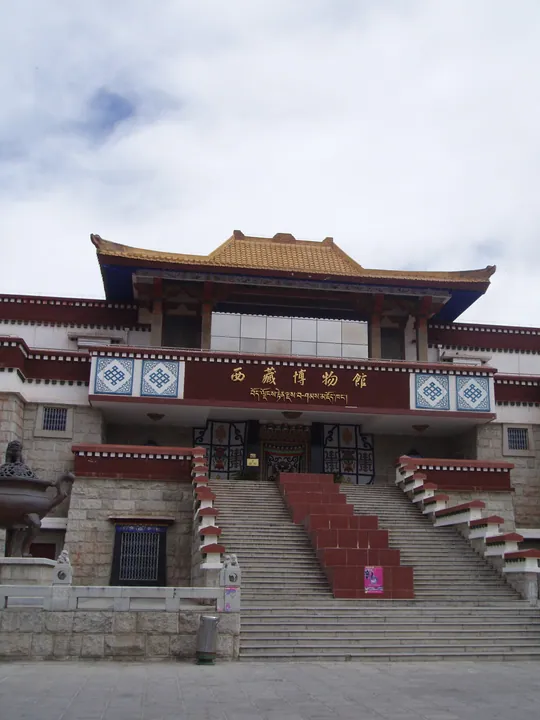
Photo adjustments
Full frame retained; proportionally resized and converted to WebP. No retouching or changes to the photographed subject. Card displays may crop the view.
Explore the region
About Tibet Museum
The second-floor ‘Song of the Snowlands’ exhibition includes a reconstruction of a Karuo dwelling and the distinctive double-bodied pottery vessel from the prehistoric site. The museum also interprets food, clothing and performance traditions through objects such as a leather tsampa bag and a Gesar storyteller’s hat. These tangible details make a useful starting point before visiting archaeological sites or monasteries elsewhere in Tibet.
The museum opened on 5 October 1999 as a comprehensive institution combining collection care, conservation, education and research. On 7 June 2016, a gallery devoted to the folk collection donated by Ye Xingsheng (叶星生) opened inside it, centred on 2,300 objects. Work on enlargement and reconstruction began on 28 October 2017, using a symmetrical design on the existing site.
The collection contains more than 520,000 objects, including ceramics, jade, Buddhist statues, thangkas and historical texts. Seals and official patents form part of its documentary holdings, alongside material relating to Tibetan art and folk customs. Prehistoric displays draw on excavations at Karuo and Qugong, with stone tools, pottery and bone objects, and the museum also holds botanical and geological specimens.
What to look for
- The Karuo dwelling reconstruction and double-bodied pottery vessel in the history exhibition.
- Everyday and performance objects, including the tsampa bag and Gesar storyteller’s hat, subject to display rotation.
The surrounding area
Palaces, monasteries, museums and a working old city with a strong tea-house culture.
Location & getting there
Getting to Tibet Museum
Use the museum’s current official address: 2 Minzu South Road (民族南路2号), Chengguan District, Lhasa.
- Start with the entrance information desk to confirm the open galleries; older sources may still describe the building before its reconstruction.
Combine your visit
Suggested order for this visit:
-
Prehistoric archaeology section
Begin with the Karuo material and reconstructed domestic setting.
-
Historical galleries
Continue through the object-based chronology on the second floor.
-
Folk-culture displays
Finish with food, clothing and storytelling traditions.
This is an editorial sequence based on the features described in the sources. Confirm access locally; no walking time, shared admission or guaranteed interior access is implied.
Find Tibet Museum
西藏博物馆 · 拉萨
The pin marks the area, not the entrance.
More places nearby
Approximate straight-line distances between map pins, not travel distances.
Norbulingka 罗布林卡
Less than 1 km awayNorbulingka combines summer palaces with gardens on Lhasa’s western side. The Kelsang Palace began the complex in the eighteenth century, while later Dalai Lamas added residences and pavilions. The Lake Palace introduces a…
View guide →Potala Palace 布达拉宫
2 km awayThe Potala rises from Marpo Ri, Lhasa’s Red Hill, as a stepped mass of white walls surrounding the crimson Red Palace. Its former residential and ceremonial spaces trace the history of the Dalai Lamas, while chapels and gilded…
View guide →Ramoche Temple 小昭寺
3 km awayRamoche stands north of the Barkhor and is traditionally paired with the Jokhang as one of Lhasa's two great early temples. Its central object of devotion is a gilded image representing Shakyamuni at eight years old, giving this…
View guide →Sources & visit information
The sources below support the place-specific description and arrival information. Suggested combinations are editorial planning ideas; confirm current opening, entry arrangements and transport services for your date.
- Tibet Museum official site: current address, museum and featured objects ↗
- Tibet Museum: Song of the Snowlands permanent exhibition ↗
- Chinese Wikipedia: 西藏博物馆 (revision 93621985, 2026-07-23) ↗
- English Wikipedia: Tibet Museum (Lhasa) (revision 1363287068, 2026-07-09) ↗
Background paragraphs translated and condensed from Wikipedia contributors, "西藏博物馆", Chinese Wikipedia · CC BY-SA 4.0. Source revision 93621985.
Background paragraphs condensed from Wikipedia contributors, "Tibet Museum (Lhasa)", English Wikipedia · CC BY-SA 4.0. Source revision 1363287068.