

Entry & permits for Tibet (Xizang)
Foreign tourists need Tibet entry approval, commonly called a Tibet Travel Permit, and an organised visit arranged through a specialist travel agency in China. Confirm your approved route before booking transport. Requirements differ for Taiwan residents and for travellers using mainland or Hong Kong/Macao Chinese resident documents; check the document guide before you book.
Check the travel-document requirements →Policy scope verified: 2026-09-06. UK FCDO: China regional travel advice ↗ State Council Taiwan Affairs Office: Tibet entry approval ↗ Xizang Department of Culture and Tourism: Medog border permit notice ↗
Explore the region
Tap any red Chinese text to hear it in Mandarin.
Why it matters
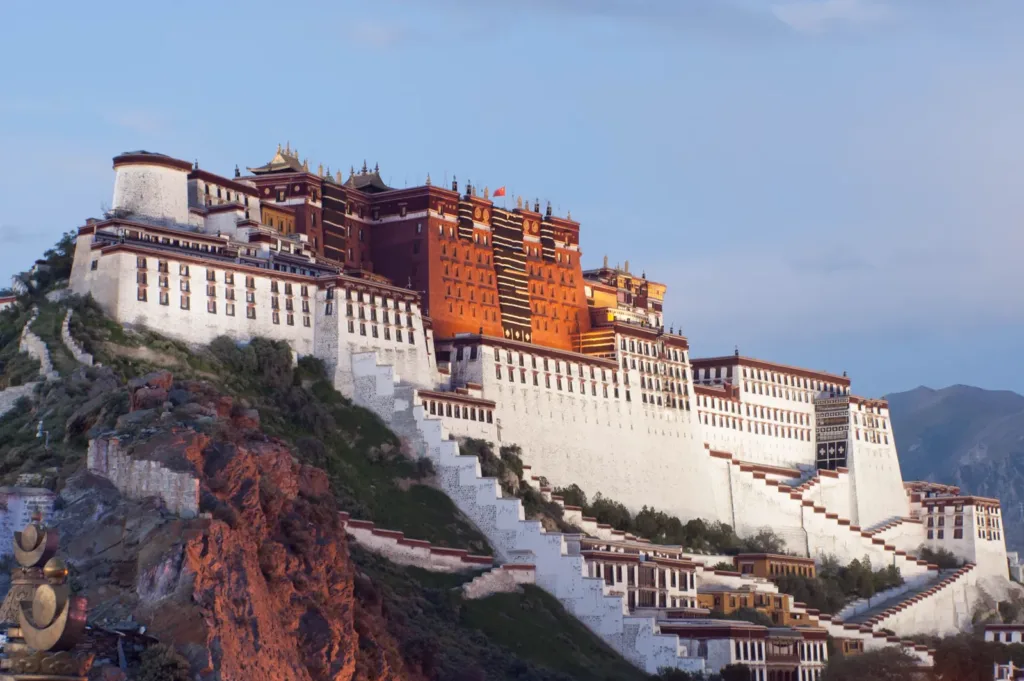
The Potala is not only Lhasa’s most recognisable skyline. It is a protected Buddhist and historic complex: UNESCO describes the White and Red Palaces and their ancillary buildings as the winter palace of the Dalai Lama and a symbol of Tibetan Buddhism and its role in traditional administration. The site stands on Red Mountain in the centre of the Lhasa Valley at about 3,700 metres.
The present complex took shape through major rebuilding in the seventeenth century. The palace’s own history places the original foundation in the seventh century and describes the later reconstruction and expansion as a large palace-fort complex with halls, chapels, stupas and monastic spaces. It entered China’s national protected-site list in 1961 and the UNESCO World Heritage List in 1994.
What to look for
Begin at the foot of the hill, where the approach makes the building’s design legible. The stairways, sloping masonry walls, layered terraces and gilded roofs are not a distant façade; they set the pace of the visit. The official visitor guide describes a zigzag stone ascent to De yang Shar courtyard before the palace interiors.
Inside, compare the White Palace’s former residential and ceremonial spaces with the central Red Palace’s chapels and gilded funerary stupas. UNESCO also records the complex’s murals, painted scrolls, sculpture, textiles, porcelain, jade, gold and silver objects, scriptures and historical documents. Not every room is necessarily open on every route, so follow the assigned visitor sequence rather than expecting an unrestricted palace tour.
The Potala remains a religious place as well as a heritage site. The palace’s visitor notice prohibits photography and video inside halls, asks visitors not to touch cultural relics or make loud noise, and requires security screening. Treat chapels, images and other worship-related spaces as places of devotion, not as photo sets.
Plan the visit
Reserve through the official Potala Palace ticket system. The official ticket page says that same-day tickets are not sold, all visitors need real-name reservation and facial recognition, and the official WeChat mini-program is the only authorised visitor reservation channel. The official homepage currently displays opening at 09:00 and closing at 15:40, but hours, closure days, routes and ticket arrangements can change; check the latest official notice for your date.
A palace ticket is not permission to enter Tibet. Current UK government travel advice says foreign visitors must obtain a permit through a specialist travel agent in China and travel on an organised tour. Have the licensed agency confirm your approved Tibet itinerary and how a foreign passport will be handled in the palace’s real-name booking and identity-check process. Do not assume that holding a palace reservation makes independent travel in Tibet lawful, and do not use the ticket system as a substitute for Tibet entry approval.
Allow time for the climb and for the altitude. Lhasa’s valley is high, and the official visitor notice specifically warns about steep stairs, uneven surfaces and slippery earthen floors. Arrive only with the documents and reservation details required for your booking, pass security, and follow staff directions.
Getting there
For a taxi or ride-hail, use the Chinese destination 布达拉宫 Bùdálā Gōng, 拉萨市城关区北京中路35号. The palace’s official visitor guide lists separate routes for group visitors and individual/mini-program bookings and identifies several security entrances around the square; follow the entrance attached to your booking rather than treating a map pin as a gate.
There is no metro to the palace, and this guide does not assert a current palace-specific bus number. A taxi or ride-hail to the Chinese address is the clearer last-mile option; verify the return pick-up point after the visit because the managed approach and pedestrian controls can differ by entrance. If you arrive by air, note that Lhasa Gonggar International Airport is in Gyazhugling Town, Gonggar County, Shannan, outside Lhasa city. It is Lhasa’s air gateway, not a city-centre airport, so arrange the onward transfer through your organised itinerary or a current airport transport service.
Combine your visit
Suggested order for this visit:
-
Southern base of Red Hill
Study the palace silhouette and orient yourself before climbing.
-
Palace stairways and terraces
Follow the visitor approach through the massive exterior walls.
-
White and Red Palace visitor route
Compare the former residential spaces with the religious halls that are open on your visit.
This is an editorial sequence based on the features described in the sources. Confirm access locally; no walking time, shared admission or guaranteed interior access is implied.
Find Potala Palace
布达拉宫 · 拉萨
The pin marks the area, not the entrance.
More places nearby
Approximate straight-line distances between map pins, not travel distances.
Ramoche Temple 小昭寺
1 km awayRamoche stands north of the Barkhor and is traditionally paired with the Jokhang as one of Lhasa's two great early temples. Its central object of devotion is a gilded image representing Shakyamuni at eight years old, giving this…
View guide →Jokhang Temple 大昭寺
2 km awayJokhang Temple faces west onto Barkhor Square in Lhasa’s old town. Founded in the seventh century and enlarged over many generations, the temple is especially associated with the Jowo Shakyamuni image, traditionally linked with…
View guide →Barkhor 八廓街
2 km awayThe Barkhor is the ring of streets surrounding the Jokhang, formed as pilgrims walked around the temple and traders gathered along their route. Its eastern, southern, western and northern sections still combine religious…
View guide →Sources & visit information
Sources checked on 23 October 2026. Hours, tickets, reservations and transport can change; confirm with the operator before you go.
- UNESCO, Historic Ensemble of the Potala Palace, Lhasa ↗
- Potala Palace official site, palace history ↗
- Potala Palace official site, ticket reservation ↗
- Potala Palace official site, ticket instructions ↗
- UK Foreign, Commonwealth & Development Office, China regional risks ↗
- Potala Palace official site, visitor reminders ↗
- Xizang Department of Culture and Tourism, 2026 visitor guide ↗
- Potala Palace official site, contact and address ↗
- Xizang Department of Transport, airport introduction ↗
- National Ethnic Affairs Commission, Potala Palace cultural landmark ↗
Image credits & notes (1)
- Exterior view of the white-and-red Potala Palace complex on its rocky hillside in Lhasa. Photo: Coolmanjackey (Wikimedia Commons username: Coolmanjackey)Photo: CC BY-SA 3.0