

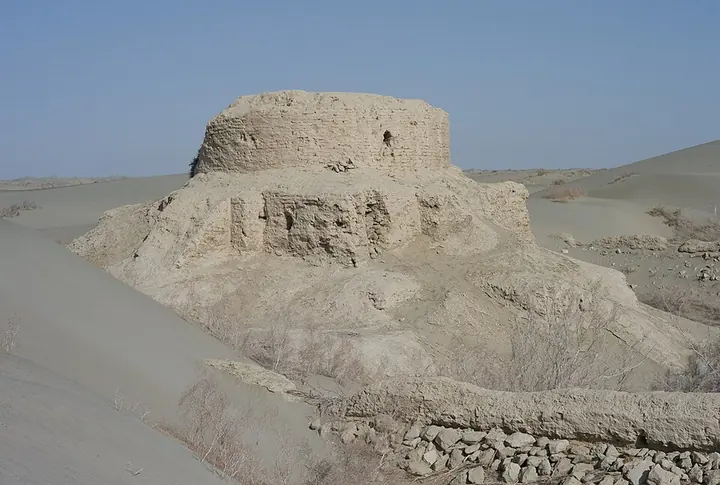
Photo adjustments
Full frame retained; proportionally resized and converted to WebP. No retouching or changes to the photographed subject. Card displays may crop the view.
City & district guides
About Rawak Stupa
Its cross-shaped base and the remains of its surrounding religious complex make it an important witness to ancient Khotan’s connections with Buddhist art farther west and south. Much of the sculpture recorded during early excavations is no longer visible at the site. Museum collections help explain what the surviving earthen forms once contained.
In April 1901, sand dunes covered part of the stupa and almost all of the surrounding site, reaching about 25 feet in places. Eight days of excavation uncovered ninety-one large stucco figures of Buddhas and bodhisattvas, with smaller attendant deities between them. The sculptures were photographed, described and then buried again beneath sand.
The sand protected the stucco from strong winds and supported figures that might otherwise collapse. By a return expedition in September 1906, treasure seekers had removed most of the large statues. Excavation that year also recovered small terracotta reliefs from nearby ruins, which the excavator assigned to the fifth or sixth century.
What to look for
- The stupa’s cross-shaped base is a distinctive architectural feature.
- Surviving enclosure walls suggest the arrangement of the former religious courtyard.
Background & history
Rawak (Chinese: 热瓦克佛寺遗址) is a Buddhist stupa located on the southern rim of the Taklamakan Desert in Xinjiang, China, along the famous trade route known as the Silk Road in the first millennium Kingdom of Khotan. Around the stupa there are other smaller structures which were originally decorated with a large number of colossal statues. The courtyard of the temple was surrounded by a wall, which contained terracotta relieves and some wall-paintings. The stupa and other structures form a three-dimensional mandala. The site is now about 40 km north of the modern city of Hotan (Chinese: 和田) in Xinjiang Autonomous Region, China.
Excerpt from Wikipedia: Rawak Stupa · Wikipedia contributors · CC BY-SA 4.0. Selected introductory sentences; formatting simplified. Background information, not current visitor-service advice.
Location & getting there
Getting to Rawak Stupa
Contact the Lop County heritage or visitor authority before arranging a trip to Rawak north of Hotan. A May 2026 report described visitor facilities as still being improved, so confirm actual admission and the permitted approach rather than treating the desert pin as an open entrance.
Combine your visit
Choose from these complementary stops when planning your visit.
-
Hotan Museum和田地区博物馆
Begin with objects and sculpture associated with regional Buddhist sites.
-
Rawak authorised approach热瓦克获准通道
Visit the original site only after admission is confirmed.
-
Stupa interpretation佛塔解说
Read the surviving base and walls from the permitted route.
This is a suggested combination, not a timed route; confirm the opening and transport arrangements for your date.
Find Rawak Stupa
热瓦克佛寺 · 和田地区
The pin marks the area, not the entrance.
More places nearby
Approximate straight-line distances between map pins, not travel distances.
Melikawat Ruins买力克阿瓦提故城
49 km awayMelikawat is an archaeological site south of Hotan associated with the ancient Khotan region. Surviving walls and scattered material remains provide evidence of a settlement whose precise historical identification remains…
View guide →Ni'ya Ruins尼雅遗址
236 km awayNiya preserves the remains of an oasis settlement north of modern Minfeng, associated with the ancient name Jingjue. Wooden documents, household objects, textiles and traces of orchards reveal a community connected to the…
View guide →Khunjerab Pass红其拉甫口岸
424 km awayKhunjerab is the high international crossing between China and Pakistan on the Karakoram Highway. The snow-and-rock landscape and border gate are its principal visual features, but sightseeing at the Chinese gate and crossing…
View guide →Sources & visit information
The sources below support the place-specific description and arrival information. Suggested combinations are editorial planning ideas; confirm current opening, entry arrangements and transport services for your date.
- May 2026 site report with Lop and Hotan museum directors: Rawak conservation and visitor-facility work ↗
- Rawak Stupa — Wikipedia geographic and historical reference ↗
- English Wikipedia: Rawak Stupa (revision 1364976628, 2026-07-19) ↗
Geographic and historical facts selectively adapted from Wikipedia contributors, Rawak Stupa · CC BY-SA 4.0. Source revision 1364976628.
Background paragraphs condensed from Wikipedia contributors, "Rawak Stupa", English Wikipedia · CC BY-SA 4.0. Source revision 1364976628.